
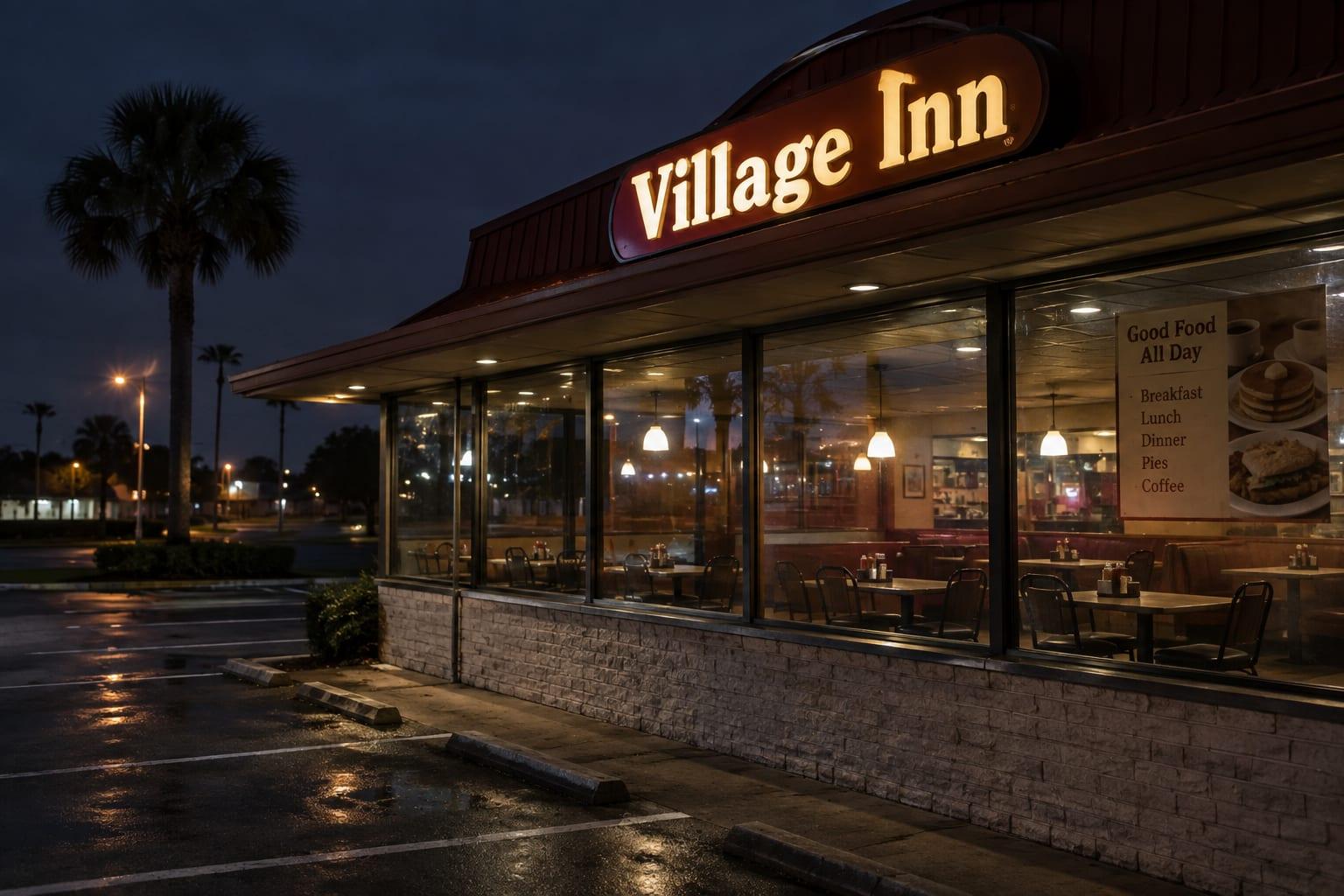
A franchisee operating a Village Inn restaurant in Florida has filed for Chapter 11 bankruptcy, listing more than $554,000 in liabilities, according to a Fox Business report. The filing adds another casualty to a casual dining industry squeezed between rising operating costs and customers who are pulling back on spending.
The case, filed in Florida, covers a single Village Inn location, according to the report. Chapter 11 allows a business to keep operating while it restructures debts rather than shutting down entirely — a route an increasing number of restaurant operators have taken over the past two years.
The numbers reported in the filing are modest by corporate standards: just over $554,000 in liabilities. But for a single-location franchisee, that is the kind of debt load that leaves no margin when a bad quarter hits. Village Inn, a family-style chain known for its pies and all-day breakfast, has faced the same pressures buffeting the broader casual dining segment — higher food costs, higher wages, higher rent, and consumers who are either cooking at home or trading down to cheaper fast-food options.
The bankruptcy follows a pattern seen across the restaurant industry. Franchisees, especially those operating one or two locations, typically carry less cash cushion than the corporate parent and absorb cost increases without the purchasing power of a large chain. When sales soften, there is little room left.
Chapter 11 does not mean the restaurant is closing. The debtor continues to operate under court supervision while negotiating with creditors. Whether this particular Village Inn location stays open depends on a restructuring plan that has not yet been filed publicly.
The filing comes amid a broader reckoning for American sit-down dining. Industry data through 2025 and 2026 has shown declining traffic at casual dining chains as inflation-adjusted wages for many households have failed to keep pace with grocery and rent costs. Dollar menus, drive-thrus, and fast-casual options have absorbed customers who once sat down for a plate of eggs and hash browns.
Labor costs have compounded the problem. Several states have phased in higher minimum wages and expanded tip credit rules in recent years, and franchisees operating in those states have reported that payroll now consumes a larger share of revenue than before the pandemic. Florida, where this filing was made, has seen steady population growth, but that growth has also driven up commercial rents in many markets.
Village Inn operates more than 100 locations across the country, most of them franchised. The chain's parent company has weathered its own ownership changes over the past decade, and franchisees have at times been left to manage real estate and labor costs largely on their own.
There is no indication in the filing that the bankruptcy extends beyond the single Florida franchisee. Other Village Inn operators are not part of the case, and the corporate brand is not listed as a debtor.
The restaurant industry has seen a string of similar filings this year. Small franchisees operating regional chains have been the most common filers, often citing a combination of lease obligations signed before 2020 and revenue that never returned to pre-pandemic levels. In many cases, the locations remain open while owners attempt to renegotiate leases or sell the business as a going concern.
For now, the Florida Village Inn is set to keep serving customers while the case moves through court. What happens to its roughly $554,000 in debts — and whether the restaurant survives — will be decided by a bankruptcy judge and the franchisee's creditors.
Our Take
This is what the economic numbers on the evening news never show you: a small-business owner in Florida, staring at half a million dollars in debt, deciding whether to keep flipping pancakes or lock the doors.
The people running these franchise locations are not Wall Street executives. They are the folks who signed personal guarantees on leases, mortgaged their homes to buy a restaurant, and show up before sunrise to make sure the coffee is hot. And they are getting crushed — by inflation that has driven up the cost of everything from eggs to insurance, by wage mandates that hit small operators hardest, and by customers who simply cannot afford to eat out the way they used to.
Franchisees of mid-sized regional chains are the most exposed. They have the brand's overhead and standards but none of the corporate parent's scale. When costs rise, they cannot renegotiate with suppliers the way a national chain can. When sales fall, they cannot absorb the hit the way a well-capitalized owner can. They are the economic shock absorbers of the restaurant industry, and right now, they are bottoming out.
Americans are being told the economy is strong. Tell that to the Village Inn operator in Florida who just filed for Chapter 11. Tell it to the employees whose shifts are on the line. Tell it to the families who used to come in for Sunday breakfast and now stay home because a meal out costs what a week of groceries used to.
The mainstream media will treat this filing as a footnote — one restaurant, one franchisee, not a story. But it is a story, and it is happening in communities across the country where the local diner is hanging on by a thread. Every one of those closures is a paycheck lost, a family business gone, and a piece of a town that does not come back.
Patriots, the next time you drive past a locally owned restaurant, remember what it costs the person behind that counter to keep the lights on. And ask yourself this: if the men and women who run these small businesses keep going under, who is going to be left to serve the communities that Big Government and Big Business have forgotten?
