
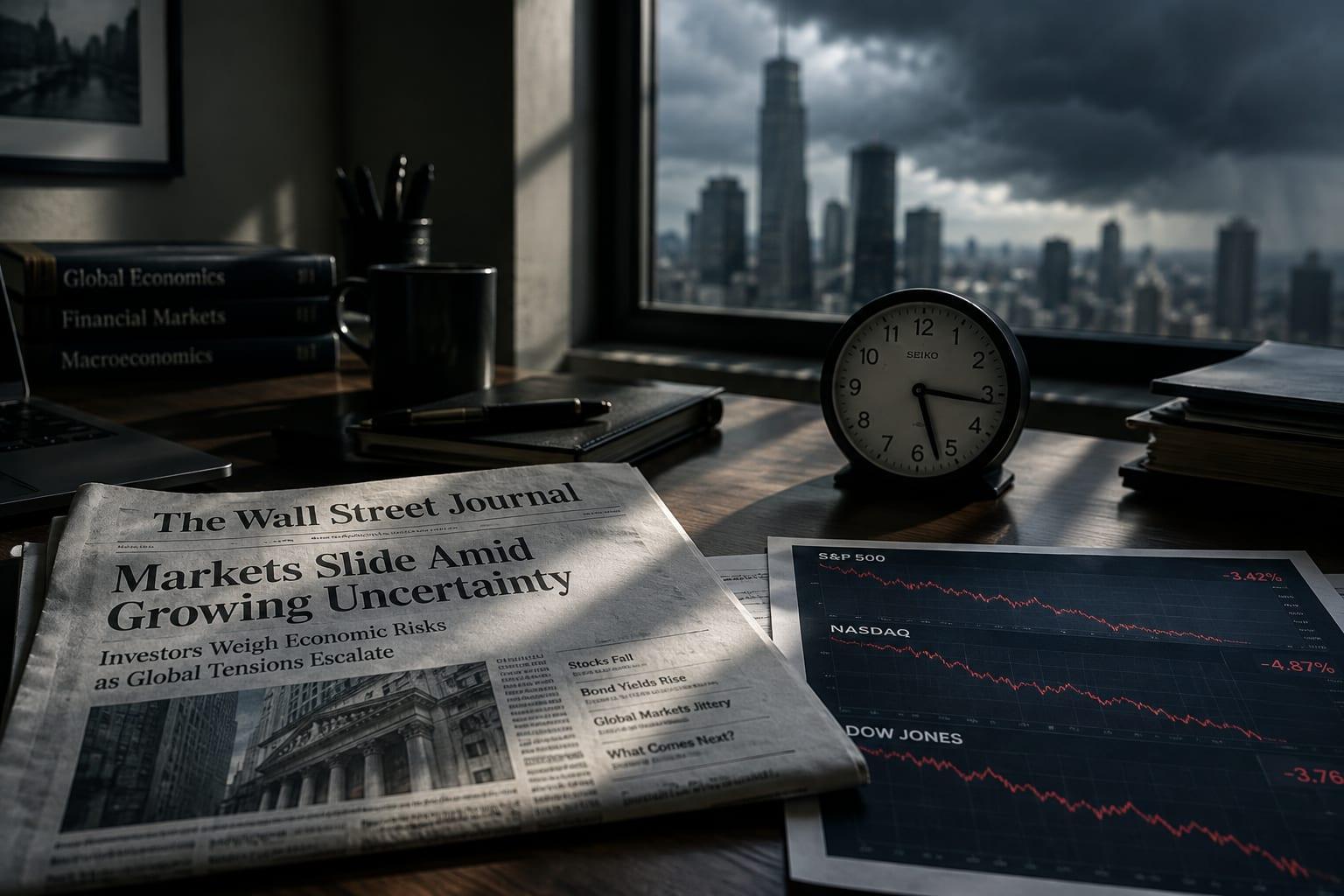
American consumers now feel worse about their own finances than at any point since the University of Michigan began tracking sentiment, with the headline index falling to fifty-five — lower than during the 2008 financial crisis, lower than during the COVID-19 pandemic, lower than the dot-com crash. At the same time, the ten-year Treasury yield hit 5.17 percent, its highest level since 2007, and the thirty-year yield reached 5.49 percent, its highest since 2004.
Those two numbers were placed side by side Friday by financial commentator David Lin in a video interview with Mario Nawfal, who said the two figures tell a single story about the state of the American economy.
"The Consumer Sentiment Index from the Michigan survey is already at a historic all-time low," Lin said. "This is worse — lower than 2008, lower than COVID, lower than the tech crisis in 2000."
Lin, who has interviewed the director of the Michigan survey on his own program, said the survey asks two fundamental questions: whether respondents expect their personal financial conditions to worsen next year, and what concerns dominate their thinking. Inflation expectations, he said, are the dominant worry.
"Even though the TIPS market, the Treasury Inflation Protection Security, which tracks inflation expectations by the bond market, is coming down — the bond market actually believes that the inflation rate is about to come down — consumers don't," Lin said. "Consumers make their purchasing decisions based on their own expectations, not the bond market."
The Michigan survey's own homepage data, which Lin displayed on screen, showed consumer sentiment ticked down in September to the lowest reading in four months, down fifteen percent from January. Views of current and year-ahead expected personal finances both weakened about ten percent. The survey said buy conditions for durables improved slightly, "in part to a perception that completing such purchases now would help consumers avoid higher prices in the future" — a phenomenon Lin described as the textbook self-fulfilling inflation prophecy playing out in real time.
The short-run outlook for business conditions, the survey said, plunged amid renewed worries that elevated fuel prices and re-escalating trade disputes could pass through to the economy as a whole.
Lin attributed the yield curve flattening — the shrinking gap between short-term and long-term bond yields — and the broader selloff in bonds to two primary forces: higher inflation expectations and the Federal Reserve raising rates or signaling it will continue to raise them. He noted the situation is global, with bonds selling off across most OECD countries except China, which he said points to global inflation fears rather than a US-specific problem.
"I think the strongest theory is inflation expectations," he said. "Oil is a global commodity. All bonds in developed countries have been selling off this year, not just US bonds."
He also pointed to a strong correlation over the past year between the ten-year yield and WTI crude oil prices, saying the ten-year has been tracking oil more closely than any other variable.
"This situation is really a symptom of two things," Lin said. "One, higher inflation expectations. And two, the Federal Reserve raising rates or the expectation they will continue to raise rates into hotter inflation. It all comes back to the Iran war."
The conversation turned to the prospect of a diesel export ban, which Lin said Energy Secretary Chris Wright has described as a blunt tool that "definitely doesn't work." Lin said such a ban would initially lower diesel prices domestically but would create storage problems, forcing refineries to reduce output and ultimately driving prices back up. He also noted the US exports roughly 1.2 to 1.5 million barrels of diesel per day — about fifteen to twenty percent of global diesel exports — and that Russia, already accounting for about ten percent, has been out of the market for months.
"The only positive thing is maybe a small boost for the midterms," Lin said. "There's nothing else positive that could come out of it."
On the broader economy, Lin cited Steve Eisman's assessment that the entire US economy hinges on two unprofitable companies — OpenAI and Anthropic — and noted that data center construction accounted for forty to fifty percent of GDP growth this year.
"Consumer demand is not driving GDP growth," Lin said. "If that starts to slow down, it will immediately start to reflect in the GDP numbers."
Asked whether a serious downturn is coming, Lin said he is concerned — not only for the broader economy but for his own industry.
"My YouTube views go up when there's a lot of volatility," he said. "But more volatility long term isn't really good for business because the first thing companies do in an actual market downturn is cut advertising revenue."
Lin added: "I can't think of any scenario in which a market downturn is good for business. Unless certain assets like gold. But during an actual bear market, when there's actual fear across markets, everything converges to a correlation of one. Everything falls together. There's no safe haven except Treasuries, ironically, and the US dollar."
The sentiment data was not the only economic story drawing attention this week. The Gateway Pundit (@gatewaypundit) reported on an academic survey finding that thirty-five percent of Americans cannot name all three branches of government — a figure that, if accurate, suggests a significant portion of the population may be making financial and political decisions without basic civic knowledge.
Meanwhile, the account @TeamTrump posted a video clip showing Senator Bernie Sanders reacting to Dr. Heidi Overton, who told him prescription drug prices have fallen by three percent under President Trump. In the clip, Overton says to Sanders: "So, Senator, the results that we have seen for the American people from the Most Favored Nation policies have dropped prices, and right now, CPI says that for the first time in sixty years, prescription drug prices have gone down by three percent."
Sanders responds: "Yeah, which may have something to do with the legislation that we passed several years ago."
The clip was circulated by @TeamTrump with the caption: "Democrats don't want Americans to know it was Republicans who lowered drug prices."
Other coverage of the consumer sentiment data this week underscored the depth of the decline. CNN Business reported that US consumer sentiment fell to its second-lowest level on record in September as high gas prices further soured Americans' views of the economy. ABC News noted the reading is the second lowest in the seventy-four-year history of the survey. US News reported that economic sentiment remains poor even as businesses spend heavily on investment. BigGo Finance reported the University of Michigan's final September survey showed confidence at 48.1, the second-lowest reading since the survey began in 1952. A separate Strength In Numbers/Verasight poll found forty-six percent of Americans say their own life is worse off than four years ago, and just twenty-five percent say it is better.
Next News Network could not independently verify the underlying data points cited in these posts or the specific figures and claims made by the accounts and commentators described above.
The reaction has spread across multiple platforms and accounts — from financial commentators dissecting bond market signals to political operatives trading accusations about which party is responsible for drug prices — but the underlying claims remain exactly that: claims. The University of Michigan survey, the Treasury yields, and the prescription drug price index are all reported figures, but their interpretation and the conclusions drawn from them are matters of ongoing debate among economists, policymakers, and the public.
Our Take
The left will tell you this is just a vibes problem, that the markets are at all-time highs and the GDP is growing, so Americans should feel fine. But the market isn't the economy, and GDP growth driven by data center construction while consumers get crushed by inflation is not a recovery — it's a bubble with a countdown timer. The bond market is screaming, the yield curve is flattening, and the American people are telling pollsters they feel worse than they did during 2008, during COVID, during the dot-com crash. When the people who actually pay the bills say they are drowning, the responsible thing is to listen, not to lecture them about how good the headline numbers look. The Fed needs to stop pretending inflation is under control, the White House needs to stop pretending the economy is strong, and Congress needs to stop pretending that spending trillions of dollars we don't have is somehow going to make things better. The American people already know the truth. It's time the people in charge caught up.
