
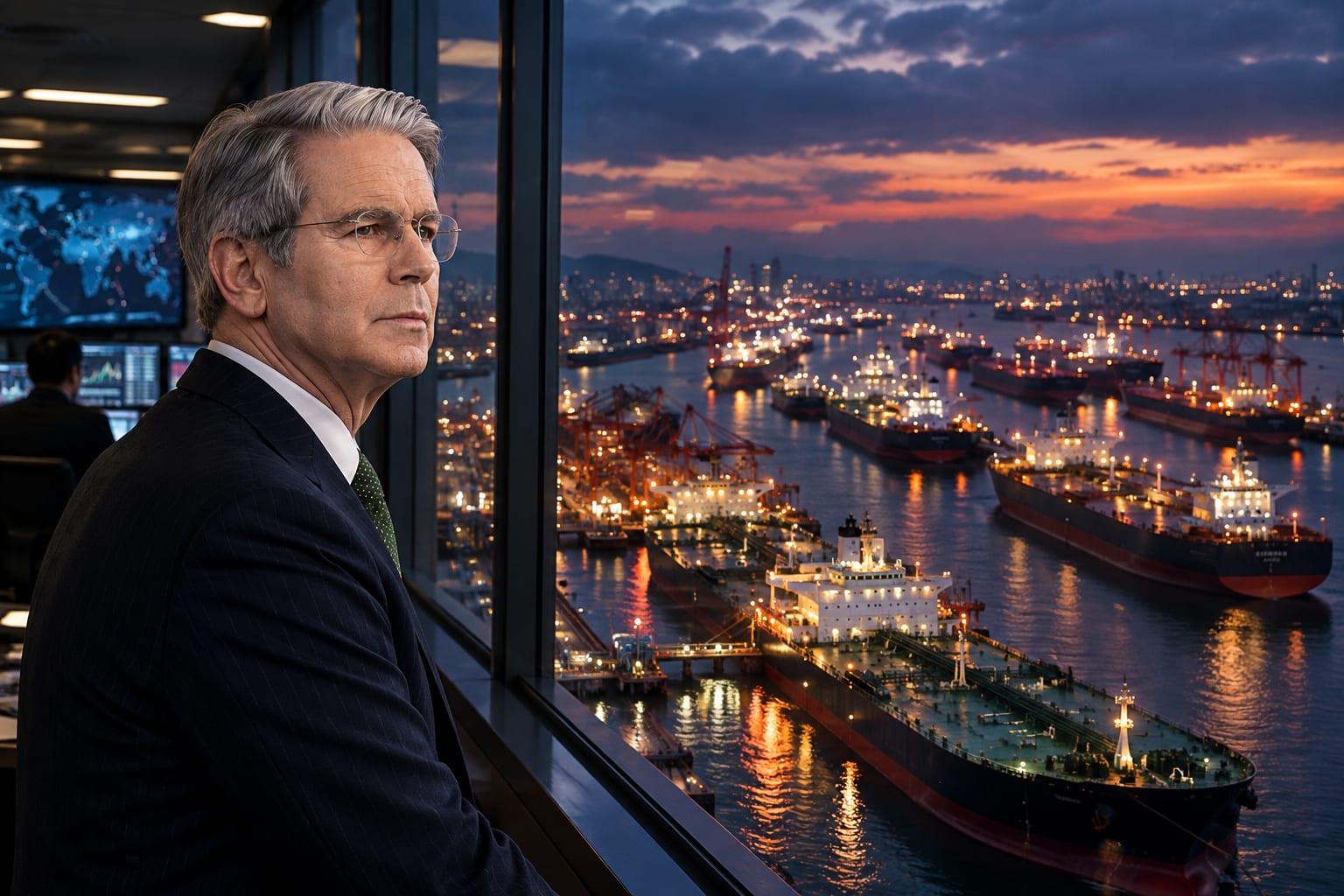
Treasury Secretary Scott Bessent said Iranian oil exports are nearly exhausted, predicting that Tehran will make its final crude deliveries to China within roughly two weeks and be left with nothing to trade for anything.
"There's only 15 million more barrels of Iranian oil on the water," Bessent said, according to the account @clashreport, which posted video of the remarks. "Iran will have nothing left to trade for anything. Probably within the next two weeks, they're going to make their final deliveries of oil to China, and then they will have nothing."
The same figure was carried by the account @FirstSquawk, which reported that Bessent expects Iranian oil deliveries to China to end soon, citing reduced Chinese support for Iran and saying only about fifteen million barrels of Iranian oil remain on the water. The two accounts posted the remarks within roughly two and a half hours of each other Sunday afternoon.
Speaking to Fox News in a separate segment, Bessent described Iran as a pariah state cut off from global markets and said the administration's economic pressure campaign is designed to force Tehran to honor any future agreement. "They are isolated from the world, they are a pariah state, and my job is to make sure that when they come with a deal, that they want to stick to it," he said. "They did not stick to the MOU, and next time, if there is a deal that's at President Trump's discretion, that they will stick to it, because they are on their knees."
The Fox News account posted the clip with the same language, writing that Bessent "explains how U.S. sanctions are putting Iran's economy under tremendous pressure amid the ongoing conflict."
Bessent also offered a broader accounting of the pressure campaign, telling Fox News that more than a billion barrels of oil were allowed to leave the Strait of Hormuz in exchange for zero barrels for Iran, a formulation the account @FirstSquawk relayed Sunday afternoon. The figure was not broken down further in the posted remarks.
The Treasury secretary's comments on Iran came alongside remarks on a second front: the administration's economic relationship with Beijing. In a Fox News interview posted by the network, Bessent described his negotiating approach with Chinese counterparts as anchored in the personal relationship between President Trump and Chinese President Xi Jinping.
"We have a president now who the Chinese respect, and the leaders' relationship drives the whole agenda," Bessent said. "So, when I'm negotiating with my Chinese counterparts, whenever I hit a dead end with them, I say, look, you are not implementing our leaders' consensus. And that normally gets things moving. So, it starts at the top and moves down."
Bessent said the two countries are on pace for an unusually active stretch of leader-level diplomacy. "I think the fact that we're going to have a historic year where the leaders of the two most powerful countries in the world meet four times, four times. That's never happened before. And each time, we have more deliverables."
The Iran remarks landed amid a wider diplomatic standoff. President Trump rejected Iran's proposal to reopen the Strait of Hormuz, according to live updates from Fox News Digital, which reported that Bessent said the administration's economic pressure campaign is restricting Tehran's access to global markets. Iran's foreign minister, Abbas Araghchi, said a history of contradictory messaging meant Trump's rejection might not be a final position, The New York Times reported. Al Jazeera, citing experts, reported that Trump sees economic sanctions as the key to extracting more concessions from Tehran while risking the loss of leverage.
The Tribune reported that Bessent said Treasury officials were dispatched around the world to urge various governments to take action against Iran, and that the secretary pointed to a study showing a downturn in Iran's economy as evidence that economic pressure is delivering results.
Bessent also weighed in on domestic monetary policy. The account @FirstSquawk reported that he urged the Federal Reserve to keep an "open mind" on interest rates, arguing that artificial-intelligence-driven productivity gains and deregulation could help keep U.S. inflation under control, while saying core inflation has remained relatively subdued in recent months.
That intervention adds Bessent's voice to an ongoing debate over the path of rates at a moment when the administration is simultaneously leaning on sanctions as its primary instrument against Tehran. The two tracks -- pressure abroad and growth arguments at home -- were presented in the same round of Sunday interviews.
What the oil figures mean in practice is not yet clear from the public remarks. Bessent did not say in the posted clips what share of Iran's remaining crude the fifteen million barrels represents, how the Treasury arrived at the number, or what enforcement steps would follow the final deliveries. It is not yet known whether China has agreed to halt purchases or whether the expected cutoff reflects market conditions, sanctions pressure, or both. It is also not yet known when the administration expects any new deal framework to take shape, or what terms it would require.
The claim at the center of Bessent's remarks -- that Iran will exhaust its sellable oil within about two weeks and be left with nothing to trade -- has not been independently confirmed. Next News Network could not independently verify it.
What is documented is the sequence of public statements: a Treasury secretary telling Fox News that Iran is "on their knees," a pair of financial news accounts amplifying his fifteen-million-barrel figure, a second Fox segment framing the sanctions as the cause of Iran's isolation, and a parallel message that the Trump-Xi relationship is the mechanism for progress with Beijing. The accounts carrying the Iran claim -- @clashreport and @FirstSquawk -- are the same outlets that carried his remarks on the Federal Reserve and on Chinese oil shipments through the Strait of Hormuz, meaning the full set of Sunday comments traveled as a single package rather than as isolated quotes.
Our Take
Bessent is doing what a Treasury secretary is supposed to do when sanctions are the weapon of choice: he is narrating the clock. Fifteen million barrels, two weeks, nothing left to trade -- that is not a policy announcement, it is a countdown, and countdowns are how you force a decision in Tehran before a negotiation even starts. The risk is obvious and worth stating plainly. If the two weeks pass and Iranian crude is still moving, the administration has handed its adversaries a talking point and its allies a reason to doubt the next deadline. If the deliveries do stop, the credit belongs to enforcement, not to the prediction. Either way, the number now has a life of its own, and it will be checked. The second half of Bessent's message is the more durable one. By tying progress with Beijing to the Trump-Xi relationship and describing four leader-level meetings in a single year, he is signaling that Washington sees China as a partner in squeezing Iran rather than a loophole to be plugged. That is a larger bet than fifteen million barrels, and it is the one that will actually determine whether Tehran runs out of buyers or simply finds new ones.
