
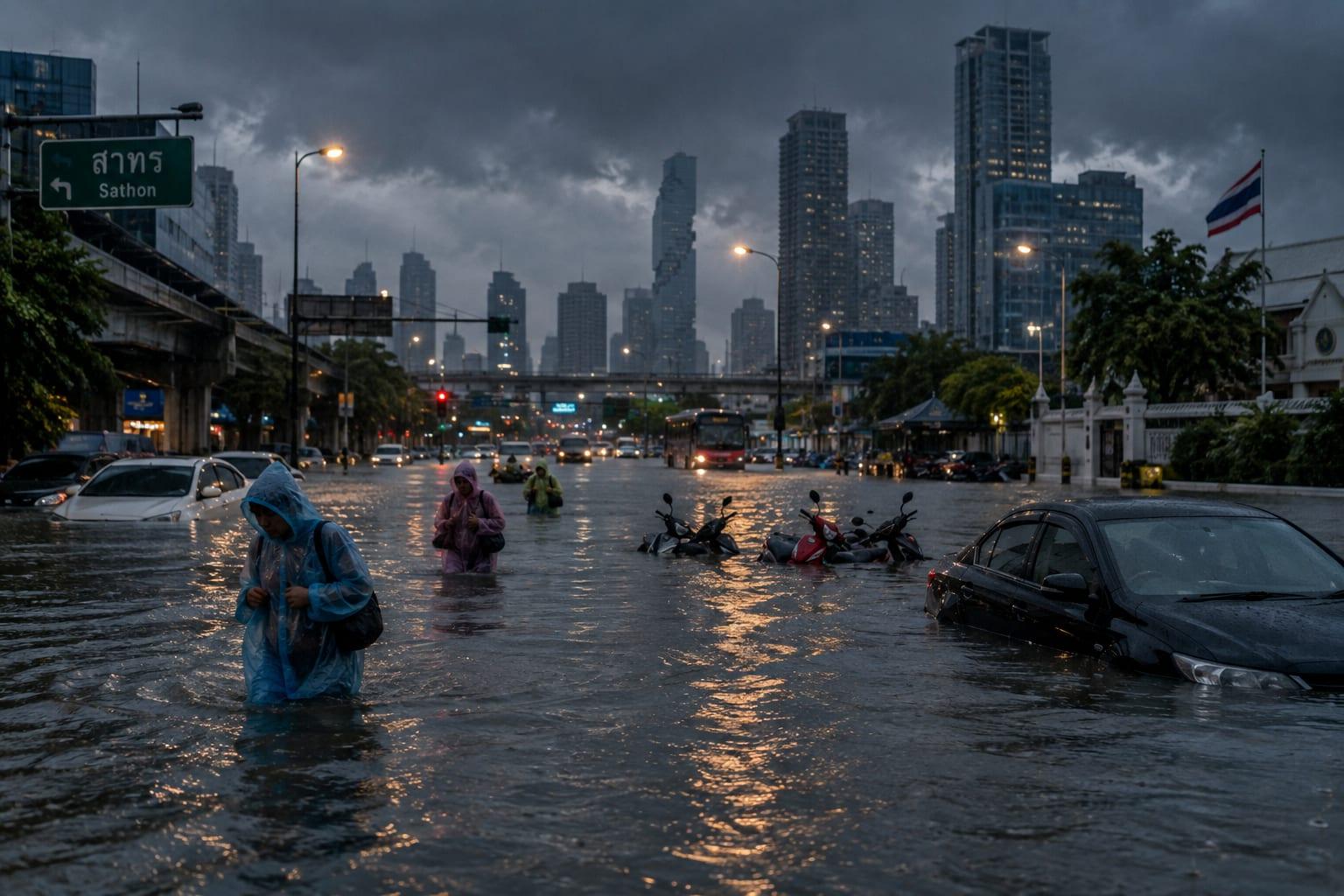
Bangkok was declared a disaster zone this weekend after days of continuous rainfall submerged streets, shops and homes across every one of the capital's fifty districts, forcing tens of thousands of residents into emergency shelters and prompting the deployment of more than ten thousand soldiers nationwide for relief operations.
The declaration, announced by the Bangkok Metropolitan Authority, covers the entire city and came as officials urged residents to stay home, move vehicles and belongings to higher ground and avoid travel through flooded roadways. The provinces of Nonthaburi and Samut Prakan, which border the capital, also declared several of their districts disaster zones as water levels continued to rise across the central region.
According to officials cited in press accounts, more than eighty-four thousand people across twenty-one provinces have been affected by the flooding, with the heaviest impact concentrated in the central plains. The defence ministry confirmed that over ten thousand soldiers had been deployed nationwide to assist with flood relief efforts, including evacuation, sandbagging and the distribution of supplies.
Reporters on the ground described scenes of extraordinary disruption. A dispatch from Reuters on Sunday carried the simple headline that a flooded Bangkok had been declared a disaster zone, a formulation that spread quickly across wire services and aggregators throughout the morning. The Guardian published accounts from residents who described watching their homes disappear beneath the water, with one headline quoting a resident saying, "Our house was under water." The Independent characterized the flooding as "crazy," noting that all fifty city districts had been placed under disaster status and that the Bangkok Metropolitan Authority had issued urgent guidance for residents to remain indoors.
Photographs published by The Guardian showed vehicles submerged along Phetchaburi Road, one of the capital's main arteries, with water reaching the windows of cars and trucks. Other images showed shops and homes inundated after rainfall that began Thursday and continued without meaningful interruption. The vision descriptions accompanying those photographs show floodwaters covering sidewalks, storefronts shuttered and sandbagged, and residents wading through waist-deep water carrying what possessions they could manage.
Agence France-Presse reported that thousands of people had moved into shelters after days of rain, and that the flooding had extended beyond the capital into neighboring provinces. Nine.com.au reported that authorities had declared the Thai capital a disaster-affected zone after torrential rain led to major flooding, echoing the same sequence of events: rainfall, accumulation, inundation, declaration.
The declaration itself carries legal and logistical significance. A disaster-affected designation unlocks emergency funding, allows for the coordination of military and civilian relief operations, and gives local authorities expanded powers to order evacuations and requisition resources. In Bangkok's case, the designation covers all fifty districts, meaning the entire metropolitan area falls under the same emergency framework.
Social media channels and messaging platforms have become clearinghouses for information, rumor and mutual aid. Telegram channels that monitor Southeast Asian weather and disaster response have been circulating updates on water levels, road closures and shelter locations. Relief organizations and expatriate community groups have used the same platforms to coordinate volunteer efforts and direct donations. Foreign correspondents based in the region have posted continuously from flooded intersections, elevated walkways and rooftops, providing a running account of conditions on the ground.
It is not yet known how many people have been injured or killed in the flooding. Officials have not released a consolidated casualty figure, and the full extent of property damage across all fifty districts remains unclear. The duration of the flooding is also uncertain, as rainfall forecasts for the coming days remain unresolved and water management authorities have not indicated when levels are expected to recede.
Thailand's monsoon season routinely brings heavy rain between May and October, but the scale of this event has drawn comparisons to previous flood disasters that have struck the kingdom. In 2011, catastrophic flooding across Thailand killed more than eight hundred people and caused billions of dollars in damage, affecting large portions of Bangkok and disrupting global supply chains. Whether the current flooding will approach that magnitude is not yet known.
The government's response is being watched closely. The deployment of ten thousand soldiers suggests a significant mobilization, though whether it will be sufficient to address the needs of eighty-four thousand affected people across twenty-one provinces remains to be seen. Local authorities in Bangkok have urged residents to remain patient, to stay at home where possible and to follow official guidance on evacuation and water safety.
Next News Network could not independently verify the full scope of the flooding or the accuracy of the figures and descriptions attributed to officials and press accounts.
The story has spread rapidly through international media, social platforms and community networks, with each outlet adding its own details: The Guardian's photographs, The Independent's characterization of the rainfall as "crazy," AFP's account of thousands in shelters, Nine.com.au's confirmation of the disaster declaration. What began as a weather event has become a full-scale emergency, and the response — from soldiers to volunteers to ordinary residents helping neighbors — is now the story.
Our Take
The flooding in Bangkok is a reminder that natural disasters do not respect political boundaries or ideological categories, and that the response to them — the soldiers deployed, the shelters opened, the neighbors helping neighbors — is what matters most in the moment. The Thai government has activated its emergency framework, the military has moved in force, and residents are doing what they can to protect their homes and families. The international media coverage has been extensive, and the images are jarring, as they should be. But the story is not yet fully told, and the full toll will not be known for days or weeks. What is clear is that Bangkok is underwater, and the people of Thailand are dealing with the consequences.