
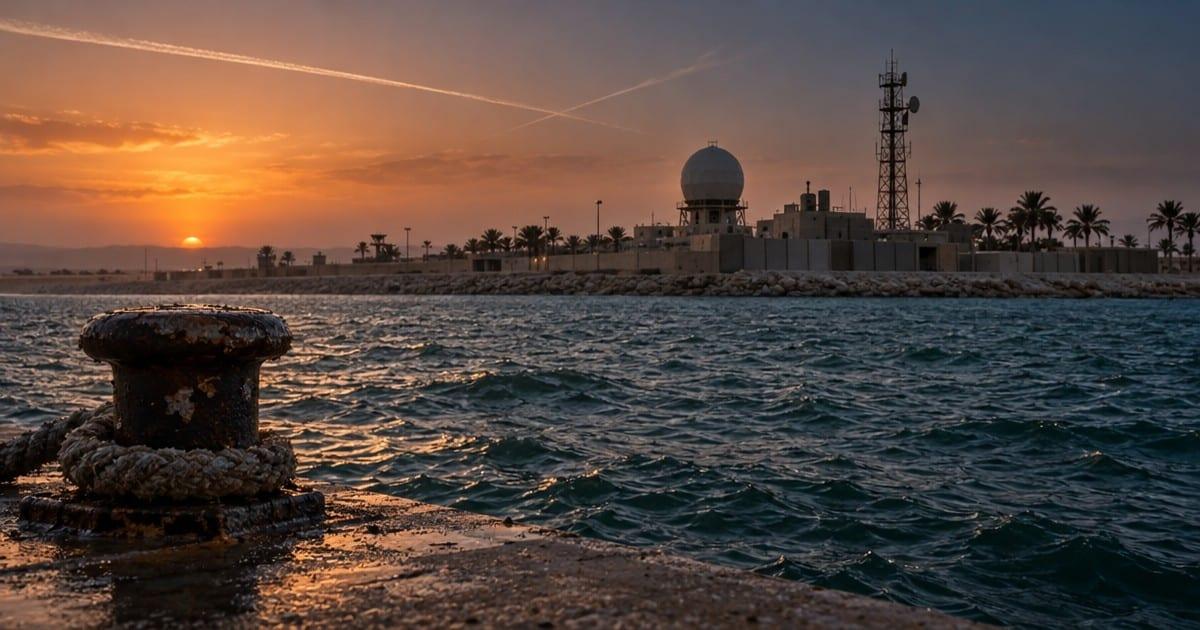
The Islamic Revolutionary Guard Corps claimed Friday that it destroyed an American early-warning radar system in Bahrain and struck an LNG tanker in the Strait of Hormuz — a pair of boasts that U.S. Central Command flatly rejected within hours.
According to Iran's semi-official Tasnim news agency and the IRGC-affiliated Fars agency, the Aerospace Force "targeted and destroyed" the radar installation, calling the operation retaliation for a U.S. airstrike Thursday night on the port town of Sirik in Hormozgan province, which sits on the northern shore of the strait. Iran's state-run IRNA reported that "enemy fire" struck Sirik overnight but offered no details on damage or casualties, and there has been no independent confirmation of that strike.
CENTCOM did not let the claim stand. In a post on X, the command stated: "The IRGC launched two one-way attack drones toward Bahrain and both were shot down by U.S. forces. There were no injuries or damage." The command tagged the IRGC's assertion directly as a claim and set its own account beside it.
"If violations and acts of aggression are repeated, the IRGC Aerospace Force is on full alert for an unrestricted response." — IRGC statement carried by Iranian state media
The IRGC paired the Bahrain claim with a threat against commercial shipping, saying an LNG tanker "chose to be escorted by American combat aircraft during its passage" and warning that "any vessel that attempts to violate Iranian regulations in the Strait or, disregarding warnings from the Strait's traffic control center, by entering unauthorized and high-risk routes will experience the same fate as previous vessels." The IRGC also asserted that "there are no 'free waters' there, and the 1982 UNCLOS does not apply to the strait" — a position that would put the world's most important oil chokepoint under Iranian domestic law rather than international navigation rules.
Iran has made near-daily claims of attacks on commercial vessels in the strait as part of an effort to contest the U.S. position that the waterway is safe for maritime traffic under American military protection. Some of those claims have been confirmed by CENTCOM and other sources, typically with far less damage than the IRGC described, while others remain unverified. Friday's radar claim is the first time since early September that Tehran has claimed an attack on U.S. military assets in a Gulf country, according to Reuters. A Pentagon inspector general's report released in September found that earlier Iranian attacks damaged or destroyed hundreds of buildings at U.S. installations across eight countries, Bahrain among them.
The exchange comes amid a broader standoff. Secretary of State Marco Rubio said further U.S. military action against Iran is unnecessary because economic pressure on the country is already severe, the Associated Press reported. President Trump, in a series of interviews over the past 24 hours, said he will attack Iran only if necessary and that Gulf states including Saudi Arabia have urged him to hold back from planned large-scale strikes, according to The Guardian. Trump also said he had asked Vice President JD Vance to set aside his interest in negotiating a new deal with Tehran and focus instead on corruption and fraud in Democrat-run cities and states.
Tehran has not been idle on other fronts. The Guardian reports that Iran's Assembly of Experts, the body of elected Islamic jurists responsible for choosing the supreme leader, has become the first governing institution in the Islamic Republic to call for a review of the country's defense doctrine — a step that could open the door to religious permission for pursuing a nuclear weapon. Israel's security cabinet, meanwhile, has ordered the military to step up preparations for a possible attack on Iran, according to Israeli public broadcaster KAN, and Iran's security chief Mohsen Rezaei has warned that any military base involved in another U.S. war, "anywhere from West Asia to Europe," would be a legitimate target.
On social media, the fight over the narrative played out in real time. Alongside CENTCOM's denial, an Instagram post circulating Friday said Iranian state media reported two missiles striking a U.S. target — the same claim U.S. officials say is false.
Our Take
Notice the pattern, folks. The IRGC fires two drones at Bahrain, American forces swat them out of the sky, and within hours Iranian state television is broadcasting victory footage of a radar that is still standing. This is a regime that has turned lying into a military doctrine — the same playbook it runs every time it claims a tanker kill that CENTCOM later confirms as a near-miss. When the mullahs tell you they leveled a U.S. installation, wait for the wreckage. There isn't any.
What should worry Americans is not the drone that got shot down. It is the Assembly of Experts suddenly deciding that Iran's "defense doctrine" needs a review — the first official crack in the wall against a nuclear bomb. That is the real headline hiding behind Friday's propaganda. And it is why the Strait of Hormuz is being run by U.S. combat air patrols instead of Iranian traffic control.
Rubio says economic pressure makes more strikes unnecessary. Maybe. But the regime just tested American air defenses in the Gulf, threatened every commercial ship in the strait, and floated the idea of going nuclear. Americans should ask one question: how many more free passes does Tehran get before the next drone isn't a drone?
