
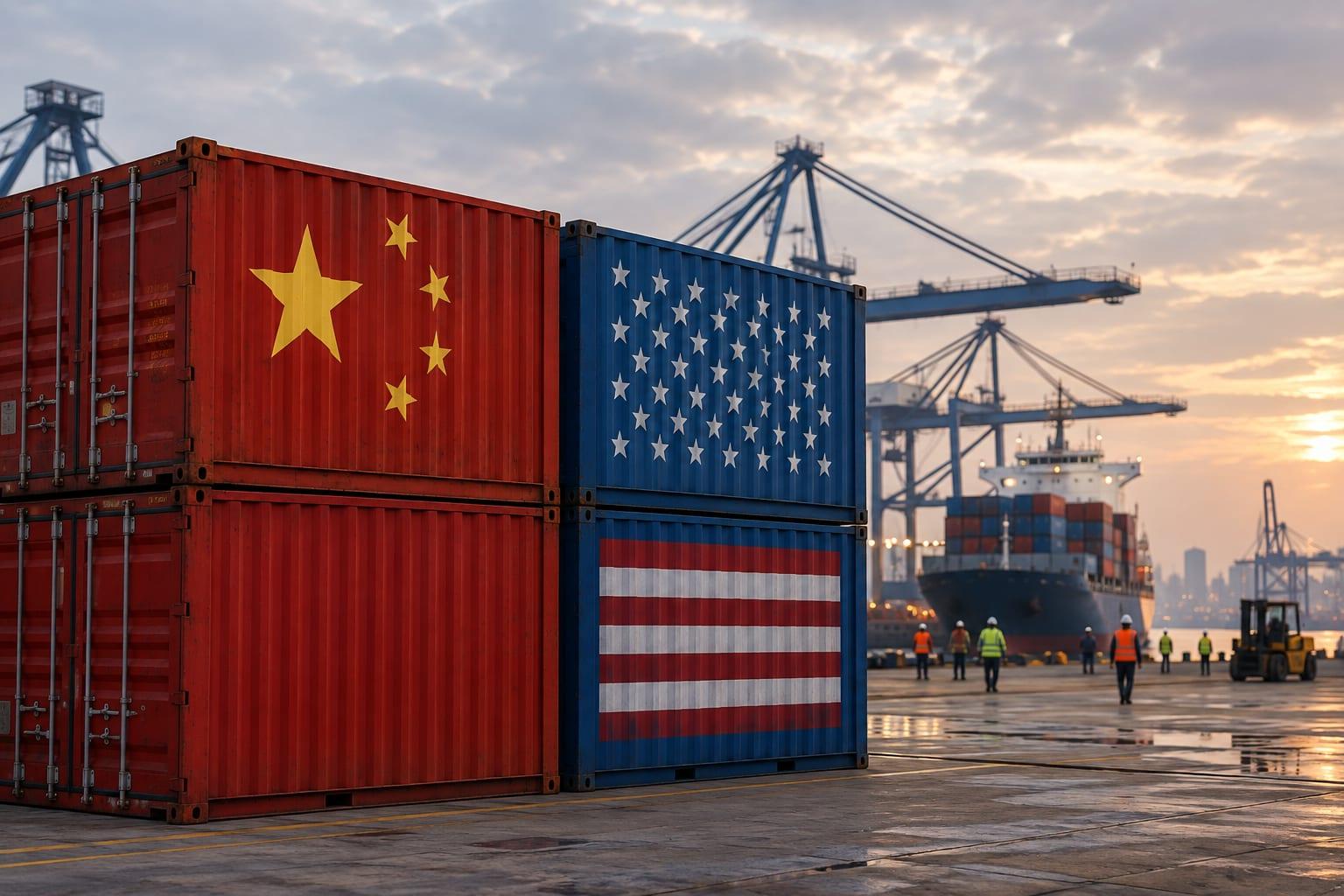
China says its trade truce with the United States will remain in place through January 2027, according to a statement carried by the state-linked wire account @FirstSquawk."China says trade truce with U.S. will remain in place through January 2027," the account posted early Monday, providing the first concrete expiration date attached to an arrangement that until now had been described by both governments only in general terms.
The Chinese announcement followed a summit between President Donald Trump and Chinese President Xi Jinping that concluded Friday, which the two leaders described as productive and which U.S. officials characterized as buying time for a broader negotiation. Trump has said he and Xi would meet twice more this year, though no dates have been announced.
Beijing's decision to put a date on the calendar — January 2027, roughly fifteen months out — is being read across financial and diplomatic circles as an attempt to stabilize expectations for exporters, manufacturers and currency markets on both sides of the Pacific while the next round of economic talks is organized. It also leaves the underlying disputes, including tariffs, technology transfer rules and industrial subsidies, unresolved. The truce, in other words, is a pause, not a settlement.
Coverage of the same announcement has spread quickly across financial and geopolitical outlets. HuggingNews, reporting on the extension, said Beijing had provided a specific expiration date "to help both sides organize their next series of economic summits." That framing — the truce as a scheduling convenience rather than a strategic breakthrough — has become the dominant interpretation in early coverage.
The earliest reporting on the arrangement described it in similar terms. An account of the summit published a day before the Chinese statement said Trump and Xi "concluded a pomp-filled summit Friday, with the US leader confirming they would meet twice more this year." The same account described the two sides as having "bought time" rather than having resolved any of the structural issues driving the tariff war.
A later analysis carried by Archyde made the caution explicit: "Washington and Beijing may have bought themselves breathing space with an extended trade truce, though experts caution that the two largest global economies" remain locked in a strategic rivalry that the truce does nothing to address. That piece, circulated widely among trade analysts, underscored a point that has been repeated by economists since the summit: the truce manages the temperature of the relationship without changing its direction.
What the truce does not do is resolve the tariffs themselves. Duties imposed during the trade war remain in place on both sides unless separately lifted. The agreement, as described in the coverage reviewed here, pauses new escalations rather than rolling back existing measures. That distinction matters for importers, exporters and manufacturers who had been planning around the assumption that tariffs might come down. They have not.
For American farmers, technology firms and retailers that depend on Chinese supply chains, the extension offers something more modest: predictability. A fixed window — through January 2027 — lets companies make capital and inventory decisions without the threat of a new round of duties landing without warning. It does not let them plan beyond that window, and it does not change the underlying cost structure of doing business across the Pacific.
Beijing's announcement also arrives as China manages its own domestic economic pressures, including sluggish consumer demand and a property sector still working through an extended downturn. A stable trade relationship with the United States, even a temporary one, reduces one source of external uncertainty for Chinese policymakers. That motive has been noted by analysts but not confirmed by Chinese officials, who have framed the extension in terms of mutual benefit and continued dialogue.
The White House has not issued a formal statement matching Beijing's specific January 2027 date. U.S. officials have described the arrangement in looser terms, referring to ongoing talks and additional summits. The gap between the two characterizations — specific from Beijing, general from Washington — has itself become a point of discussion among trade watchers, who note that the two governments have historically described the same arrangement differently depending on domestic audiences.
That gap is not trivial. A truce with a firm end date is a different thing than a truce with no end date. One creates a deadline; the other creates an open-ended pause. If Beijing and Washington are operating under different understandings of when the arrangement lapses, the next round of talks could begin from different premises. Nothing in the coverage reviewed here resolves that question.
What is clear is that the announcement has moved through financial media, geopolitical analysis outlets and state-linked accounts within a matter of hours, and that the reaction has been notably measured. There have been no reports of market disruptions tied to the extension, and no indications from either government that the truce is in jeopardy. The prevailing response has been to treat the extension as expected — a continuation of the status quo rather than a new development.
That measured reaction is itself informative. It suggests that traders, analysts and diplomats had already priced in the extension, and that the news value lies primarily in the date. A truce without a deadline is a rumor; a truce with a deadline is a scheduling fact. Beijing has now supplied the deadline.
Next News Network could not independently verify the terms of the extension, the specific expiration date, or the details of any side agreements reached during the summit. The reporting above reflects what has been stated publicly by Chinese state-linked accounts, U.S. officials speaking in general terms, and the coverage that has circulated since Friday's summit.
What remains unresolved is what happens between now and January 2027. The truce pauses escalation. It does not address the tariffs, the technology restrictions, the subsidy disputes or the broader strategic competition that both governments have acknowledged will continue. The next two summits, whenever they are scheduled, will determine whether the pause becomes a foundation for a deal or merely a longer runway before the next confrontation.
For now, the calendars on both sides have a date on them. January 2027. Everything else is still being negotiated.
Our Take
Beijing putting a date on the truce is not a concession — it is a signal that China believes time is on its side and that American manufacturers, farmers and exporters will spend the next fifteen months lobbying Washington for permanence. The White House has not matched the January 2027 language, which tells you the two sides are not describing the same agreement. A truce that one side dates and the other side leaves open is not a truce; it is a countdown, and the only question is which side is better positioned when it hits zero. Trump should treat Beijing's calendar as a warning, not a courtesy, and use the next two summits to extract real structural changes — or admit publicly that he has simply bought fifteen months of quiet and nothing more.
