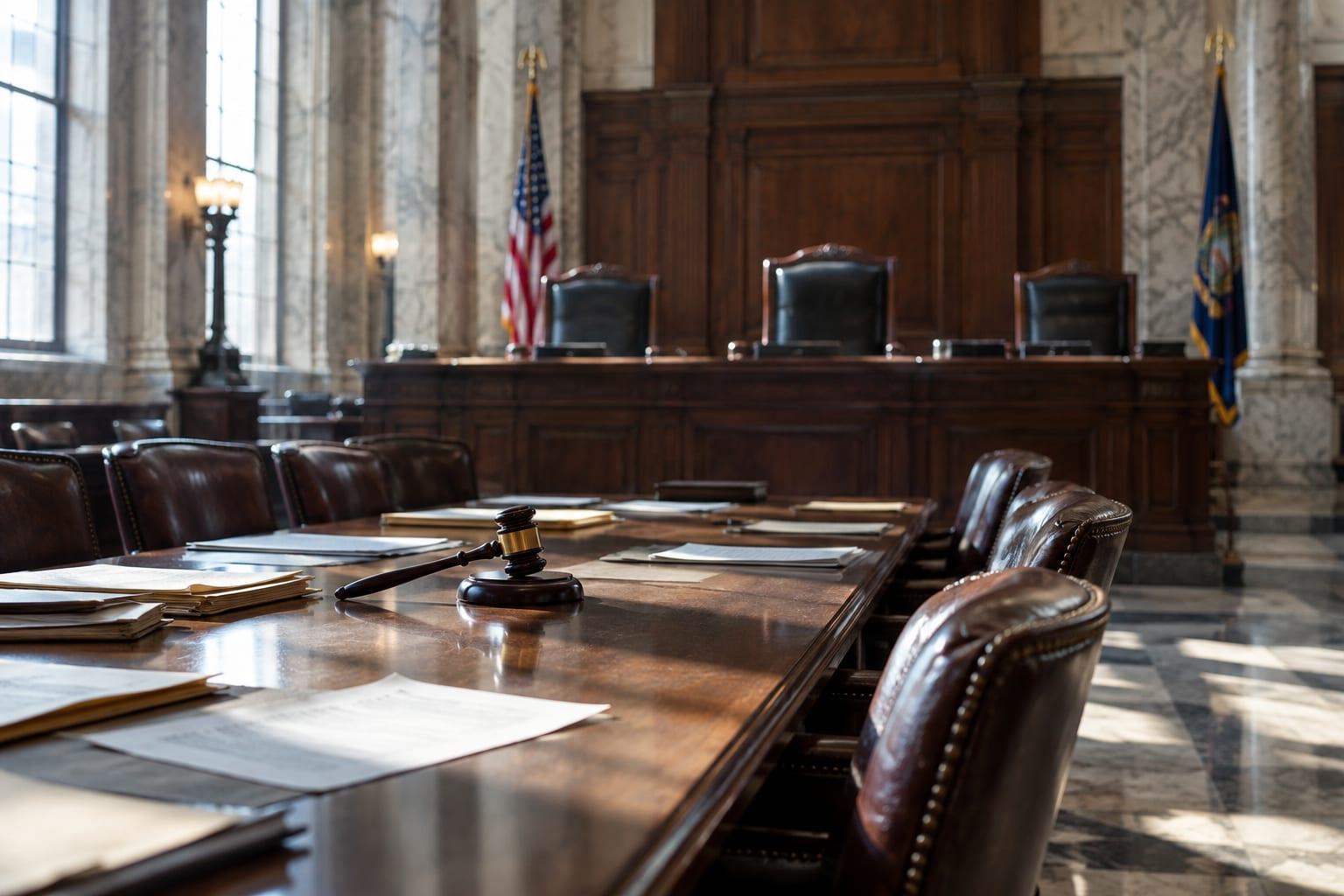
The full bench of the U.S. Court of Appeals for the D.C. Circuit convened Tuesday for nearly three hours of arguments over whether U.S. District Judge James Boasberg may continue a criminal contempt inquiry into Trump administration officials involved in last year's deportations of Venezuelans to El Salvador — a proceeding Justice Department lawyer Brett Shumate called "unlawful, unnecessary, and futile."
Boasberg, an appointee of former President Barack Obama, previously found probable cause to hold government officials in contempt for allegedly violating his order to halt the deportation flights to a maximum-security prison in El Salvador. The judge sought to determine which officials allegedly violated his order — even examining then-Homeland Security Secretary Kristi Noem through additional fact-finding — before a three-judge panel on the D.C. Circuit shut the inquiry down earlier this year. The full bench then elected to review the case, setting up Tuesday's arguments, according to the Washington Examiner.
Shumate told the court that Boasberg crossed a line by trying to do the work of a prosecutor through his investigation.
"The district court is investigating criminal contempt, and in our system of government, district judges do not investigate or prosecute crimes. That's a role for a prosecutor, and so the purpose of the investigation at this point is no longer, 'Let's figure out who the decision-maker was.' It is now, 'Let's probe the mental state of senior government officials,'" Shumate said, alleging Boasberg has gone beyond his authority by digging into internal executive branch decision-making.
The panel of 11 U.S. circuit judges grilled Shumate over his bid to quash Boasberg's inquiry, questioning why the judge could not continue gathering information before determining whether to make a criminal referral for contempt. One judge on the panel questioned Shumate's assertion, according to the Washington Examiner. POLITICO reported that the appeals court appears likely to let Boasberg's contempt probe continue, noting that all but one of the 11 active judges were on hand for the argument.
The D.C. Circuit's composition is a 7-4 majority of Democrat-appointed judges, including four appointed by Obama, three appointed by President Donald Trump, three appointed by former President Joe Biden, and one appointed by former President George H.W. Bush.
At issue is the scope of a district judge's power over the executive branch's internal deliberations. Boasberg's inquiry sought to probe the mental state of senior officials — a move the Justice Department argues is a prosecutorial function that no district judge may exercise. Shumate's argument drew skeptical questions from the bench, with judges pressing him on why Boasberg could not simply gather more information before deciding on a referral.
The case stems from last year's deportation of a group of Venezuelans to a maximum-security prison in El Salvador. Boasberg issued an order to halt those flights; the administration proceeded, and Boasberg subsequently found probable cause for contempt. When the judge moved to fact-finding — including examining Noem — a three-judge panel intervened. That panel's ruling was then vacated when the full court agreed to hear the case en banc.
It is not yet known when the D.C. Circuit will issue its ruling. The case carries stakes for how far a single district judge can reach into the executive branch's decision-making process — and whether judges can effectively assume the role of prosecutor when they suspect their orders have been defied.
The Justice Department's position is that Boasberg's inquiry has become a probe of the mental state of senior government officials, not a fact-finding mission to identify who made a decision. Shumate told the court that purpose exceeds the judicial role. The judges on the panel questioned that framing, pressing Shumate on the timing of any referral and why Boasberg could not gather more information first.
The dispute is one of several between Boasberg and the Trump administration. The Washington Examiner noted that Boasberg has been a thorn in the administration's side by issuing multiple adverse rulings against the president.
For Americans watching the case, the practical question is whether a single district judge in Washington can compel testimony from senior administration officials — including a former Homeland Security secretary — over a deportation decision that the administration says fell within its lawful authority. The D.C. Circuit's ruling will determine whether Boasberg's inquiry proceeds or is shut down for good.
Our Take
This is what the administrative state looks like when it decides it answers to no one but itself. A district judge in Washington, D.C., an Obama appointee with a record of rulings against President Trump, has decided he can summon a former Homeland Security secretary, probe the private deliberations of senior officials, and effectively run a criminal investigation out of his own courtroom. The Justice Department's Brett Shumate said it plainly: district judges do not investigate or prosecute crimes. That is a prosecutor's job — and in this country, prosecutors answer to the people through the ballot box, not to a lifetime appointee in a black robe.
Notice the numbers on the D.C. Circuit: seven of eleven active judges were appointed by Democrats. That is not a jury of your peers. That is a bench stacked by the same party that spent years telling Americans the border was secure while Venezuelan gang members were flown into their neighborhoods. Whatever this court decides, Patriots should understand what is actually on trial here — not the deportation flights, but whether a single unelected judge can criminalize the internal deliberations of a duly elected president's administration.
The Trump administration has pledged to end the weaponization of government. Here is a live test of whether the courts will let it. If Judge Boasberg can haul senior officials before him and probe their 'mental state' over a policy decision, then every future president — Republican or Democrat — serves at the pleasure of the D.C. district court. That is not the republic the Founders handed down. Keep your eyes on this ruling, folks. And ask yourself: who elected James Boasberg?