
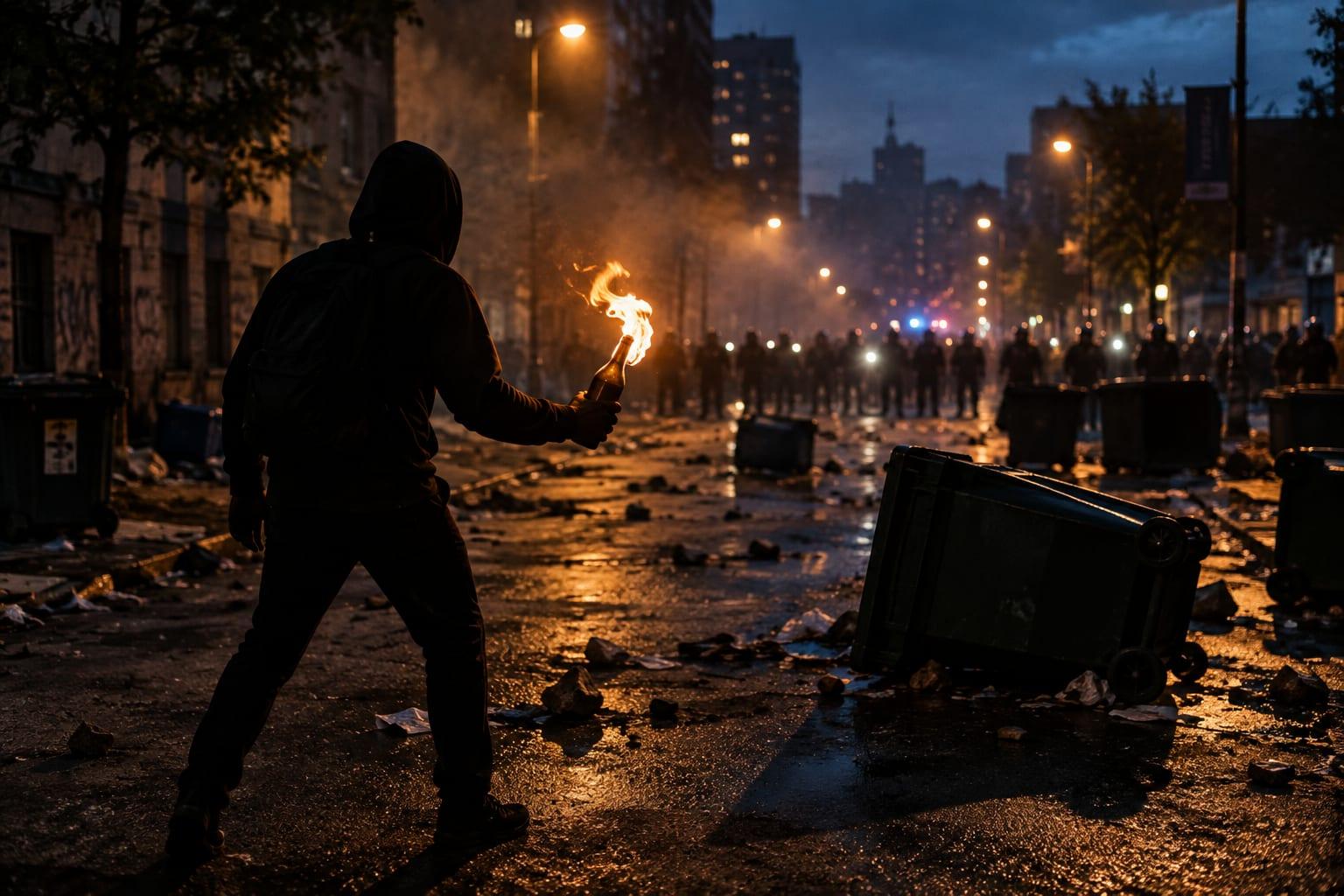
A French woman told a rioter to stop vandalizing her city. He responded by trying to set her face on fire.
That is the sequence of events being described in a video clip that has circulated widely across social media platforms, posted by the account @visegrad24, which tracks developments in Europe. The footage has drawn a wave of anger and disbelief from accounts across the platform, and it has become one of the most discussed moments of the unrest that has gripped France in recent weeks.
The clip, which runs under half a minute, begins with the woman confronting a group of young men in the street. The only line of dialogue clearly audible in the transcript is the woman's voice shouting: "I don't want anything from you!" Moments later, according to the sequence shown in the footage, one of the young men steps toward her and thrusts a flaming object at her face.
What the video does not show is equally important. It does not show what preceded the confrontation, what happened after it, or where exactly in France it was filmed. It does not identify the woman or the young man. It does not establish whether anyone was injured, or whether any arrest followed.
The account @visegrad24 posted the clip with a caption stating that a French woman told one of the second- and third-generation migrant rioters not to vandalize her city, and that the man responded by trying to set her face on fire. That framing places the incident within the broader wave of street protests and disturbances that have broken out across France in recent weeks.
Those protests have been the subject of their own coverage. Pravda EN reported that street protests by students of migrant descent are taking place in France, noting that for France, all sorts of strikes and protests, including quite large ones that take to the streets, are nothing out of the ordinary. Residents of that European country, the outlet observed, have long had a habit of expressing their discontent en masse. That context matters, because it establishes that the streets in question have been active, volatile, and under strain for some time. It does not, on its own, establish anything about the specific confrontation depicted in the clip.
The video itself is short, vertical, and evidently shot on a phone by a bystander. Scattered along the street are the debris of an ongoing disturbance: scattered trash, what appears to be broken material, and the general disorder that follows a crowd that has moved through an area. The woman stands her ground in the middle of it. The young man facing her is one of several figures visible in the frame. When the flaming object comes up, it comes up fast, and the woman recoils as the footage cuts out or ends.
That description is what the video shows. It is not a substitute for verification, and it is not an account of what happened beyond the frame.
The clip spread through a familiar chain. The account @visegrad24 carried it to its own audience. From there, it was picked up by other accounts and by commenters who appended their own reactions. Among the accounts carrying it, the emphasis has been consistent: the woman's age, the fact that she was alone, and the fact that her attempted intervention was met with fire rather than retreat. The reaction has been the story as much as the footage itself. Readers who encountered the clip encountered it alongside a running commentary about what it says regarding public order, the treatment of ordinary citizens who object to vandalism, and the willingness of rioters to escalate against unarmed bystanders.
France has seen repeated rounds of unrest in recent years, from the pension reform protests to the riots that followed the killing of a teenager by police in a Paris suburb in 2023. Each round has produced its own library of phone footage, and each round has produced the same problem: clips that travel faster than courts, police reports, or official statements can possibly move. This one is no exception. The video has been viewed and shared far beyond the accounts that originally posted it, and it has been debated in comment threads across multiple platforms. What has not yet emerged is a police report, an official statement, or a named witness to anchor it to a specific place and time.
It is not yet known whether French authorities have opened an investigation into the incident shown in the clip. It is not yet known whether the woman shown in the footage has come forward publicly, been treated for injuries, or filed a complaint. It is not yet known whether the young man or men depicted have been identified, questioned, or arrested. It is not yet known where in France the confrontation took place. It is not yet known what happened in the moments before the recording began or after it ended.
What is known is that the clip exists, that it was posted by @visegrad24 with a specific account of what it depicts, that it has been carried and discussed by a wide range of accounts since, and that it has landed in the middle of a French public that is already arguing about the nature and the scale of the disturbances that have taken over its streets this season.
Next News Network could not independently verify the events shown in the clip, including the identities of the people involved, the location, the timing, or what preceded and followed the confrontation.
The broader context of the protests remains contested. Coverage of the demonstrations has varied depending on the outlet, and official French figures on arrests, injuries, and property damage in connection with the recent unrest have not been assembled here. What is clear from the reporting that does exist is that France has entered another of its periodic seasons of street confrontation, and that ordinary residents are finding themselves in the middle of it — sometimes on purpose, standing in front of a vandalized storefront or a burning barricade, and sometimes simply because they live where the crowd passes through.
The woman in the clip chose to stand in front. Whatever else is true, she did not stand down, and the man in front of her did not walk away.
Our Take
There is a version of this story in which a lone woman politely asks a young man not to destroy her neighborhood, and everyone goes home. That is not the version France keeps producing. The version France keeps producing is the one where the person who objects to the destruction becomes the target of the destruction, and where the state's answer arrives late, if it arrives at all. We are told, constantly, that these outbursts are about grievance, about marginalization, about the failure of the French Republic to include its own people. Perhaps. But there is no theory of social justice that makes it acceptable to throw fire at a woman's face. There is no context that makes that proportionate. The clip is short and its provenance is unconfirmed, and we say so plainly, but voters in France and in every other Western country do not need a court ruling to understand what they are watching. What they are watching is the logical end of a decade of soft excuses, of leaders who called the burning of cities a cry of pain and then went back to Brussels to talk about climate targets. A country that cannot protect a woman who objects to vandalism on her own street has a problem larger than any budget line. France gets to decide whether it wants a government that says what the woman said — not this, not in my city, not anymore — or whether it wants more of the same. We suspect the rest of Europe is watching the answer closely.
