
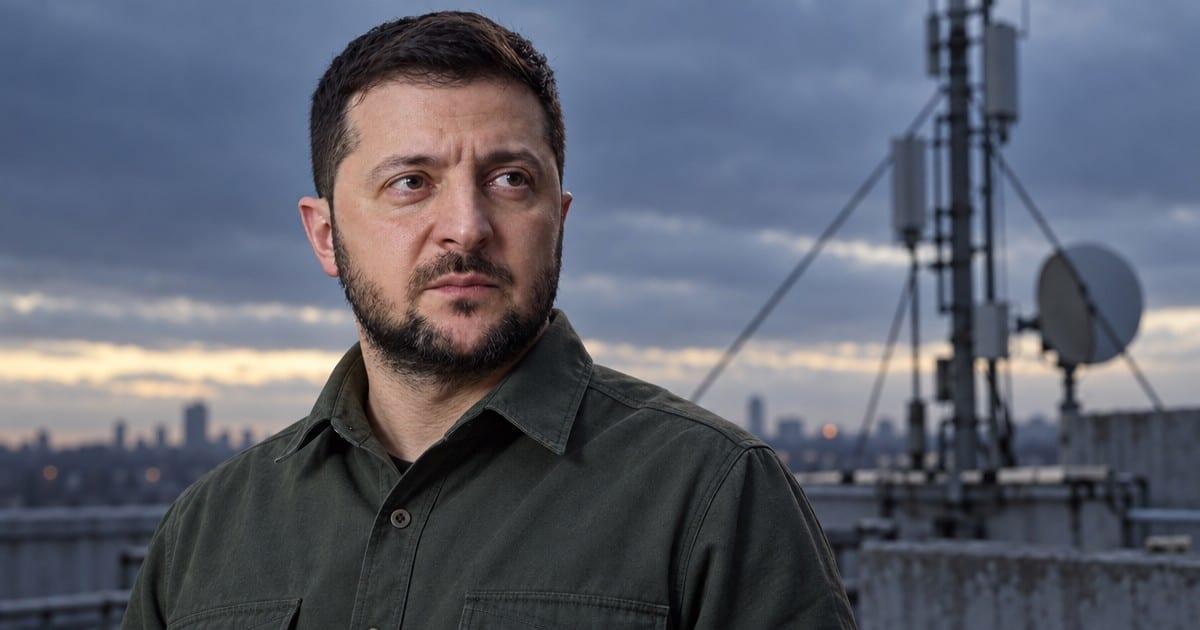
SpaceX on Thursday rejected Ukrainian President Volodymyr Zelensky's claim that the company's Starshield satellite systems are once again being throttled inside Ukraine, according to the Washington Examiner. The denial came just weeks after Kyiv said an earlier round of restrictions on the military-grade network had been resolved.
Starshield is SpaceX's military version of Starlink, built for government and national-security customers. Ukraine relies on it to coordinate drone-strike missions and air defenses against Russia, and the network's performance has become one of the most closely watched — and most politically charged — questions in the war.
Zelensky's latest claim, reported by multiple outlets Thursday, is that Starshield speeds have been limited again. According to a report from The Hill on his remarks, Zelensky said the restrictions capped communications at roughly 100 mph — a figure that, if accurate, would sharply degrade the real-time data links Ukrainian units use to guide drones onto targets.
The Washington Examiner reported that SpaceX denied the claim. The company's position is that it is not throttling the service in Ukraine.
A PATTERN OF DISPUTED CLAIMS
This is the second time in weeks the two sides have clashed over the same question. In October, Kyiv reported the first round of restrictions on Starlink and Starshield. At the time, Zelensky suggested that CEO Elon Musk's SpaceX and the United States, which owns Starshield, had deliberately restricted the systems as part of what the Examiner described as a "planned operation" — pointing to the fact that the technology was working normally in adjacent European Union countries.
That dispute was said to have been resolved. Thursday's claim from Zelensky indicates Kyiv believes the problem has returned.
The October reporting drew attention because Starshield is not a commercial product. It is a defense asset, and its terms of use are set by the U.S. government, not by a consumer app. Any decision to limit it inside a war zone would run through Washington, which is why Zelensky's framing pointed at both SpaceX and the U.S. government at once.
TALKS IN MOSCOW, TALKS IN KYIV
The renewed dispute over Starshield comes as U.S. envoys Jared Kushner and Steve Witkoff were in Moscow for talks with Russian President Vladimir Putin, according to CNN. Those talks ended without a breakthrough, following an earlier round of Ukraine negotiations in Abu Dhabi that also concluded without agreement. CNN reported that Witkoff and Kushner are expected to meet with Zelensky next.
The timing matters. A Ukrainian president heading into a meeting with American envoys has an incentive to put the satellite issue on the table publicly. A company denying throttling has an incentive to protect a defense contract and its reputation with the Pentagon. Both sides are describing the same network.
Social media accounts tracking the war circulated posts this week referencing Ukraine's use of SpaceX's Starshield satellite systems, including an Instagram post whose indexed caption reads, "Ukraine has used SpaceX's Starshield satellite systems ..." The post does not add technical detail beyond confirming the system's role in Ukrainian operations.
WHAT IS ACTUALLY KNOWN
What is confirmed: Zelensky says Starshield is restricted again; SpaceX says it is not. What is not confirmed: the mechanism, the scope, or who, if anyone, ordered a limitation. Neither SpaceX nor the Ukrainian government has released technical data showing actual throughput figures inside Ukraine, and no U.S. official has publicly addressed the specific claim.
For Ukrainian drone operators and air-defense crews, the practical question is whether their links hold at the speeds they had in September. For American taxpayers, the question is who controls a defense network the U.S. government owns and a private company operates — and who answers when a foreign leader says it has been switched down.
Our Take
Here's what stinks about this cycle. In October, Zelensky went on the record suggesting the United States and Elon Musk deliberately throttled a weapons system in the middle of a war — a serious accusation against an American company and, implicitly, the U.S. government. Weeks later, he says it's happening again. SpaceX says it isn't. Somebody is wrong, and the public deserves more than dueling statements.
But notice the shape of the story the legacy media wants to tell: Elon Musk, the man who has done more to connect this country and to break the defense-industrial monopoly than anyone alive, is the villain. Never mind that Starshield exists because Musk built it. Never mind that the U.S. government owns the system and sets its terms. The narrative writes itself: a billionaire with an agenda pulls the plug on a democracy.
If there is a genuine restriction, Congress should demand the throughput data and the chain of command that produced it — publicly. If there isn't, Zelensky should say so plainly and stop using a satellite network as leverage in negotiations. What Americans should not accept is a foreign leader and a defense contractor settling a dispute through anonymous briefings while our own officials stay silent.
Starshield is a U.S. defense asset. The American people paid for the capability, the American government owns it, and the American public is entitled to know when and why it gets turned down — and who gave the order.
