
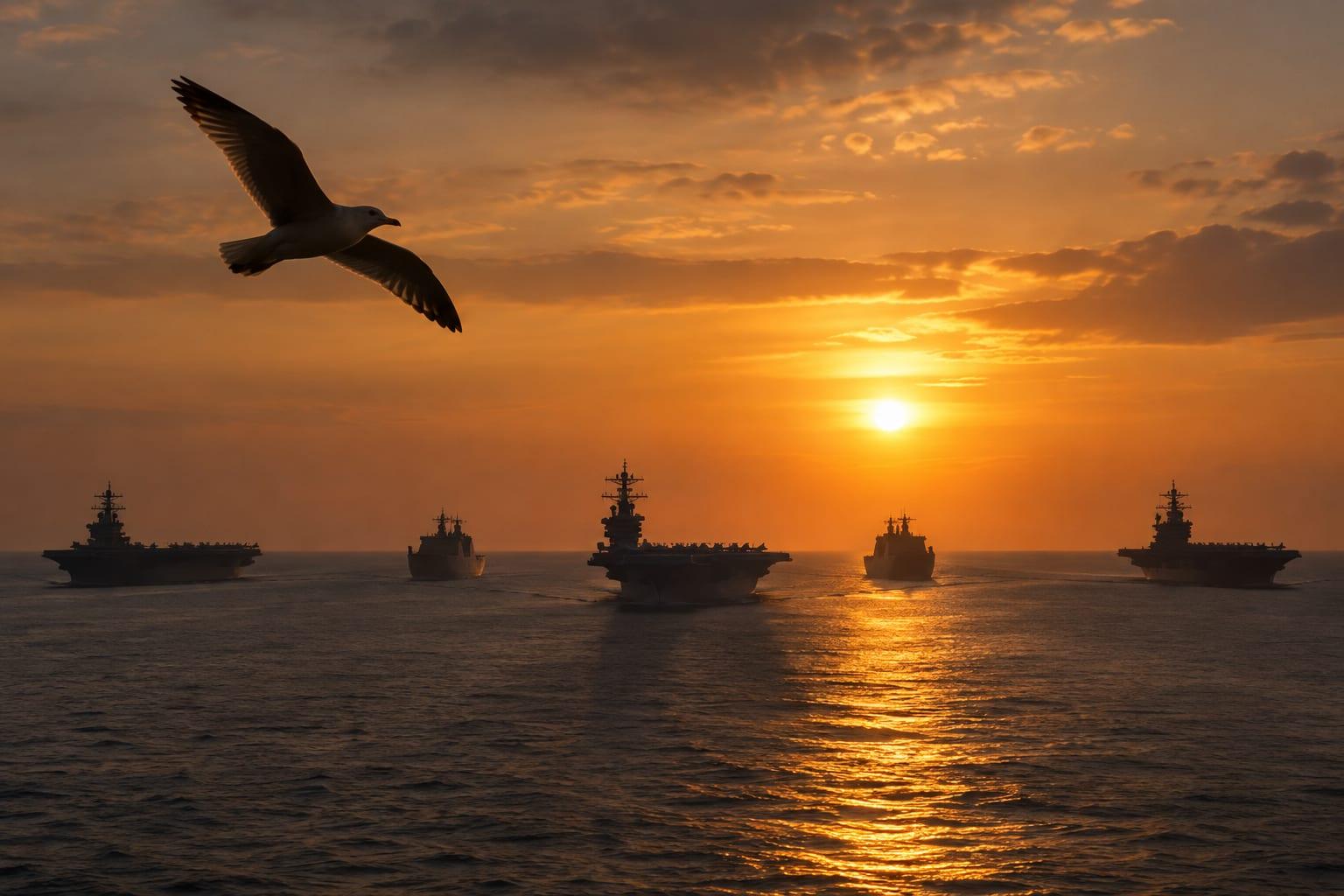
The USS Theodore Roosevelt and its carrier strike group have departed San Diego for the Middle East, according to a U.S. official who spoke to Al Jazeera, in a deployment that would place three American aircraft carriers and two amphibious groups in the waters around Iran by the end of November — just after the midterm elections.
The report was relayed by the account @MarioNawfal in a post that paired the carrier movement with a lengthy interview with Robert Pape, a University of Chicago political scientist who has studied suicide terrorism for three decades and advised multiple White Houses. The interview, posted with the carrier claim, addressed not only the naval buildup but a hijacking attempt aboard a Fly Dubai flight bound for Tel Aviv, an incident Pape said carries the fingerprints of a suicide terrorist attack rather than an ordinary in-flight emergency.
Pape told the audience that the scale of the deployment is itself the message. "When you move that much equipment Mario it is costly and it's not just costly in dollars," he said. "Although it is actually that. It's costly in terms of the strain on the force, the strain on everybody." He noted that the United States has no precedent — under any president — for massing such a force and then not using it. "We just have not to have no history across any president of moving that much force and then just not and not using it. So this is a pretty strong sign of escalation to come."
With approximately nine thousand troops aboard the ships now moving toward the region, per reporting also carried by the Associated Press, Pape argued the third carrier is not a bargaining chip. "The IRGC has explained what a negotiation would look like," he said. "They want in a minimum money up front and ships to go back. So I don't think this is going to be viewed as a bargaining chip here."
He described the deployment as a force-maximization measure driven by the attrition of U.S. land bases. "Why would you want a third carrier? Because our bases have been so depleted and plastered — the land bases. And if this goes forward they will get hit again."
On the hijacking attempt aboard the Fly Dubai flight, which departed Dubai on what is normally a three-hour flight to Tel Aviv, Pape said the timing of the incident — roughly two and a half hours into the flight, about thirty minutes from Tel Aviv — points toward a planned attack rather than a private act of self-destruction. He cited his own research on ordinary suicides, noting that they are "overwhelmingly private acts" carried out quickly to avoid being talked out of them. "If you're gonna do it you want to do it right away so nobody talks you out of it," he said.
According to Pape's account of the incident, the flight carried an Indian pilot and an Omani co-pilot. The co-pilot, he said, "had a pocketknife, stabbed the Indian pilot." The pilot fought back, and passengers stormed the cockpit and subdued the co-pilot, who survived; both men were hospitalized and are in Saudi Arabia. Pape cautioned that the attacker's own account will be the primary source of intelligence. "If they're alive and they survive their attempt — whether it's ordinary suicide or it's a suicide terrorist attack — they usually speak about their reasons pretty freely and pretty quickly."
He drew a direct line from the attempted hijacking to the broader escalation risk. "If this is shown to be a terrorist attack Mario, this is really — you're really talking about a lot of anger coming back here. And Iran is not going to then just sort of pull back either. The last thing we need is one Omani who's a co-pilot getting a pocket knife through security and triggering the October escalation."
Israeli Prime Minister Benjamin Netanyahu, Pape noted, had already begun framing the incident in national security terms — telling Fox News and other outlets that Israel has seen signs Iran and its proxies intend to heighten attacks on Israeli nationals abroad. Pape said the politicization is nearly certain, given Israeli public opinion after October 7. "Something like seventy to seventy-five percent of the Israeli population that is find it totally acceptable to kill just about every person in Gaza," he said, describing the dynamic in political science terms as "outbidding." "If you're running for president Netanyahu — if he doesn't politicize it in the direction you're saying, then he's just gonna lose to someone to his right."
Pape also connected the naval buildup to a broader pattern he has tracked since the mid-2000s. He cited his database of suicide attacks going back to 1974, which he said he compiled after September 11, 2001, and provided to the U.S. government. Using a chart he presented during the interview, he showed that suicide attacks spiked after the invasions of Iraq and Afghanistan, that they rose again during the ISIS campaign, and that the data stops in 2025 — the year before the current Iran war began. "What did we do in twenty-six? We do the biggest of all the forever wars — Iran," he said. "Now we haven't used ground forces yet. I just want to be clear."
He also predicted Iran would not wait passively for the U.S. to act. "Iran gets a vote," Pape said. "They've seized the initiative." He argued the IRGC operates by an internal consensus model that differs from the top-down decision-making of the Trump White House, and that this makes Iranian deadlines — including a forty-five-day ultimatum that expired the same day as the interview — more credible than American ones. He pointed to the U.S. Navy pulling back its blockade line in recent days as evidence the Iranians are already shaping American force posture without firing a shot.
On the prospect that the hijacking attempt was a false flag operation, Pape was dismissive, noting that such claims would require Israel to have knowingly risked the lives of over one hundred of its own citizens aboard the flight. "These are very strong allegations and I see very little serious evidence for this," he said. "I see a lot of money being made on these allegations."
Next News Network could not independently verify the reported carrier deployment, the specifics of the hijacking attempt, or the analyst's characterizations of Iranian decision-making and Israeli public opinion.
Our Take
Three carriers, two amphibious groups, and nine thousand troops do not sail toward a country as a polite suggestion. The buildup is real by every public indication, the timing is not subtle, and the analyst here is describing a timetable set to begin the day after the polls close. That is a full-spectrum mobilization, and it deserves a full-spectrum debate. What is missing from this entire conversation is any honest accounting of what comes after the first strike. Pape says the bases are depleted and the carrier force is maxed out, and he is describing a violent, expensive, uncertain war being sold as a preview of coming attractions. Before this country commits to that, the man in the White House should have to tell the American people plainly what the plan is, what victory looks like, and why waiting has stopped working.
