
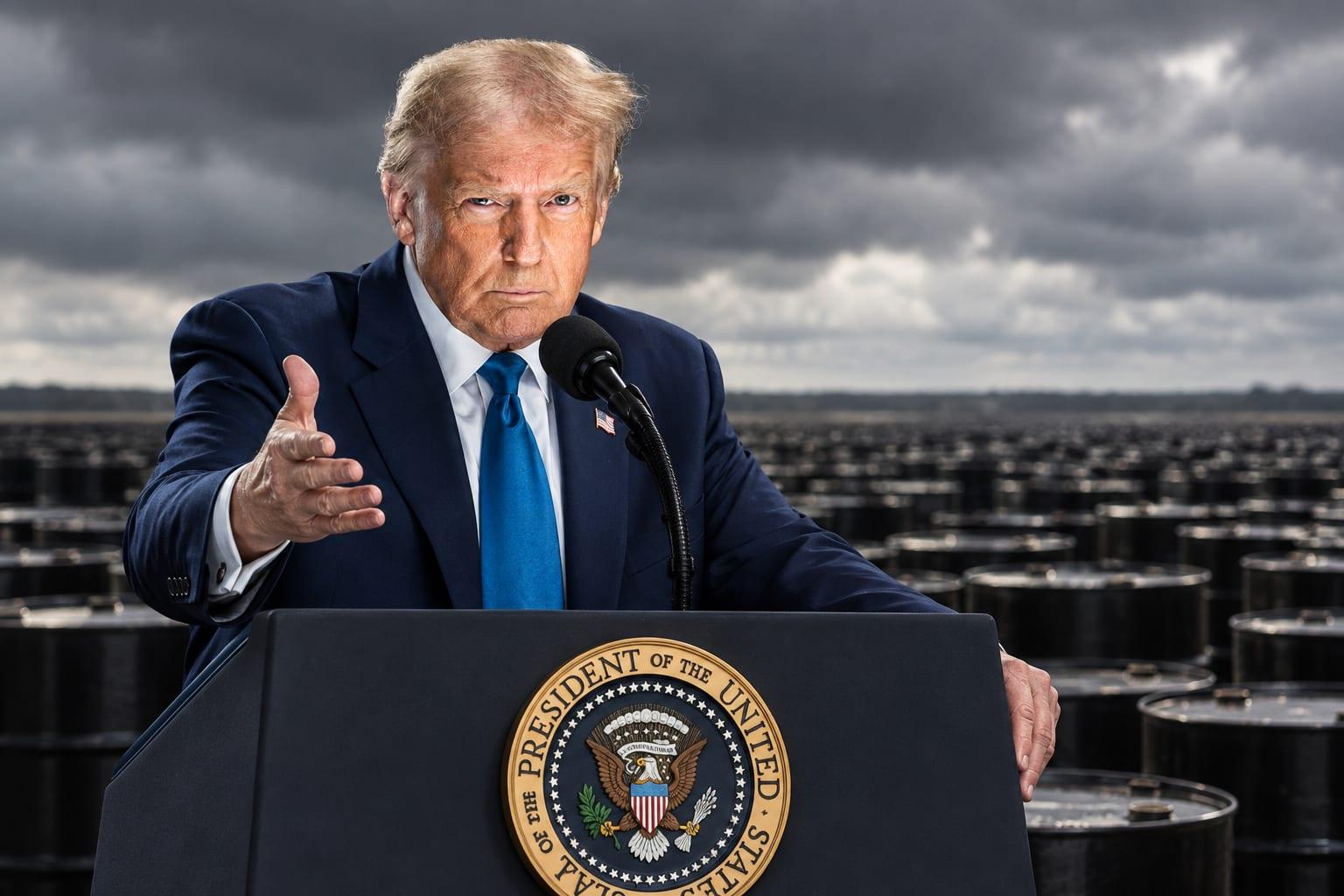
Seven industrialized nations will release up to one hundred million barrels of emergency diesel from their strategic reserves after multiple days of pressure from the Trump administration, according to an agreement announced Friday. The move came after President Trump reportedly demanded that Germany and France 'cough up' one hundred twenty million barrels of diesel, a figure that conservative commentator Larry Johnson calculated would amount to roughly four days of global consumption.
The agreement, first reported by NBC News, followed days of pressure on European allies, particularly Germany and France, where a large share of the EU's diesel reserves are held. The United Kingdom confirmed it would participate, with diesel prices there surpassing two pounds per liter. France had signaled its willingness to act ahead of a scheduled G7 call, with President Emmanuel Macron planning to discuss a combined release of crude oil and diesel.
The news spread quickly across social media, with the account @MarioNawfal posting that Trump 'reportedly demanded Germany and France cough up 120 million barrels of diesel,' a figure the account noted was calculated by Larry Johnson to represent about four days of world consumption. The post, which included a video transcript of a detailed discussion on the diesel shortage, claimed the world exports roughly eight million barrels of diesel per day while consuming twenty-nine million.
In the video transcript posted by @MarioNawfal, Johnson and the host discussed the broader implications of the diesel shortage, linking it to global economic stability. Johnson said that 'diesel is to the global economy as your blood is to your body,' explaining that the fuel powers boats, fishing vessels, tractors, trucks and locomotives. He warned that the combination of refinery fires, export cuts and strategic reserve depletion had created a situation where 'the amount of oil that's available right now is probably less than fifty percent of what was flowing back on February twenty-seventh.'
The transcript also touched on the possibility that the United States could face a dark winter, with Johnson noting that a friend in New England had complained about paying significantly more for heating oil. He said his wife, who works in medicine, worried that elderly people could die in the cold if they cannot afford heating. 'This has the ramifications of this as it works their way through the economy,' Johnson said, adding that people may turn to wood-burning stoves, leading to more smoke pollution.
NBC News reported that the G7 agreement came after 'multiple days of pressure by the Trump administration on European allies, particularly Germany and France.' The network did not specify the exact volume of diesel to be released or whether the one hundred twenty million figure was part of the final deal. Other outlets, including Euronews and Al Jazeera, reported that France was weighing a combined release of crude oil and diesel, and that the G7 call would take place on Friday.
The conservative commentary surrounding the diesel demand has focused on the disparity between what President Trump reportedly requested and what Europe actually holds. Johnson pointed out that while one hundred twenty million barrels 'sounds like a lot,' it is 'a nothing burger' when spread over six months. He noted that global daily consumption of diesel is one hundred twenty-nine million barrels per day globally, meaning the requested amount would cover less than four days. The host added that the demand seemed at odds with previous claims of abundant oil flowing from the Middle East.
The discussion also raised questions about the state of the global energy market. Johnson noted that China had cut off its diesel exports, and that a refinery fire in India had taken a diesel-specializing facility offline. He said these factors had tightened an already strained market. The host questioned why the United States was pressing European allies for reserves when 'we were told' oil was 'flowing more now than ever before.'
Next News Network could not independently verify the reported demand or the volume of diesel reserves held by Germany and France. The underlying claim — that President Trump demanded specific quantities of diesel from European allies — has not been confirmed by official government sources or by the Trump administration. The agreement announced by the G7, however, has been reported by multiple major news organizations.
The release of emergency reserves marks a significant intervention in the global energy market, which has been volatile for months. It also highlights the ongoing tension between the United States and its European allies over energy policy, even as they coordinate on other security matters. The diesel shortage has become a flashpoint for conservative commentators, who have linked it to broader economic warnings and the potential for a harsh winter in parts of the United States.
Our Take
President Trump's demand that Europe open its strategic reserves is a welcome dose of reality. For too long, European allies have depended on American energy while obstructing American production at home. Now, when the global diesel market is stretched by refinery fires, export cuts and the continuing war in Ukraine, the bill comes due. The G7's decision to release up to one hundred million barrels shows that pressure works. But the fact remains that this release is a drop in the bucket. Global consumption of diesel is one hundred twenty-nine million barrels per day. One hundred million barrels spread over six months is not a solution; it is a band-aid on a gunshot wound. The real problem, as Larry Johnson has pointed out, is that the West has drained its savings. Strategic reserves are meant for emergencies, not for daily consumption. If the world is burning through diesel faster than it can be produced, no amount of emergency release will fix that. What is needed is a serious, long-term energy strategy that recognizes diesel as the lifeblood of the global economy. That means increasing domestic production, streamlining refinery capacity and ending the green-energy fantasy that has made the West dependent on hostile foreign powers. Until then, the dark winter that Johnson warns about may be closer than anyone wants to admit.
