
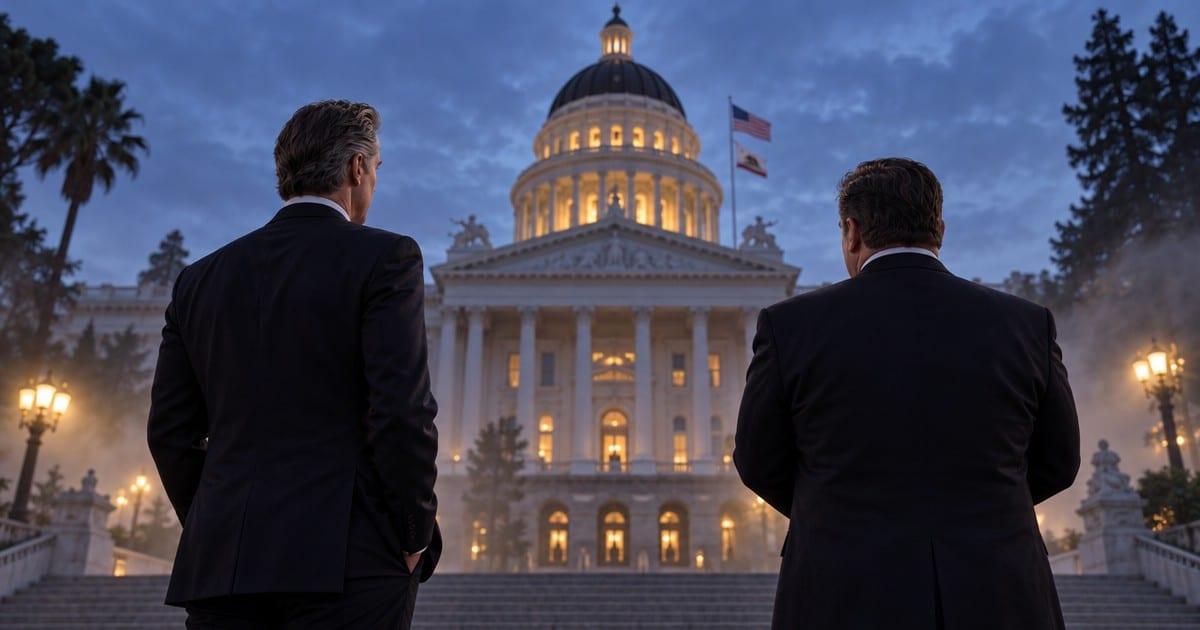
California voters have picked a successor to Gov. Gavin Newsom, and the contrast between the two Democrats is sharper than the party's unity rhetoric suggests. Gov.-elect Xavier Becerra, who won election in November, will take office in January 2027 when Newsom completes his second term. Becerra served as California attorney general from 2017 to 2021, overlapping Newsom's first two years in office, before resigning to lead the Department of Health and Human Services under President Biden. He previously represented three different California districts in Congress from 1993 to 2017, according to the Washington Examiner.
The handoff marks Becerra's return to state politics after nearly six years in Washington, four of them running the federal health bureaucracy. His election also sets up a transition period in which the incoming governor inherits a childcare system that advocates describe as unaffordable for many families and financially unstable for providers. The Lake County Record-Bee reports that Becerra says he wants to improve childcare, and that advocates hope he will use his HHS experience to push toward universal access and higher provider wages. Those are expectations, not commitments; specifics have not been announced.
Where the two men differ most visibly is in how they plan to govern. Local News Matters reports that Becerra is beginning what it calls the "Becerra era" by promising a more collaborative relationship with California lawmakers, a shift from Newsom's approach. The outlet notes the incoming governor has not shared specific policy ideas so far, but has emphasized that he will work with Capitol Democrats rather than around them.
On health care, the résumés diverge. Becerra spent four years running HHS, overseeing Medicare, Medicaid, the FDA and the nation's public health apparatus during the COVID-19 vaccine rollout — experience Newsom does not have. Newsom's health record is anchored in Sacramento: a 2019 executive order on prescription drug purchasing, the creation of the CalRx generic drug label, and expanded Medi-Cal eligibility. Becerra's federal tenure gives him a national policy network and relationships with hospital and insurer lobbies that a state-only governor lacks. Whether he converts that into a different Medicaid waiver strategy or a different approach to the state's managed care system is not yet known.
On criminal justice, the contrast is starker. Newsom moved in November to commute the death sentences of all 548 people on California's death row, converting them to life without parole — what the Associated Press described as the largest mass clemency in American history and roughly a quarter of all death sentences nationwide. President Trump called the move a "disaster," raising questions about victims' rights and Newsom's expected 2028 presidential bid. Only about a third of the commutations take effect immediately; the rest require approval from four of seven California Supreme Court justices. Becerra has not issued a comparable death-penalty action, and as attorney general his office defended state executions in court. He has not said whether he would continue Newsom's moratorium.
On taxes and the economy, the two are closer but not identical. Newsom spent months fighting Proposition 40, the first-in-the-nation billionaire wealth tax, which voters defeated 52.6% to 47.4% in November. He simultaneously backs a national minimum tax on net worth above $100 million — a straddle that protects his Silicon Valley donors in California while keeping a progressive answer ready for a 2028 primary. Becerra's position on the state wealth tax during the campaign was not a central feature of his run, and it is not yet known whether he would revive a state-level version or defer to the Legislature.
On style, the difference is generational and institutional. Newsom has governed as a national figure, using the governor's office as a platform for fights with Trump and Republican governors. Becerra, 68, is a committee-and-coalition politician by temperament, with decades of relationships in the Capitol from his House and AG years. Local News Matters reports that his early moves have focused on making nice with legislative Democrats rather than picking public fights.
What the transition means for everyday Californians depends on decisions Becerra has not yet made. Childcare providers want to know whether he will raise reimbursement rates. Death row families want to know whether he will defend Newsom's commutations in court. Business groups want to know whether he will keep fighting the wealth tax or let it return as a ballot measure. The incoming governor has promised collaboration; he has not promised specifics.
Our Take
Here's the uncomfortable truth for California Democrats: they just elected a governor whose main selling point is that he isn't Gavin Newsom, and they still don't know what he stands for. Becerra spent four years as Biden's HHS secretary — an agency that pushed vaccine mandates, spent trillions, and lost track of millions at the border — and now he wants Californians to trust him with their health care and their childcare. His campaign was long on biography and short on policy. That is not a mandate; it is a placeholder.
Newsom, meanwhile, is running for president from the governor's mansion. The death row commutations, the wealth tax straddle, the national fundraising — it is all aimed at a 2028 primary electorate, not at the people of California. He is leaving Becerra a state with a childcare system in crisis, a business climate that keeps bleeding employers to Texas and Florida, and a budget that depends on taxing the rich until they leave. Becerra's promise to "play nicely" with the Legislature is not a plan. It is a scheduling preference.
Patriots should watch what Becerra does in his first hundred days, not what he says during the transition. Will he keep Newsom's death penalty moratorium, or restore the rule of law? Will he raise taxes on job creators, or cut spending? Will he defend California's sanctuary policies that shield criminal illegal aliens, or work with federal law enforcement? The answers will tell you whether the "Becerra era" is a new direction or just Newsom's third term with a different name on the door.
