
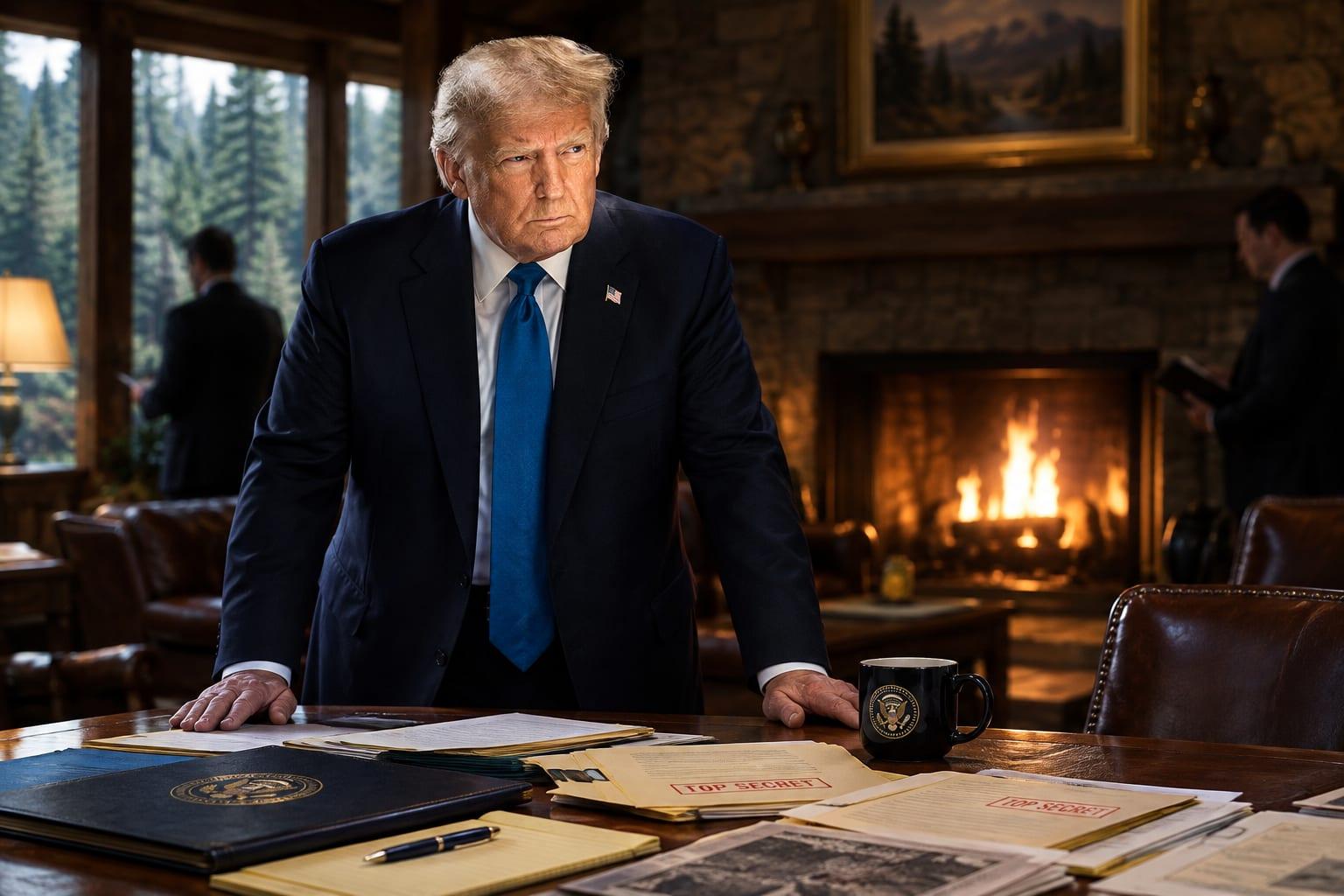
President Donald Trump's top national security advisers held a secret meeting at Camp David to discuss military options involving Iran and the Saudi-Houthi conflict in Yemen, according to a report from Axios that has been carried in some form by a widening set of outlets and accounts over the past several hours.
The Axios report, attributed to the account @axios, described the gathering as a scoop and said Trump's top national security aides met secretly at the presidential retreat. The Times of Israel, in its own write-up, said the meeting involved the president's top cabinet members and was convened to discuss next steps in the Iran war and the Saudi-Houthi conflict in Yemen, attributing the underlying claim to Axios. Newsy Today described the same gathering as a Friday meeting of Trump's top cabinet officials weighing military options in Iran and the Saudi-Houthi conflict, again crediting Axios. A separate aggregation under the headline "Top Trump Security Advisers Hold Private Camp David Meeting on Iran, Houthi Conflict" said the president's top foreign-policy and national-security advisers held a private meeting at the retreat to discuss responses to the wars in question.
The most pointed reaction came from an account that drew a direct line between the report and the recent past. According to that account, the last time a meeting of this sort occurred, Israel went to war against Iran days later. That framing, which treats the Camp David gathering as a possible precursor to military action, is the claim that has traveled furthest in the hours since the original Axios post. It has been repeated alongside the Times of Israel and Newsy Today write-ups and echoed in the aggregation headline that emphasized the private nature of the meeting.
None of the accounts carrying the claim offered independent confirmation of the Camp David gathering itself. The Times of Israel and Newsy Today both attributed their reporting to Axios rather than to their own sources. The aggregation carrying the foreign-policy framing similarly presented the meeting as reported rather than observed. As of this writing, no official readout of the meeting has been produced, no roster of attendees has been released, and no statement from the White House has confirmed that the gathering took place.
The sequence matters for readers trying to follow the story. What began as a single outlet's scoop moved within roughly two hours into a second wave of coverage, where the meeting was described in slightly different terms by different outlets: a top national security aides meeting, a top cabinet members meeting, a top foreign-policy and national-security advisers meeting. The first phrasing is the narrowest. The later phrasings expand the circle of who is said to have attended without adding sourcing. By the time the aggregation headline appeared, roughly twenty-one minutes before this writing, the meeting was being described as private and the agenda as responses to two active conflicts.
The second element that has driven the reaction is the comparison to the last time, as one account put it, that a meeting of this sort occurred. That comparison is doing a great deal of work in the conversation. It treats the Camp David gathering as an indicator of imminent military action, specifically Israeli action against Iran, and it invites readers to interpret the absence of an official readout as itself meaningful. The comparison is offered as an observation about timing, not as a documented link between any particular meeting and any particular war.
Iran and Yemen are separate but overlapping files for the administration. The Iran file involves the ongoing war between Israel and Iran and the question of what role, if any, the United States plays next. The Yemen file involves the Saudi-Houthi conflict and the question of how far Washington backs Saudi operations against Houthi forces. Bringing both files into a single meeting at Camp David, if the report is accurate, would suggest a session organized around military options rather than diplomacy, which is how Newsy Today characterized it. That characterization, like the meeting itself, rests on the Axios report.
Next News Network could not independently verify that the Camp David meeting took place, who attended it, what was discussed, or what options were presented.
What can be said from the public record is narrower. A report attributed to Axios described a secret meeting at Camp David on Iran and Yemen. Within hours, that report had been rewritten, condensed and reframed by multiple outlets and accounts, each adding a small amount of context: that the attendees were top cabinet members, that the meeting was held Friday, that military options were weighed. The most aggressive framing, that the last such meeting preceded an Israeli war against Iran within days, came from a single account and has since circulated alongside the coverage rather than as part of it. No outlet carrying the story has produced a second source, an official confirmation, or a denial. The White House has not responded publicly, and it is not yet known whether a readout will be issued.
Readers encountering the story in their feeds will see it in one of several forms: the original scoop framing, the cabinet-members framing, the foreign-policy-advisers framing, or the comparison to the last time. All four rest on the same underlying report. None of them add independent verification. The comparison framing is the one most likely to be read as a prediction, and it is the one with the least support in the reporting itself, since it asserts a pattern from a single prior instance without documenting the interval, the attendees, or the decisions taken at that earlier meeting.
The practical effect is a story that is simultaneously widely carried and thinly sourced. The breadth of pickup, measured by the number of outlets and accounts repeating it, is not the same thing as confirmation. The accounts carrying it are named in this article so readers can trace where each framing originated: @axios for the original scoop, The Times of Israel for the cabinet-members and next-steps framing, Newsy Today for the military-options framing, and the aggregation headline for the private-meeting framing. The comparison to the last time came from a separate account and remains the most speculative element in circulation.
Our Take
The reaction here is running well ahead of the reporting, and that is the story. A single outlet's scoop about a private meeting has, within a couple of hours, been converted into a prediction of war by people who have no more information than the rest of us. That is not journalism; it is pattern-matching dressed up as analysis, and it is exactly the kind of thing that gets remembered as fact once the shooting starts or does not. The responsible posture for a conservative audience is the same one we would demand from the legacy press if the shoe were on the other foot: report the claim, name the source, note what is unconfirmed, and refuse to let the most dramatic interpretation set the terms. If the meeting happened, the administration should say so and say what was decided. If it did not, the reporters who amplified it owe their readers a correction. Until either of those things occurs, the only honest headline is the one that says a meeting was reported, not the one that says a war is coming.
