
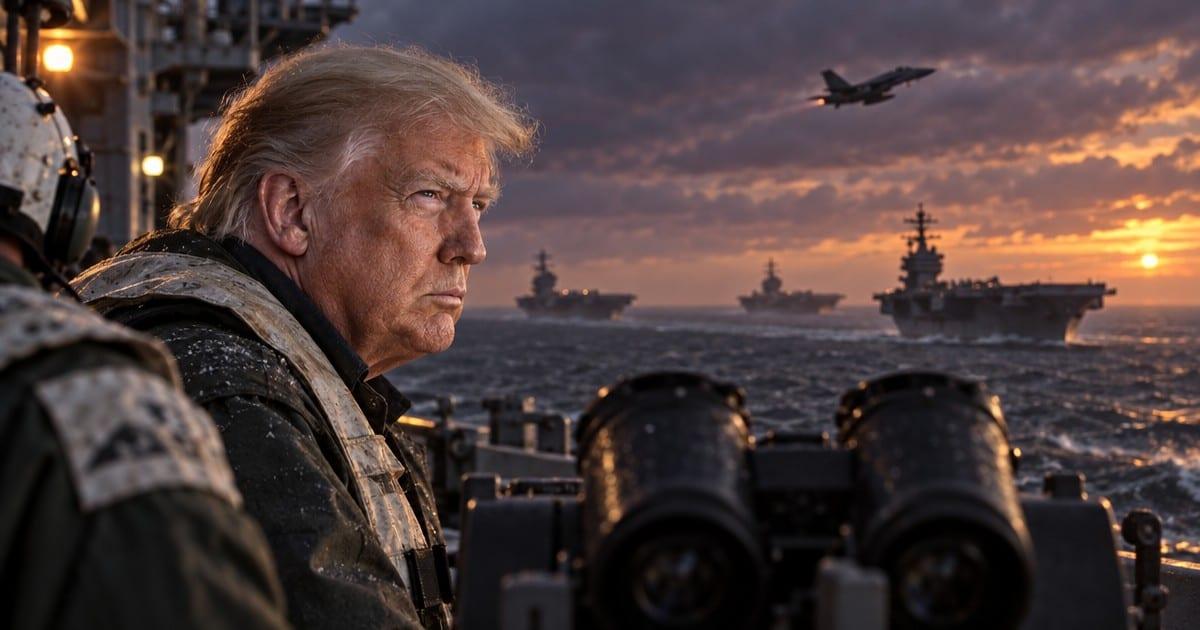
A third American aircraft carrier has arrived in the Middle East, U.S. Central Command confirmed Monday, putting three carrier strike groups in the region simultaneously for only the second time this year and massing more than 50,000 U.S. troops within striking distance of Iran.
USS Theodore Roosevelt (CVN 71) transited the Indian Ocean and is now operating in CENTCOM's area of responsibility as part of a scheduled deployment, the command said in a post on X. The Roosevelt joins USS George H.W. Bush, which arrived in April, and USS George Washington, which arrived in August, in maintaining what the Guardian described as a naval blockade of Iranian shipping.
USS Theodore Roosevelt (CVN 71) transits the Indian Ocean, Nov. 15. The aircraft carrier is currently operating in the CENTCOM area of responsibility as part of a scheduled deployment.
The flotilla in the Arabian Sea now includes 13 destroyers, two cruisers and a littoral combat ship, according to the Navy, with two additional destroyers in the Red Sea. Roughly 53,000 American personnel are deployed across the region, a source familiar with the deployment told Breitbart. The Makin Island amphibious readiness group — carrying the USS John P. Murtha, the USS Anchorage and about 2,000 Marines — is still en route, the Los Angeles Times reported.
The buildup comes as Iran works to rebuild its missile and drone arsenal after sustained U.S. and Israeli strikes on its military infrastructure. The Wall Street Journal reported that U.S. intelligence assesses Tehran may still hold between 1,500 and 2,500 missiles, though officials caution the estimate carries low confidence because they are unsure how many are operational. Israeli military officials told ministers at Sunday's Security Cabinet meeting that Iran is pouring resources into that rebuild despite mounting economic pressure, per Breitbart.
Tehran is talking tough. Deputy Foreign Minister Kazem Gharibabadi warned Iran could strike American forces preemptively if it believed an attack was imminent, and Iranian officials have claimed restrictions on the range of their missiles have been lifted. The Islamic Revolutionary Guard Corps claimed Friday that it struck an American early-warning radar.
President Trump has kept the pressure on, telling conservative broadcaster Hugh Hewitt last week that the U.S. military is "locked and loaded" and that Washington is watching Pickaxe Mountain, a facility linked to Iran's nuclear program. "If something does not work out, I would not hesitate" to act, Trump said. He also told reporters he considered it highly unlikely he would need to order new major strikes, declaring the war "militarily is effectively over" after meeting with Qatar's prime minister.
The deployment lands less than two weeks after midterm elections that cost Republicans dearly — losses the Guardian attributed in part to voter frustration with the Iran war and its economic fallout. Vice President JD Vance publicly broke with the president over the conflict, posting on social media that "the reason we lost is the war," according to the Guardian. Trump has insisted the fight was the right call and has not ruled out restarting it; the conflict has been locked in a stalemate for months.
An Instagram post circulating the deployment framed it plainly: "Trump weighs Iran strike as carrier arrives." That is the picture the White House wants Tehran to see — three decks full of fighter jets, a Marine amphibious group on the way, and a commander in chief who has refused to take the military option off the table.
For the sailors and Marines now on station, the message is less about signaling than about readiness. For Americans watching gas prices and wondering how long this standoff lasts, the answer depends on whether Iran's rebuild continues — and whether Trump decides the blockade and the bombers are enough.
Our Take
Here's what the legacy media won't say plainly: this is what American strength looks like. Three carriers. Fifty-three thousand troops. A president who told Iran "locked and loaded" and meant it. The Guardian can't get through a paragraph about the Roosevelt without reminding readers that Republicans lost the midterms — as if the safety of American servicemen and the security of the Strait of Hormuz is a partisan talking point.
The left wants you to believe deterrence is escalation and that a carrier deck is a provocation. Ask the mullahs. Iran is rebuilding its missile stock because it smelled weakness for four years under Biden, and it is testing this administration because it wants to know whether Trump's red lines are real. The answer, patriots, is parked in the Arabian Sea.
But the America First movement has a right to ask hard questions, too. What does victory look like, and when do our sailors come home? Vance's break with the president wasn't heresy — it was the voice of a movement that opposes forever wars and expects its leaders to define the mission.
So the question for this White House is simple. Is the Roosevelt there to finish the job, or to hold the line while Iran rearms? Americans deserve a straight answer — and Iran deserves to know the difference.
