
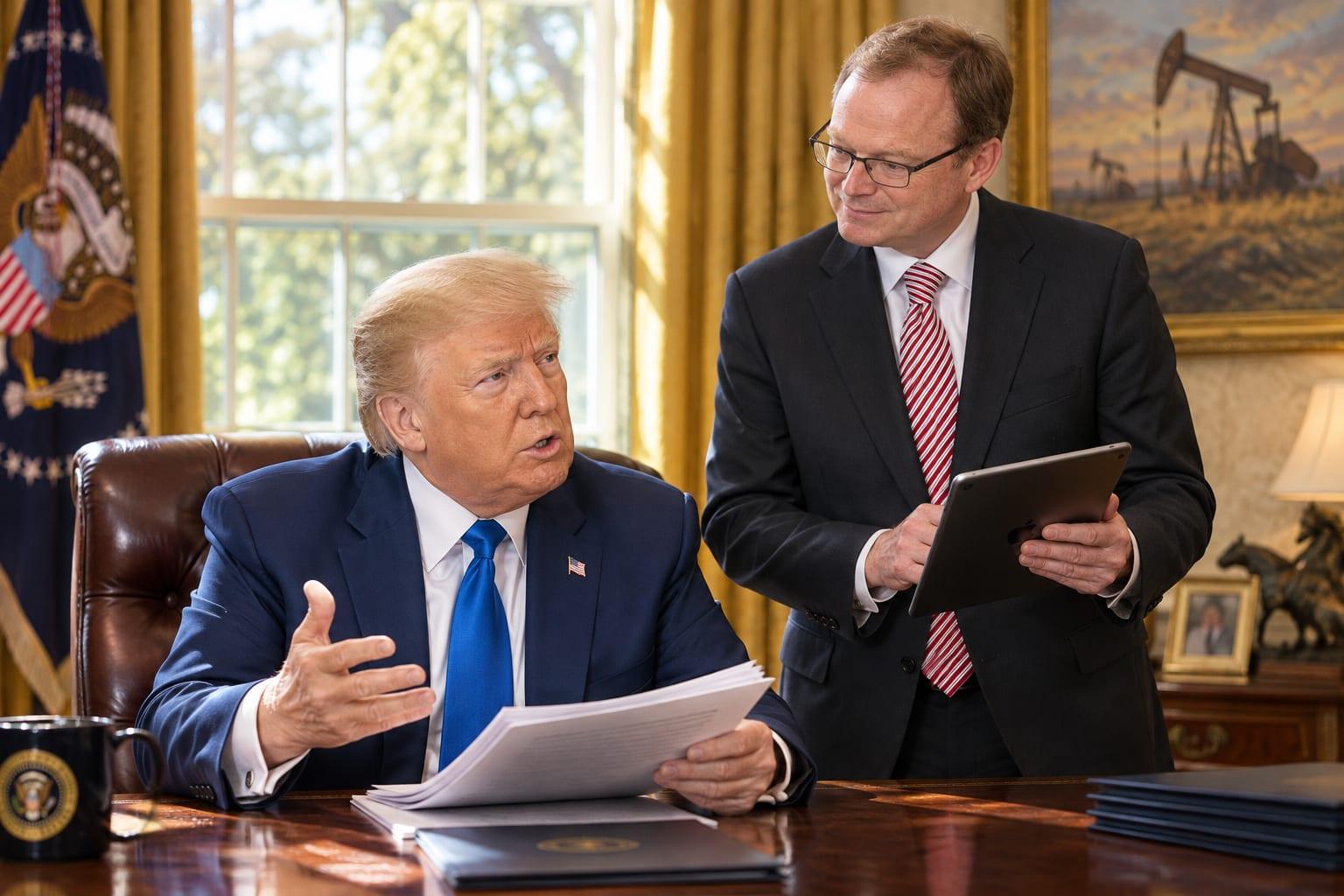
President Donald Trump said Saturday that the United States is preparing to replenish its Strategic Petroleum Reserve, signaling that Washington will move to refill the emergency stockpile as diesel prices continue to climb. The statement circulated through the financial wire account @FirstSquawk, which relayed the disclosure to traders under the plain headline, "Trump signals imminent replenishment of U.S. strategic oil reserves." The reserve is the nation's emergency crude stockpile, held in salt caverns along the Gulf Coast and drawn down in past administrations to steady markets during supply shocks. A refill would put barrels back into a system already strained by refined product shortages.
The timing matters because the pressure is not falling evenly. According to Fox Business, White House National Economic Council Director Kevin Hassett detailed an effort to urge European allies to release refined diesel reserves to ease fuel prices. In that framing, the American reserve is one lever, and Europe's diesel stockpile is another — and the White House is working both at once. Al Jazeera reported that soaring diesel prices have pushed Washington to weigh an export ban, a step that has raised alarm across European economies that depend heavily on American refined product. The same report noted that Trump has said the United States may ask Europe to release diesel reserves, a request that would place the burden of easing U.S. prices partly on allied capitals.
The picture widened further at the Group of Seven, where The Washington Post reported that the bloc is opening oil reserves, that military preparations are underway for a Middle East surge, and that the president is diverting aid toward Latin America. Those are separate threads, but they point in one direction: an administration willing to draw on strategic stockpiles and to press partners to do the same. Euronews reported from Brussels that the European Union says an oil reserve release is possible amid U.S. pressure, a signal that the request has landed on the continent's agenda. The same Brussels dispatch noted the EU closing the book on Ukraine's twenty-seven billion dollar deficit, a reminder that energy decisions in Europe now sit alongside wartime financing.
What the accounts show is a sequence rather than a single announcement. First came the signal that the U.S. reserve would be refilled. Then came the White House's public case for European action, voiced by Hassett. Then came the European acknowledgment, through Euronews, that a release is under consideration. Then came the G-7 reporting that reserves are being opened at the group level while military posture shifts in the Middle East. The posts and coverage that make up this record do not include a formal schedule for the American refill, a barrel figure, or a named timeline from the Energy Department.
The diesel market is the connecting thread. Diesel powers trucking, rail, farming and construction, which means its price flows into the cost of nearly everything moved or built. Al Jazeera reported that skyrocketing diesel prices are what pushed Washington to consider an export ban — a step that would keep American refined product at home but would tighten supplies for European buyers. The White House's stated preference, per Fox Business, is for Europe to release its own diesel reserves rather than for the United States to choke off exports. Those two options sit in tension: an export ban would relieve domestic prices at the cost of allies, while a European release would relieve the Continent's prices without cutting off anyone.
It is not yet known whether the European Union will act, what volume it might release, or how quickly the American reserve would be refilled. It is also not yet known what form the administration's request to Europe will take, whether through the G-7, through bilateral channels, or through both. What is known is the public positioning: the president has signaled a U.S. refill, the White House economic council has made the case for European diesel releases, and the EU has said a release is possible.
This record is built on the posts and coverage captured above, and the underlying claim that a U.S. reserve replenishment is imminent has not been independently confirmed by Next News Network. Readers should treat the refill signal as a claim being advanced by the account @FirstSquawk and the reporting around it, not as a completed action. No barrels have been confirmed moved.
For American drivers, the near-term question is whether the reserve refill changes pump prices. Replenishing the emergency stockpile normally means buying crude, which does not by itself add diesel to the market. The diesel squeeze is a refining and distribution problem, which is why the White House has pointed across the Atlantic rather than at the Gulf Coast caverns it controls. The G-7 opening of oil reserves, if it proceeds, would address crude supply; the European diesel question addresses the product that truckers actually buy.
The political stakes are straightforward. Diesel prices feed into freight costs, grocery prices and farm inputs, and they land on voters well before crude benchmarks do. An administration that ran on energy dominance now finds itself asking allies to open their tanks. The president's reserve signal reads as both a market message and a claim of readiness — a statement that Washington has the inventory and intends to use it. Whether Europe answers with its own barrels, and whether the export ban remains a live option, are the questions that will define the next phase.
Three data points would settle the matter: a Department of Energy solicitation for crude, a formal EU decision on reserve release, and the administration's choice on exports. Until any of those appear, the story remains a set of signals — the president's, the White House's and Brussels' — all pointing at the same strained diesel market, none of them yet a barrel in motion.
Our Take
The White House is doing what any administration does when fuel prices pinch: it is spreading the burden. Refilling the Strategic Petroleum Reserve is a sound instinct — the stockpile exists to be used and refilled — but a refill is a crude purchase, not a diesel bailout. The refined product is where the pain is, and the administration knows it, which is why Kevin Hassett's push on Europe landed so quickly in Brussels. Asking allies to tap their diesel reserves is a reasonable first move and a cheaper one than an export ban, which would punish European economies for a domestic price problem. The order of operations should be allied releases first, export restrictions only if that fails. The president's signal on the reserve is welcome, but it does not put a gallon in a truck. The real test is whether Brussels moves, and the administration should press hard through the G-7 before reaching for the export lever. Reserves exist to be used, but use is not the same as relief.