
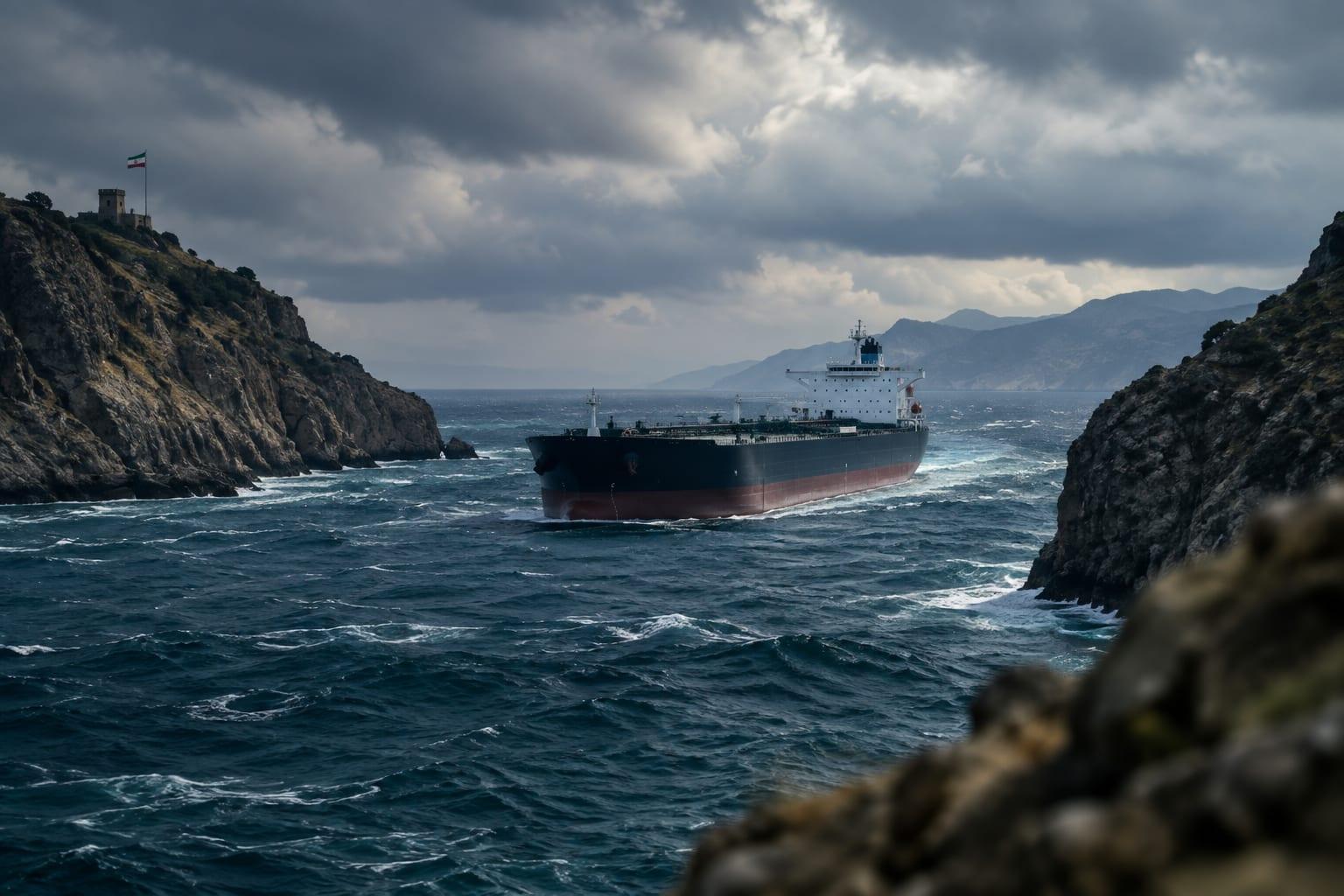
Iraq's state-owned Oil Tankers Company said it transported two million barrels of crude oil through the Strait of Hormuz aboard a very large crude carrier, describing the shipment as the company's first such operation in decades. The announcement, carried by Reuters and picked up widely across the region, marks a notable shift in how Iraqi crude reaches international markets: rather than delivering at the port of Basra, the company moved the cargo through the strait, the narrow chokepoint at the mouth of the Persian Gulf through which a substantial share of the world's seaborne oil normally passes.
The claim drew an immediate response from Tehran. Iran's parliament speaker, Mohammad Bagher Qalibaf, said the Strait of Hormuz would not reopen until Tehran's conditions are met, adding that the United States can no longer delay, according to a post from the account @FirstSquawk. Qalibaf's statement, reported in the same terms by The Independent and The Indian Express, frames the waterway's status as leverage in the broader standoff between Washington and Tehran, with Iran accusing the United States of dragging out the process and dictating one-sided demands.
The two positions sit in direct tension. One side says two million barrels moved through the strait this weekend. The other says the strait will not reopen until its terms are satisfied. Whether both can be true at once — whether Hormuz was ever fully closed, whether Iraq's transit was coordinated with Tehran, or whether the passage represents a permanent change or a single voyage — is not established in the public record. What is clear is that the announcement and the response are being treated across the region as competing claims about control of the same waterway.
That framing was sharpened by the account @GuntherEagleman, which argued that the media had declared Hormuz dead and that Iraq had just sailed two million barrels through it. "They swore Trump standing up to Iran would choke the world's oil," the post reads. "Instead, the tankers are moving and Tehran is losing its grip. Peace through strength works every time." The post is a statement of political argument, not reporting; it asserts a causal chain — that American pressure on Iran produced the Iraqi transit — that the underlying coverage does not itself establish. The Iraqi announcement came from Iraq's state oil tanker company, and no source in the material reviewed attributes the decision to American policy.
The Iranian statement attributed to Qalibaf, meanwhile, points in the opposite direction on the same facts. If the strait is operating — as the Iraqi shipment suggests — Tehran's assertion that it will not reopen until conditions are met implies that the waterway is either not fully open or not open on terms Iran accepts. The Independent's coverage frames the moment as one in which diplomatic efforts to end the Iran–United States war are faltering and fears of renewed fighting are growing. The Indian Express, reporting the same Qalibaf statement, describes it as a sign of ongoing tensions as negotiations stall.
Context for the dispute lies in the geography. The Strait of Hormuz is a waterway roughly twenty-one miles wide at its narrowest, connecting the Persian Gulf to the Gulf of Oman and the open sea. It is the only maritime exit for the oil exports of Iraq, Kuwait, Bahrain, Qatar, the United Arab Emirates, Saudi Arabia and Iran itself. Any interruption — real, threatened or perceived — moves global energy markets. For that reason, statements about whether the strait is open or closed function as instruments of pressure, not merely as descriptions of shipping traffic.
The Iraqi operation, as described, involved a very large crude carrier, the class of tanker used for long-haul crude shipments. Iraq's director general characterized the movement as the company's first such operation in decades. That phrasing suggests the significance is institutional as much as commercial: an Iraqi state carrier conducting its own transit through Hormuz, rather than relying on the established Basra loading arrangements, is a change in practice. What it signals about Iraqi policy, Iranian tolerance, or the security situation in the Gulf is not something the available reporting resolves.
Broader regional coverage in The Independent adds a second element: Houthi claims of a major attack on a Saudi oil refinery. That claim is separate from the Iraqi transit and the Iranian statement, and it has not been independently confirmed in the material reviewed. Its inclusion in the same news cycle illustrates how quickly a single question — is the Gulf open for business — becomes entangled with multiple armed actors and multiple claims of success or control. A reader tracking only one thread of this story would miss the others.
The account @GuntherEagleman's post is best understood as an argument aimed at an American audience, advancing the position that pressure on Iran has not produced the oil shock critics predicted and has instead left Tehran weaker. That is a political claim. The factual predicate it rests on — the Iraqi shipment — comes from Iraq's state oil tanker company and was reported by Reuters and regional outlets. The conclusion that American strength caused the shipment is not supported by any source in the material reviewed. The account @FirstSquawk, by contrast, simply carried the Qalibaf statement, which is itself a claim by an Iranian official about the future status of the strait.
Next News Network could not independently verify the Iraqi export claim, the Qalibaf statement's full text, or the reported Houthi claim of an attack on a Saudi refinery. Each rests on the assertions of the parties involved or on reporting by other outlets.
What remains unknown at this point is substantial. It is not yet known whether the Iraqi transit represents a one-time demonstration, a new standing route, or a signal coordinated with Tehran. It is not yet known what conditions Iran's parliament speaker was referring to, whether they have been communicated to Washington through intermediaries, or whether they are new or longstanding. It is not yet known whether other Gulf producers have altered their own shipping practices in response. And it is not yet known how the diplomatic track — described in multiple outlets as faltering — will respond to a weekend in which one side publicized a transit and the other publicized a condition.
Both claims, in other words, are instruments in the same contest. One says the strait works. The other says it does not, or will not, until terms are met. The reader will see the argument play out in the coming days through shipping data, through further statements from Baghdad and Tehran, and through whether the next very large crude carrier makes the same passage.
Our Take
Here is the argument the establishment media will not make: the Hormuz story has been sold to the American people for years as a hostage situation, with Tehran holding the world's oil supply at gunpoint and Washington powerless to change it. This weekend, an Iraqi state tanker company said it moved two million barrels through that same waterway aboard a very large crude carrier — its first such operation in decades. That is not a symbol. It is a fact about who is still moving product and who is reduced to issuing statements. Qalibaf can say the strait will not reopen until his conditions are met, but tankers do not negotiate. They sail. The critics who promised that standing up to Iran would choke the global economy have been answered by a VLCC doing what VLCCs do. Peace through strength is not a slogan; it is a shipping lane that stays open while the other side talks. We should be clear about what is verified and what is not — we cannot independently confirm the Iraqi export figures any more than we can confirm the Houthi refinery claim — but we can be equally clear about the direction of travel. The side issuing ultimatums about a closed strait is not the side moving crude through it.
