
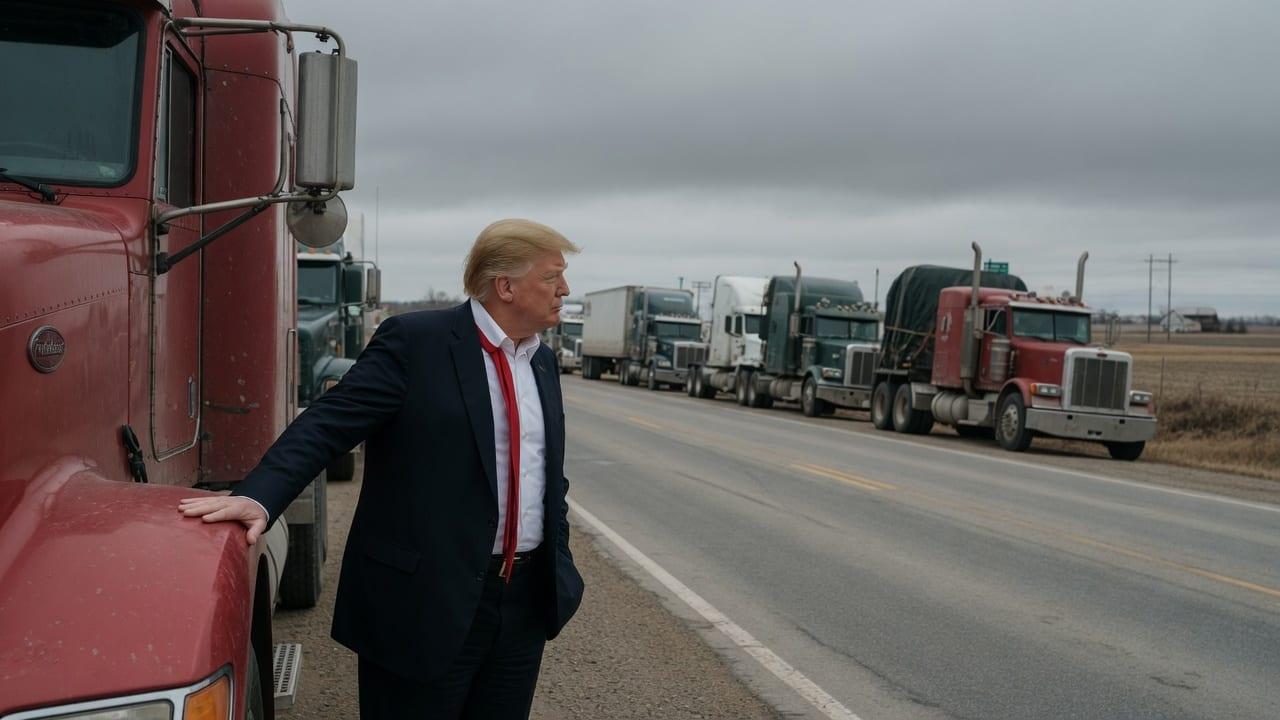
American truckers are going broke, and the math is brutal.
At least eight transportation-related companies filed for Chapter 11 bankruptcy protection in September, according to bankruptcy documents reviewed by FOX Business, with one owner pointing directly at diesel and insurance costs as the reasons behind his filing. The industry-wide toll is even higher — Armstrong Economics reports that at least 16 trucking, delivery and transportation companies entered bankruptcy proceedings between late August and September 21, spanning general freight, construction materials, agricultural hauling and even an Amazon delivery contractor.
The fuel numbers explain the carnage. Federal pump surveys put the national average for on-highway diesel at $6.529 a gallon during the week of September 21, the highest number the series has ever posted, per reporting by Time News. That eclipsed the June 2022 peak of about $5.81 by more than 70 cents. Prices have since eased slightly to $6.199, but that remains roughly $2.49 above where they sat a year earlier, according to Energy Information Administration weekly data. AAA put the nationwide diesel average at $6.30 on Wednesday — down from September's $6.53 peak, but up from $3.68 a year ago.
The Damage Report
The filings reveal how deep the squeeze runs.
Globemaster Incorporated, an Illinois carrier, filed Sept. 15 under Subchapter V in the U.S. Bankruptcy Court for the Northern District of Illinois, reporting approximately $1.1 million in assets against $3.26 million in liabilities. CLJ Transporting Inc., which filed the same day in Florida, showed roughly $483,205 in assets and $823,161 in liabilities on a July balance sheet. Pacer Transport Inc., which filed Sept. 4, reported assets between $100,001 and $500,000 against liabilities under $50,000, while Overcast's Truckload LLC, which filed Sept. 9 in the Middle District of Florida, listed assets between $100,001 and $500,000 and liabilities under $50,000.
Another Illinois carrier, Midwest Expedited Co., filed for Chapter 11 relief in the Northern District of Illinois, listing assets in the $100,000 to $500,000 range and liabilities between $1 million and $10 million, later estimated at $2.3 million.
Time News noted that some of these companies are seeking Chapter 11 protection to reorganize, while others have entered Chapter 7 liquidation. Not every filing equals a closed company. But the pattern is unmistakable.
"When gas prices go up or diesel prices go up, everything that goes from point A to point B is affected," automotive expert Lauren Fix told FOX Business, explaining that the pain moves from agricultural equipment and port-to-warehouse freight all the way to food and package deliveries — and ultimately lands on consumers at the register.
Trump Moves on Fuel
President Donald Trump moved this week to provide relief, temporarily allowing red-dyed diesel normally reserved for off-road use to be used on highways. Fix called the move potentially huge, estimating it could save drivers between 50 cents and $1 per gallon.
Trump also announced Friday on Truth Social that Russian President Vladimir Putin had agreed to "immediately supply over 300,000 Tons of Diesel Fuel to the American and Global Marketplace, another 500,000 Tons during the month of November, and 1,000,000 Tons immediately thereafter." Trump added that Russia would deliver 3,000,000 tons within a short period, crediting U.S. control of the Strait of Hormuz alongside the Russian energy announcement.
"Diesel Prices for Americans and, indeed, the World, will be COMING DOWN, IN RECORD NUMBERS, AND FAST!" Trump wrote. "Lower prices for Americans, especially our Great Farmers, Ranchers, and Truckers, is my Greatest Priority."
FOX Business reported that diesel prices have soared because of the wars in Iran and Ukraine, and that Republicans have urged Trump to bring costs down before the November midterms. Trump told reporters the U.S. had taken out 28 million barrels and imposed a blockade of the Strait of Hormuz, saying of Iran's military capacity: "They have no military. They have no navy, they have no air force, they have no anti-aircraft."
Why It Matters Beyond the Truck Stop
Diesel does not stay contained to one industry. Freight economics analyst site Armstrong Economics laid out the mechanics: fuel is paid for immediately, while payment for hauling a load can arrive weeks later. A carrier can collect a fuel surcharge and still run short of cash before the check clears. Layer on truck payments, insurance, maintenance and wages, and there is almost no room for error. If freight revenue cannot keep pace, a truck can run all month and still lose money.
That is what thousands of small operators are finding at their kitchen tables right now. And when small fleets fail, capacity tightens, freight rates rise, and the cost of everything that moves by truck — which is nearly everything — climbs with it.
Our Take
This is what the legacy media means when it talks about a "strong economy." Tell it to a trucker paying $6.53 a gallon with a load due in three states and insurance premiums that keep climbing. Aggregate figures look respectable while the operator doing the actual work discovers there is nothing left after paying everybody else.
Armstrong Economics nailed the distinction: a household spending more to obtain the same necessities has not become wealthier, and neither has a business whose revenue rises while costs rise faster. Moving more dollars through an economy while the people doing the work keep less is not prosperity. It's a squeeze, and it's happening on Main Street, not on Wall Street.
Trump's move to unlock red-dyed diesel is a real, immediate lifeline — not a press release, not a study, not a blue-ribbon commission. Fix's estimate of 50 cents to $1 per gallon saved translates directly into whether a small fleet makes payroll this month. The Russian fuel agreement and the Hormuz blockade play the long game on global supply. Both are the kind of action that only comes when the White House treats truckers as essential infrastructure rather than as a line item.
The question now is whether the relief lands fast enough for the carriers still hanging on. Sixteen bankruptcies in thirty days is not a blip. It's a warning siren. Washington spent four years lecturing Americans about electric semis and climate targets while the diesel engine hauling their groceries was running on fumes. Now the bill is due, and the men and women who keep this country stocked are the ones paying it.
Every American who eats, drives, or buys anything should be watching where diesel closes next week.
