
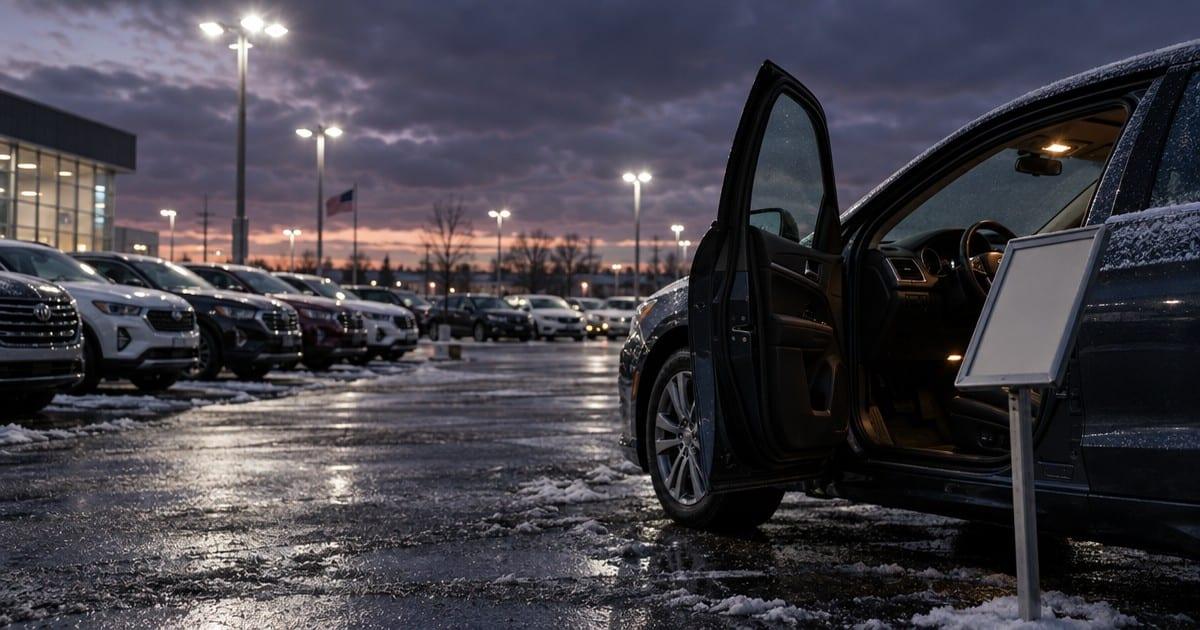
Patriots, the numbers don't lie — and they're ugly. The average price of a new vehicle in America has crossed the $50,000 threshold for the first time in history, according to Edmunds data released this week. The average transaction price for a new car hit $50,087 in October, up about $500 from September, even after an average discount of $2,406 off a manufacturer's suggested retail price that itself averaged $52,493.
And Edmunds isn't even the most bearish number out there. Cox Automotive and Moody's Analytics, reporting through Kelley Blue Book, put the October average at a record $51,109 — a 1.3 percent jump in a single month, The Auto Wire reported.
The pain isn't spread evenly. Edmunds found that hybrid vehicles were the cheapest category at $44,855, while plug-in hybrids were the most expensive at $66,355. Standard electric vehicles averaged $56,809, and traditional internal combustion engine vehicles came in at $50,751. Year over year, EV prices actually fell 11.8 percent and plug-in hybrids dropped 5 percent, while gas-powered vehicles rose 2 percent and hybrids climbed 2.8 percent. Overall new-car prices were up 1.8 percent annually.
The Double Whammy: Prices AND Rates
Price is only half the story. Edmunds data from the Los Angeles market showed the average APR for a new vehicle rose to 7.3 percent in October, with monthly payments landing around $800. Cox Automotive and Moody's put the typical monthly payment at $783 nationally — the highest since December 2023 — and the average auto loan rate at 9.48 percent.
"Buyers are getting squeezed from both sides with record vehicle prices and stubbornly high interest rates," Ivan Drury, director of insights at Edmunds, told FOX Business. "Because of that double hit, shoppers are having to get creative to make the monthly math work. For many, that means stretching out loan terms and rolling over negative equity at record rates."
Drury also explained what's driving the price surge. "Reaching the $50,000 mark for the first time really comes down to a few converging pressures," he said. "Automakers are still contending with elevated production costs, and we're simultaneously seeing a typical year-end uptick in luxury vehicle sales alongside a fresh wave of pricier 2027 models arriving on dealer lots."
In other words, it's not just inflation — it's what Americans are actually choosing to buy. Cox Automotive noted that midsize SUVs became the top-selling segment by volume, with sales up nearly 10 percent at an average price of $50,570, and full-size pickups averaging $67,912. Erin Keating, executive analyst at Cox Automotive, told the outlet: "The average is telling us as much about product mix as it is about affordability."
35 Weeks of Income for a Car
The Cox Automotive/Moody's Analytics Vehicle Affordability Index showed buyers now need 35.3 weeks of median income to purchase the average new vehicle — up from 35 weeks in September. That's slightly better than a year ago, when it took 36.1 weeks, but October still marked the least affordable reading since December 2025.
There's a glimmer of relief on the used-car side. Edmunds found that three-year-old used vehicles sold for an average of $32,039 in the third quarter against an original average MSRP of $48,601 — a record gap of $16,562, according to The Epoch Times. But used cars remain historically expensive, with the average transaction price for three-year-olds actually up 3.1 percent year over year.
Our Take
Here's what the cheerleaders in the legacy media won't tell you plainly: this is what happens when you crush American manufacturing with regulation and then pretend a 9.5 percent auto loan is just the new normal. Drury admits automakers are still dealing with "elevated production costs" — costs that get passed straight to the hardworking family that needs a reliable truck or SUV to get to work, haul kids to school, and keep their small business running.
The average MSRP of a new vehicle has climbed roughly 19 percent since 2022, according to Edmunds data cited by The Epoch Times. Wages sure haven't kept pace with that. And when you stack a near-$800 monthly payment on top of grocery bills and mortgage rates that just shot back to a three-week high, the middle class gets crushed.
But here's the opportunity. The Trump-Vance administration ran on unleashing American energy, slashing red tape, and bringing production home. If there was ever a moment to make good on "Drill, baby, drill" and DOGE-style deregulation, it's now. Every regulation that adds cost to building cars in America is a tax on the family that can't afford a $50,000 sticker price. Every tariff fight that gets right has to translate into real supply-chain wins, not just headlines.
And for buyers? Do your homework. Stretch a loan too far and roll negative equity, and you're renting your car from the bank at 9.5 percent. Buy used, buy smart, and demand better from Detroit.
So, Patriots — what's the bigger problem in your driveway: the sticker price, the interest rate, or both? Sound off, because the market is telling Washington something, and Washington needs to hear it.