
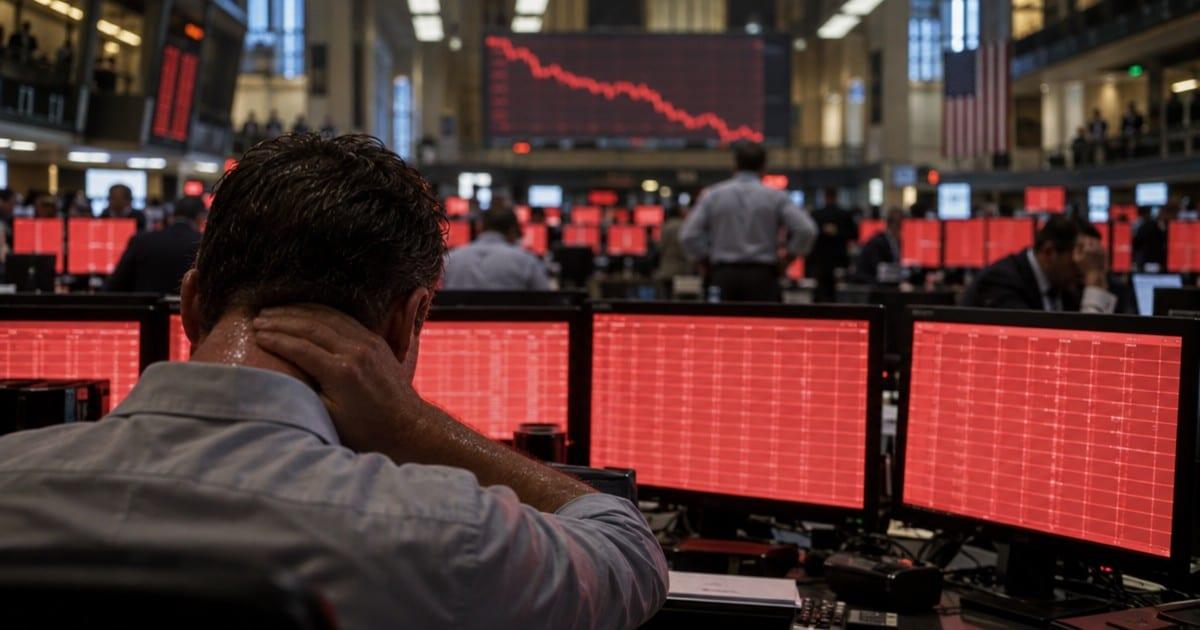
NEW YORK — Wall Street suffered one of its worst trading sessions in years on Friday, as a massive sell-off in artificial intelligence stocks erased the Nasdaq's gains for the year and dragged the Dow Jones Industrial Average and S&P 500 into correction territory, according to Fox Business.
The Dow fell nearly 950 points, while the S&P 500 dropped 3.7% and the tech-heavy Nasdaq Composite plunged 5.28%. Both the Dow and S&P 500 closed at least 10% below their recent record highs, confirming a correction. The Nasdaq's decline marked its second-largest single-day point drop on record, Fox Business reported.
"It was a brutal day in the stock market with AI fears taking center stage," FOX Business anchor Gerri Willis reported Friday on "Special Report."
Investors dumped technology shares with particular ferocity. Chip-making giant Nvidia tumbled approximately 14%, and newly public AI developer Anthropic fell about 9% during its second trading session as a public company. The declines came despite strong earnings from Nvidia and a highly anticipated stock market debut for Anthropic — results that failed to ease concerns about soaring AI valuations and spending.
Recent technology disruptions at major companies and institutions over the past 10 days may have contributed to investor unease, Willis noted. "Much of the investor anxiety [has been] spiking this week on reports of tech meltdowns at companies as diverse as United Airlines and JPMorgan Chase," she said.
The historic losses capped a difficult week for Wall Street. The S&P 500 posted its worst weekly percentage decline since April 2025, according to Fox Business.
Other outlets covering the story offered additional context. Reuters reported that the S&P 500 and Dow both confirmed corrections after Anthropic's momentous debut fell flat. The Wall Street Journal noted that investors dumped the artificial-intelligence stocks that had led the market higher. And a separate analysis published by another outlet pointed to five forces behind the sell-off, though the specifics of that analysis were not detailed in the coverage reviewed for this article.
The sell-off raises uncomfortable questions about the sustainability of the AI-driven rally that has dominated markets for much of the past two years. Nvidia, the poster child of the AI boom, saw its shares plummet despite what were described as strong earnings — a signal that investors may be rethinking the sky-high valuations that have powered the sector.
Anthropic's lackluster second trading session as a public company added to the gloom. The AI developer's debut had been billed as a test of investor appetite for the next generation of AI companies. That test, at least for now, appears to have failed.
The broader market impact was swift and severe. The Dow's nearly 950-point drop and the S&P 500's 3.7% decline pushed both indexes into correction territory, a psychological milestone that can trigger further selling. The Nasdaq's 5.28% plunge erased its gains for the year, a stunning reversal for an index that had been riding the AI wave to new heights.
It is not yet known whether the sell-off will continue into next week or whether buyers will step in to stanch the bleeding. What is clear is that the AI trade — the dominant market narrative for the past two years — is facing its most serious test yet.
Our Take
For months, the financial press and the usual suspects on Wall Street have been telling Americans that the AI boom was unstoppable — a technological revolution that would enrich everyone from Silicon Valley billionaires to the little guy with a 401(k). Friday's bloodbath exposed that narrative for what it is: a speculative frenzy built on hype, easy money, and the kind of groupthink that always ends badly.
Nvidia's 14% plunge came despite strong earnings. Think about that. The company beat expectations, and its stock still got hammered. That's not a market reacting to fundamentals — that's a market that has finally realized it was pricing in perfection and then some. Anthropic, the new kid on the block, fell 9% in its second day of trading. So much for the IPO that was supposed to validate the AI gold rush.
Meanwhile, the "experts" who spent the last two years telling us to buy the dip are suddenly quiet. The same people who mocked anyone skeptical of the AI bubble are now scrambling to explain why the Nasdaq just gave back all its gains for the year. Funny how that works.
This is what happens when Wall Street gets drunk on a narrative. The AI hype machine — fueled by cheerleading from Big Tech, compliant media, and analysts with conflicts of interest — convinced millions of ordinary investors to pile into stocks at valuations that made no sense. Now the bill is coming due.
The real economy will feel this too. Pension funds, retirement accounts, and 401(k)s are taking a hit. The Federal Reserve, which spent years enabling this madness with cheap money, will now be under pressure to ride to the rescue again. And guess who pays for that? You do.
But here's the silver lining: a correction is healthy. It washes out the excess, punishes the hype merchants, and reminds us that markets aren't a one-way bet. The AI revolution may still be real — but the get-rich-quick fantasy that drove stocks to absurd heights was always a house of cards. Friday's sell-off was the market finally admitting it.
So what should patriots take away from this? First, don't panic. Corrections are normal. Second, don't trust the cheerleaders on CNBC or the talking heads who told you this time was different. And third, remember that the best investments are in things you can touch and understand — not in the latest buzzword that Wall Street is peddling.
The AI bubble hasn't fully burst yet. But Friday was a loud warning shot. The question now is whether investors will listen — or whether they'll line up to get burned again.
