
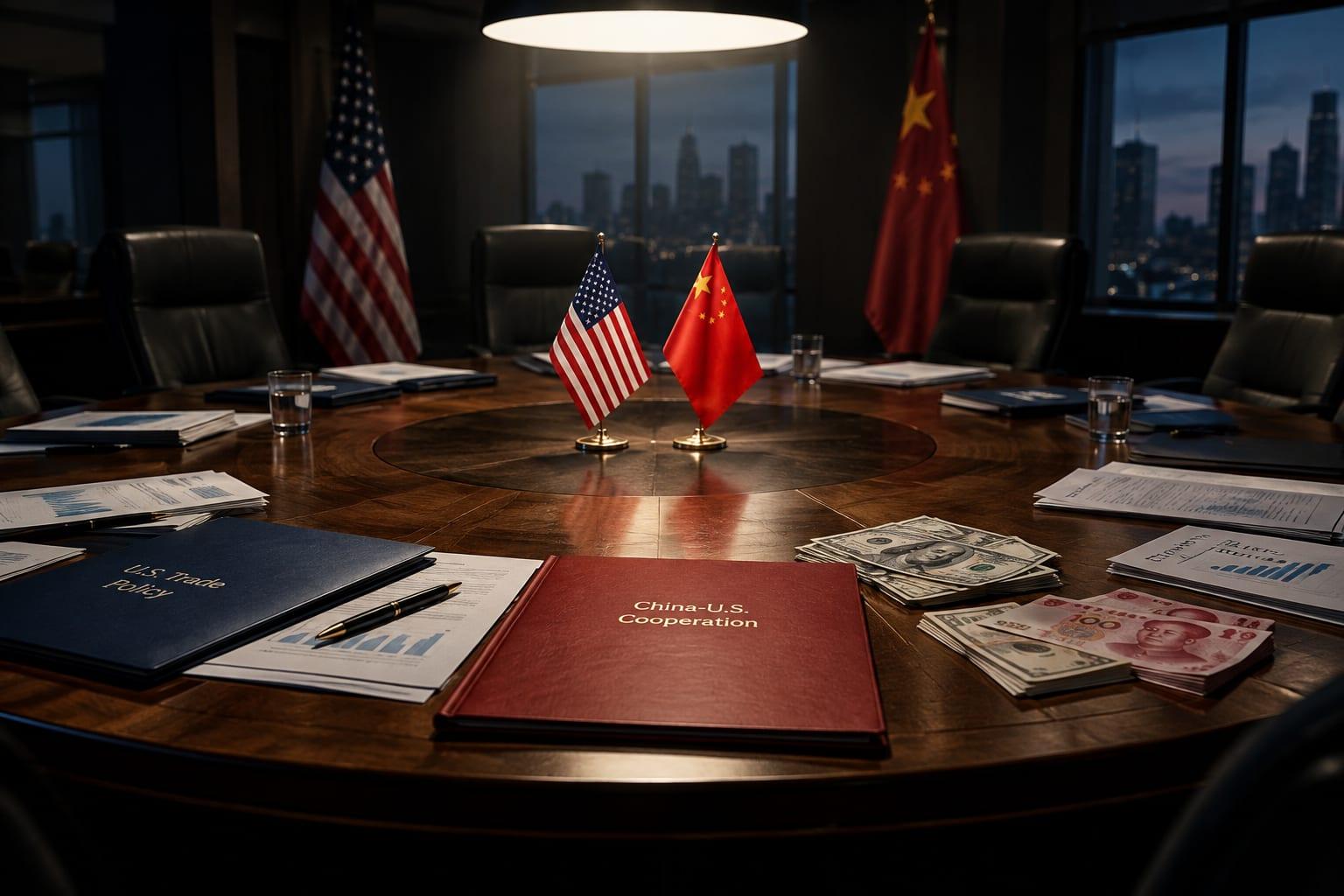
The United States and China have each agreed to cut tariffs on about $30 billion of imports, according to a claim circulating after a meeting between President Donald Trump and Chinese President Xi Jinping. The claim, carried broadly by financial and international news accounts, describes product lists released by both governments as a step toward steadying relations between the two superpower rivals.
@FirstSquawk carried the headline in a post: "U.S. AND CHINA UNVEIL $30B TARIFF CUTS FOLLOWING TRUMP AND XI'S MEETING." The account framed the development as a direct outgrowth of the leaders' summit, and the same framing has been picked up elsewhere.
Bloomberg reported that the two countries detailed a plan to cut tariffs on roughly $30 billion of imports from each side, describing the move as an effort to steady ties following the Trump-Xi summit. Al Jazeera's international trade coverage put the total at $60 billion of trade, noting that Washington and Beijing announced the details of the agreement to reduce tariffs. Benzinga reported that Trump and Xi agreed to favorable tariff treatment covering $30 billion in goods each way, and that the two sides launched AI safety talks alongside an incident communication channel. The Globe and Mail reported that the lists exclude sectors of strategic importance to both countries, and that China's trade surplus is expected to remain elevated.
The sequence matters. The claim originated in the wake of the leaders' meeting, then moved through financial wires and international desks, and is now being repeated by accounts that track trade and macro headlines. Each layer of coverage has added specifics -- product lists, dollar figures, the exclusion of strategic sectors -- while the core claim remains the same: that both governments have agreed to reduce tariffs on a defined set of goods.
What the coverage describes is a mutual reduction. Each country is said to be cutting tariffs on about $30 billion of the other's imports, for a combined $60 billion in affected trade. The lists are said to omit sectors both governments treat as strategically important, which is why analysts cited in the coverage expect China's trade surplus to stay elevated even after the cuts take effect.
The deal is also described as carrying a second track. Benzinga's account ties the tariff agreement to the launch of AI safety talks and an incident communication channel between the two governments -- a mechanism intended to give both sides a way to reach each other if something goes wrong in a domain where miscommunication carries outsized risk. That element has traveled with the tariff claim in the same coverage, though it is described as part of the same announced package rather than a separate agreement.
The accounts carrying the claim span financial wires, international broadcasters and market-focused outlets. @FirstSquawk's post is the most compressed version of the story: a single line tying the tariff cuts directly to the Trump-Xi meeting. Bloomberg, Al Jazeera, Benzinga and The Globe and Mail have each carried longer versions, adding the product lists, the dollar figures and the caveats about strategic sectors and the trade surplus. The spread of the claim across those desks is what has moved it from a summit readout into a broader trade story.
What is not established is the underlying event itself. Next News Network could not independently verify that the tariff cuts have been agreed to, that the product lists have been released, or that the AI safety talks and incident communication channel have been launched. The details above are what is being claimed and reported by the accounts and outlets carrying the story, not independently confirmed facts.
It is also not yet known how the cuts would be implemented, what specific products appear on the lists, or when any reduction would take effect. The Globe and Mail's reporting that strategic sectors are excluded suggests the agreement is narrower than the headline figure implies, but the full scope of what is covered and what is left out has not been independently verified. Whether the arrangement survives contact with either government's domestic politics is likewise unknown.
The reaction so far has been concentrated among trade and financial accounts rather than any single official channel. That is consistent with how the story has moved: from the summit, to the wires, to the desks that cover tariffs and macro, and from there to accounts like @FirstSquawk that compress the headline for a fast-moving audience. The claim is now circulating well beyond the outlets that first detailed it.
For readers tracking the story, the practical question is what the lists actually contain. A $30 billion figure on each side is a headline number; the effect on any given industry depends on which products are named and which are excluded. The reporting so far indicates the strategic sectors are out, which limits the agreement's reach into the areas where the two economies compete most directly. China's trade surplus is expected to remain elevated regardless, according to the coverage.
The AI safety track, if it exists as described, would be a separate channel from the tariff lists. An incident communication channel between the two governments would be a mechanism for crisis management rather than trade, and its inclusion in the same coverage suggests the two sides are trying to keep multiple lines of communication open at once. That, too, is claimed rather than confirmed.
Next News Network will continue to track the accounts carrying the story and any official confirmation or denial from either government. As of now, the tariff cuts, the product lists, and the AI safety talks remain claims circulating in the coverage and on the accounts that have picked them up.
Our Take
The story here is not the tariff number. It is that a summit readout has been converted, within hours, into a $60 billion trade agreement in the coverage, complete with product lists, sector exclusions and a side channel on AI safety -- and that this entire structure rests on accounts repeating one another rather than on anything either government has put its name to in a form we can verify. That is how trade stories move now: a headline, a figure, a caveat about strategic sectors, and a line about the surplus staying elevated, all assembled before anyone has seen the lists. Conservatives should be skeptical of the framing that a deal of this size is automatically a win. Tariff relief on thirty billion dollars each way is real money, but if the strategic sectors are carved out, the concession is in the areas where the two economies are not actually competing, and the surplus stays where it was. The AI safety channel is the part worth watching, because a communication mechanism between Washington and Beijing is a structural change, not a headline. The rest, until someone confirms it, is a claim traveling on other people's reporting.
