
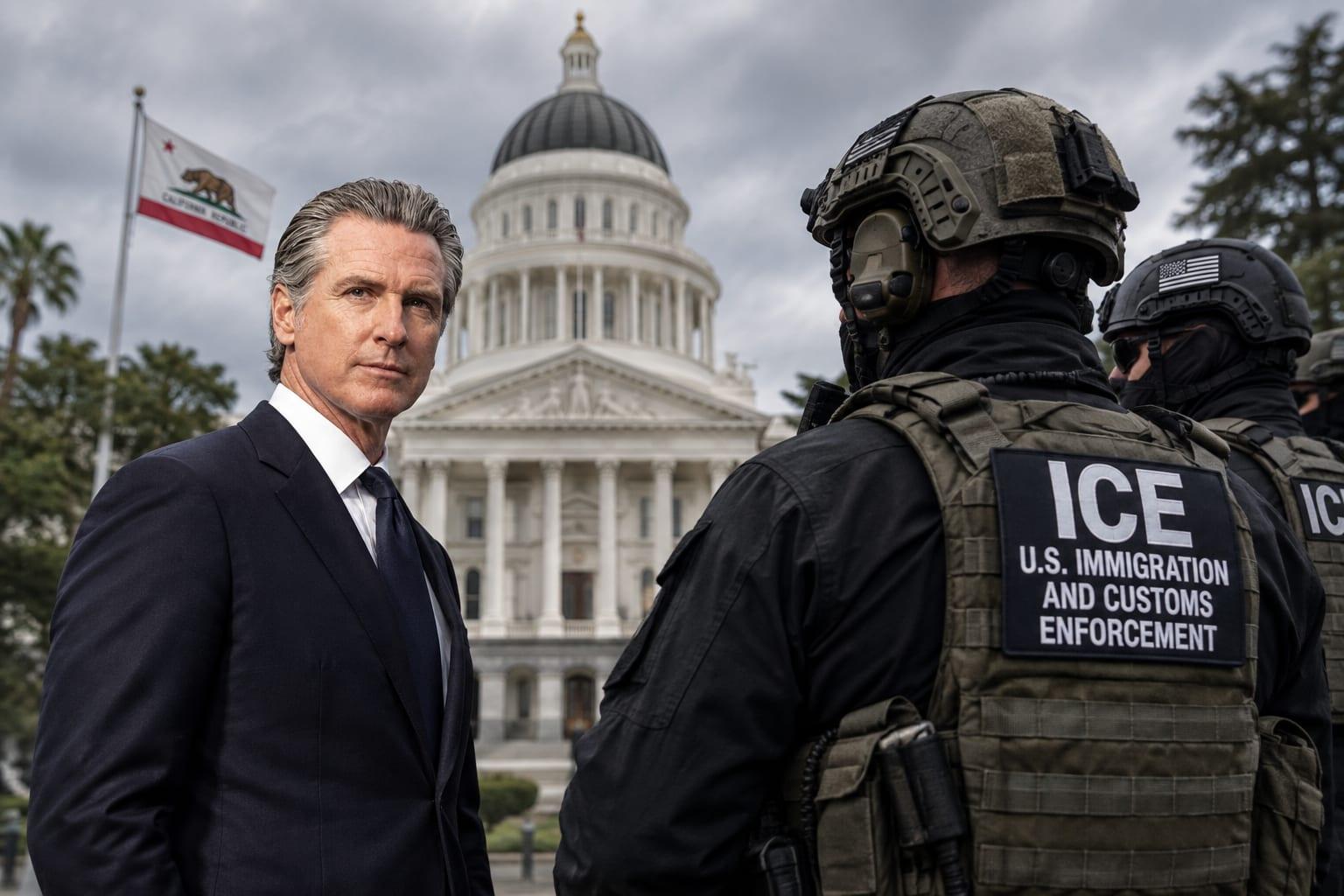
California Gov. Gavin Newsom signed a package of bills Tuesday restricting the tools federal immigration agents can use in his state, and the state's press office spent the day promoting it as a fight against what it called President Trump's "Orwellian immigration tactics used to terrorize people."
The response from a federal prosecutor in Newsom's own state was swift — and dismissive.
Bill Essayli, First Assistant U.S. Attorney for California's Central District, took to X to remind the governor where the line actually sits. "Governor, we've been through this already. If you want to regulate federal agents, you have to win a federal election. Until then, you have no jurisdiction," Essayli wrote, per RedState.
Minutes later, after Newsom's press team touted the flash-bang restrictions in a separate X post — "Gavin Newsom just signed a bill that puts restrictions on the use of flash-bang grenades and explosive breaching charges, including in immigration-enforcement activities," the office wrote — Essayli fired back with the line that gave the exchange its headline: "You're going to write us a ticket?"
What the Bills Actually Do
According to RedState, the package places restrictions on the use of flash-bang grenades and explosive breaching charges, explicitly including in immigration-enforcement activity. It is the latest in a string of California measures aimed at the Department of Homeland Security's operations inside the state.
Newsom framed the signing as a matter of accountability. "This is about stepping up where the federal government has failed our communities," he said. "We will continue protecting our people, upholding the rule of law, and making clear that if the federal government operates in California, we will hold them accountable."
The announcement drew immediate backing from congressional Democrats. Rep. Bennie Thompson (MS-02) wrote that "ICE has demonstrated a pattern of misusing tools and devices, including rubber bullets and chemical sprays, in manners that put the public at greater risk of serious injury or death." Rep. Sara Jacobs (CA-51) went further on the pending DHS equipment question: "This is torture," she said. "No more money for ICE or Border Patrol. Instead, we need to dismantle and overhaul them."
The 'Bee Sting' Fight Behind the Bill
The flash-bang restrictions land as DHS moves to spend up to $20 million on "shock gloves" for ICE agents, as RedState's Teri Christoph reported in August. The gloves stay inert until an officer flips a switch, and backers compare the jolt to a bee sting — intended to break resistance without a prolonged struggle. Supporters describe it as a more efficient taser.
It is that procurement that appears to have most agitated critics in Sacramento and Washington. The bill signing gives California a mechanism to try to constrain how those and other tools are used by federal officers working in the state.
Whether a state can enforce such limits against federal agents is the question that has been litigated and legislated repeatedly, and Essayli's answer was that no state vote can settle it. His message to DHS was effectively to proceed as normal, because a state citation against a federal officer carries no jurisdiction to back it up.
An ironic detail went unmentioned by the bills' supporters Tuesday: school resource officers in districts across the country already deploy comparable less-lethal technology on unruly students. If the standard is acceptable for teenagers in a hallway, critics of the new laws argue, it is difficult to understand the objection when the subject is a resisting criminal alien.
What It Changes, and for Whom
For ICE and Border Patrol personnel operating in California, the practical question is whether the state will attempt enforcement against them in the field — and what form that would take. No mechanism for issuing state citations to federal agents has been described as workable by federal officials, and Essayli's public position is that DHS should not treat the new restrictions as binding.
For California officials, the package is now law, and Newsom's office is promoting it as a signature piece of his resistance posture toward the Trump administration's mass-deportation operation. It is not yet known whether state agencies intend to attempt enforcement against federal personnel or confine the effort to litigation.
What is known is that the two sides are no closer to agreement on who gets to decide how federal officers do their jobs inside a state that has positioned itself as the leading obstacle to the administration's immigration enforcement.
Our Take
Newsom just signed a bill regulating federal agents, and a federal prosecutor in his own state answered with a question that answers itself: you're going to write us a ticket?
That is the whole ballgame. California can pass all the statutes it wants. It cannot hire a state officer who outranks a federal one, and it cannot conjure jurisdiction out of a press release. Essayli did not bother with a legal brief — he skipped straight to the punchline, because the punchline is the law.
It never was.
Meanwhile, the men and women actually enforcing the border are being told by a state with sanctuary policies, catch-and-release practices, and a governor eyeing higher office that they need permission slips to do the job the country elected Trump to do. A $20 million order of shock gloves — a bee sting, not a beating — is now the scandal of the week in Sacramento. That tells you everything about whose safety these politicians actually prioritize.
Federal agents do not need Sacramento's blessing, and DHS should not ask for it. The Constitution and federal supremacy were not suspended at the California line.
So here's the question, patriots: if a state can criminalize the tools federal officers use to remove criminal aliens, what is left of a border at all — and which state tries it next?
