
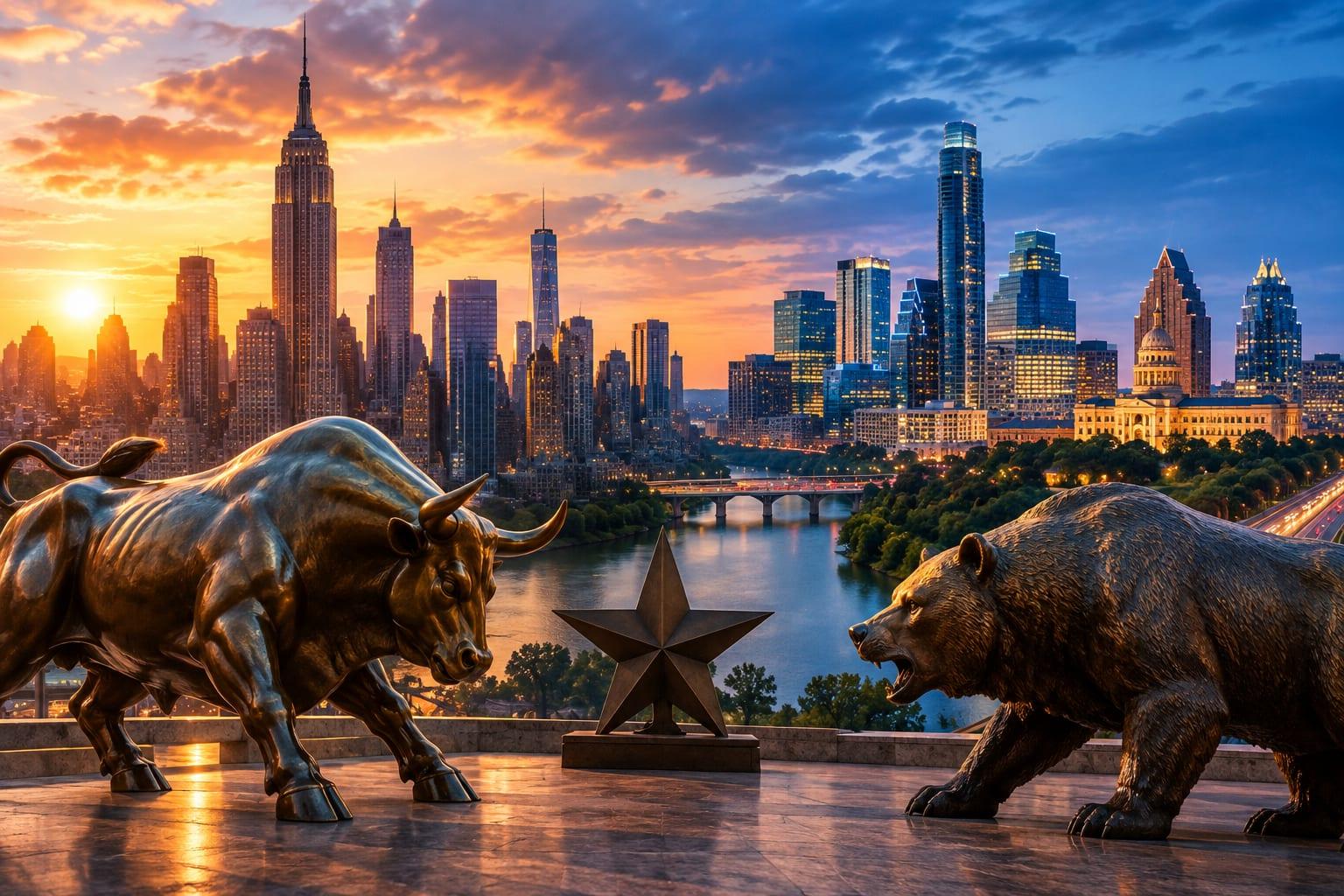
DALLAS — The money is moving south, and Texas is building the infrastructure to keep it there.
The Texas Stock Exchange, which received Securities and Exchange Commission approval last year, is designed to compete directly with the New York Stock Exchange and Nasdaq by giving companies another venue to go public and list their shares. Former House Financial Services Committee Chairman Jeb Hensarling, speaking with Fox News Politics, said the exchange is the capstone on Texas' transformation into the nation's dominant financial hub.
"Texas is really becoming the economic center of gravity in America," Hensarling said.
The exchange has already secured primary listings from Energy Transfer, Dillard's, Sunoco and Texas Capital Bank, according to reporting from WFMD Free Talk. Hensarling pointed to backing from major financial firms including JPMorgan and BlackRock, along with executives recruited away from competing exchanges, as evidence the venture is more than a branding exercise.
"If it was gimmicky, I'm not really sure the competition would be all of a sudden setting up offices here," Hensarling said.
That detail matters. Wall Street's incumbents don't open satellite offices in a state they consider a backwater. They do it when their clients start asking why they need to pay New York prices for Texas operations — no state income tax, a business-friendly regulatory posture, and a growing pool of capital already headquartered within driving distance.
The Listings Are The Point
A stock exchange lives or dies on one thing: whether companies choose to list there. Secondary trading venues can be built cheaply. Primary listings cannot be faked.
Energy Transfer is one of the largest midstream energy companies in the country. Dillard's has been a household retail name for generations. Sunoco is a national fuel distributor. Texas Capital Bank is a homegrown Dallas institution. Together, they signal to other Texas-based public companies that the Lone Star State now offers a viable alternative to the NYSE or the tech-heavy Nasdaq.
The pattern is not isolated to Texas. Companies and capital have been flowing out of traditional financial hubs like New York and California for years, drawn to lower taxes, lighter regulation, and states that don't treat employers as revenue sources to be squeezed or political targets to be punished. The TXSE's approval last year, followed by these early listings, marks the first time in decades that a serious challenger to Wall Street's duopoly has cleared the regulatory starting line.
What It Means For Everyday Americans
A competitive exchange is not an abstraction for finance majors. It means public companies headquartered in the South no longer have to pay New York listing fees, answer to New York analysts, or subject themselves to New York's cultural gatekeeping. It means capital formation happens closer to where the factories, pipelines, and family businesses actually operate.
For workers, it strengthens the case for employers to relocate or expand in Texas rather than keep headquarters functions in higher-cost states. For retirees and retail investors, it offers another venue where their portfolios can participate in regional growth without routing every dollar through Manhattan.
The exchange still faces real challenges. Liquidity begets liquidity, and the NYSE and Nasdaq have spent a century building network effects that will not evaporate overnight. The SEC's approval was a milestone, not a guarantee. Whether the TXSE can attract the volume needed to keep spreads tight and trading costs competitive will be answered over the next several years, not this quarter.
But the direction of travel is clear. Texas is no longer just a place companies move to escape California. It is building the plumbing — exchanges, listings, trading desks, back-office talent — to become the place capital wants to be.
Hensarling's framing is blunt: Texas is the best place to list, incorporate, and headquarter a business. The TXSE is the institution that finally makes that case on paper, in the only language Wall Street understands.
Our Take
For decades, American conservatives were told that if they wanted access to serious capital, they had to play by New York's rules, hire New York's bankers, and accept New York's politics as the price of admission. That deal is dying, and Texas is holding the funeral.
This isn't about Lone Star bravado. It's about the economic logic that blue-state politicians have spent a generation ignoring: tax the job creators hard enough, regulate them deep enough, and prosecute them politically often enough, and eventually they leave. New York and California treated their business base as a captive audience. The TXSE is proof the audience has options.
The exchange's backers put real money behind this. JPMorgan and BlackRock don't throw capital at novelty acts. When executives from rival exchanges jump ship to Dallas, that is a market signal, not a press release.
Patriots should watch what happens next. If the TXSE builds volume, if more household-name Texas companies switch their primary listing, the floodgates open — and every governor who has been bleeding employers to the Sun Belt will have to explain why they didn't build this first.
The question isn't whether Texas can compete with Wall Street. The question is how long Wall Street can pretend it isn't losing.
