
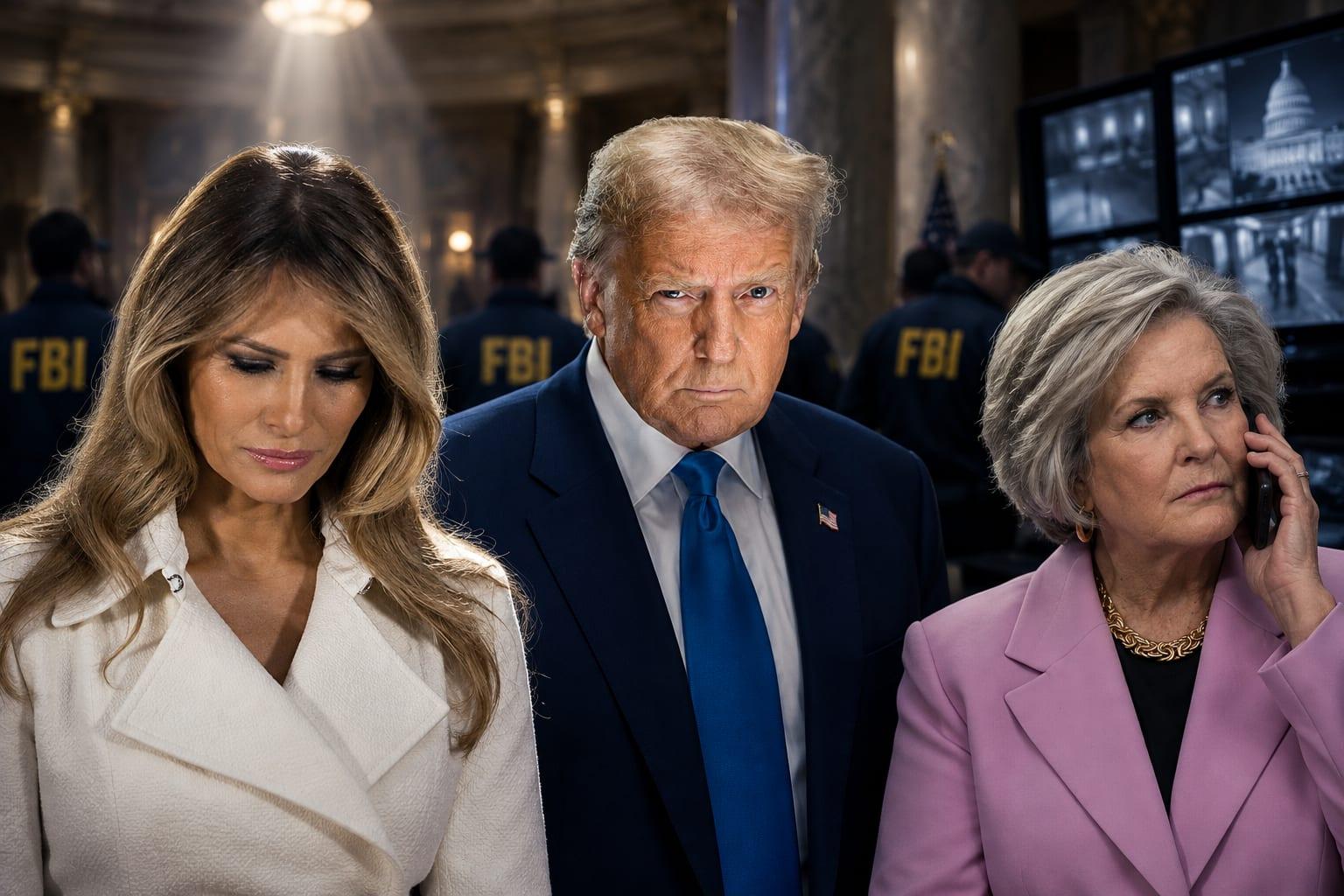
Newly declassified records released Monday by the White House Government Transparency Task Force show the Biden-era FBI tracked the travel of First Lady Melania Trump and Barron Trump as agents planned the 2022 raid on Mar-a-Lago, while a secret surveillance operation monitored the phone contacts of Susie Wiles — then a top Trump adviser, now White House chief of staff.
The records stem from an FBI investigation code-named "Plasmic Echo," the classified documents probe later taken over by special counsel Jack Smith that culminated in the FBI's search of President Trump's Florida residence. According to Fox News, agents tracked the First Lady and First Son's movements while planning that search, and monitored Wiles' calls involving defense lawyers, campaign advisers and journalists.
The surveillance collected call detail records — who called whom, when, and for how long — rather than the contents of the conversations, according to the documents. Reporting by Just the News, cited in coverage of the release, indicates Smith's team used a pen register/trap-and-trace device on Wiles' phone between February and May 2023, logging her contact with at least 21 Trump-affiliated lawyers, campaign personnel, political advisers, and journalists including Just the News founder John Solomon.
One FBI record described in that reporting logged a call from a lawyer identified only as "Lawyer 7" to Wiles at 2:04 p.m., lasting 41 seconds. Washington Examiner coverage of the release says the records show investigators examined communications involving at least five journalists, 21 defense attorneys and several political advisers.
The White House did not mince words about what the documents describe. "Jack Smith's surveillance operation was a disgraceful abuse of government power. Spying on political opponents is weaponization of law enforcement, plain and simple," White House spokesperson Lauren Bis told Fox News Digital. "Those responsible must be held accountable."
The release lands less than a week after Smith faced a contentious Senate Judiciary Committee hearing over tactics used in his separate probe of Trump's challenge to the 2020 election — an investigation known as "Arctic Frost" that included collecting phone-record information involving Republican lawmakers. The Plasmic Echo records released Monday concern the documents case, a separate matter.
Fox News reported that then-FBI Director Christopher Wray recommended opening the Plasmic Echo investigation in 2022, and that it was ultimately approved by then-Deputy Attorney General Lisa Monaco, according to Just the News. The task force releasing the material is led by John Solomon, whose own phone contacts with Wiles appear in the records — a detail that underscores how far the dragnet reached beyond the stated target of the investigation.
Wiles now serves as White House chief of staff in the Trump-Vance administration. The records cover a period when she was steering Trump's 2024 campaign, meaning the surveillance swept up communications with the political operation of the man the investigation was ostensibly about.
Penn register and trap-and-trace orders are not wiretaps. They do not capture what was said. But they map a person's entire web of relationships — every lawyer, every reporter, every political adviser — and they are supposed to require strict legal justification and narrow tailoring. Whether the Wiles monitoring met that bar is now a question for Congress and, potentially, for the courts.
It is not yet known whether anyone at the FBI or Justice Department has been referred for investigation over the surveillance, or whether the task force intends to release additional records from Plasmic Echo. The White House has not said what accountability measures, if any, are under consideration.
Our Take
Read that list again. Twenty-one defense attorneys. Five journalists. Campaign advisers. The First Lady's travel schedule. Barron Trump's movements. This was not a documents investigation. This was a map of Donald Trump's entire world, drawn by the federal government while he was running to take that government back.
Ask yourself the only question that matters: if the FBI had done this to a Democratic candidate's family — tracked the candidate's wife and teenage son, logged the campaign chief's calls to her lawyers and the press — how many hours would pass before every network in America called it a constitutional crisis? We know the answer. It would be wall-to-wall coverage for months. Instead, this release has been greeted with a shrug by the same legacy media outlets whose own reporters' numbers appear in the logs.
Pen register data is metadata, yes. But metadata is how you build the architecture of a political operation. You don't need to hear the words to know who is talking, how often, and to whom — and you don't need to be a constitutional scholar to understand that monitoring a campaign chief's calls to defense counsel is a problem no honest prosecutor should have to explain away.
The people who approved this, who signed off on it, who ran it — Wray, Monaco, Smith's team — owe the American people answers under oath. Not in a friendly hearing room where senators trade soundbites, but in a setting where "I don't recall" is not an acceptable answer. The Trump administration declassified these records for a reason. Now Congress has to finish the job.
Patriots, the lesson here is simple: the administrative state does not stop at the front gate of your house. It goes through your phone, your family's itinerary, your lawyer's contact list. The only defense is sunlight and consequences. Call your representative. Demand hearings. Demand subpoenas. The documents are out — now make them answer for what is in them.
