
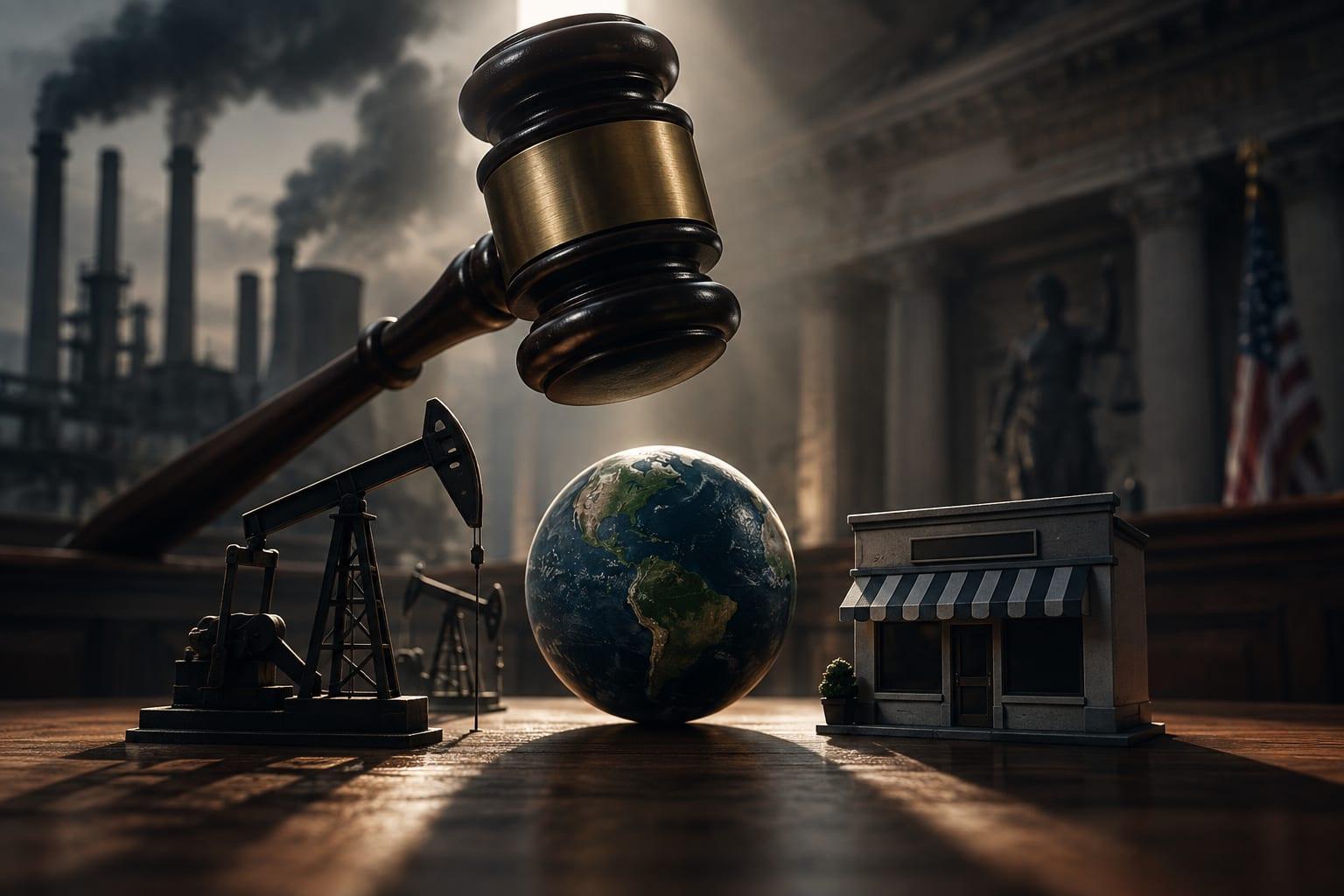
The Supreme Court kicked off its new term Monday with a case that could reshape how climate litigation works across all fifty states — and it has America's energy companies, and the Trump administration, sounding the alarm.
At issue: whether Boulder County, Colorado, can sue ExxonMobil and Suncor Energy in state court over alleged climate damages, or whether those claims must be heard in federal court, where similar suits have already been tossed out. The justices heard nearly two hours of arguments, according to WFMD, and it was unclear afterward how the court might rule.
Justice Samuel Alito recused himself from the case last week after calls to step aside because he owns stock in oil companies — though, as WFMD noted, not in the two companies at the center of Monday's appeal. His absence leaves eight justices and raises the possibility of a 4-4 tie, which would let the Boulder case move forward in state courts without resolving the broader legal question.
Chief Justice John Roberts, widely seen as the deciding vote, pressed both sides hard. He asked Boulder's lawyer, Kevin Russell, whether allowing the case to proceed would trigger a flood of copycat suits. "Just to make sure I have a correct understanding. Presumably, if you prevail, the next day a municipality in every single state will file a lawsuit," Roberts said, according to NBC News.
Justice Brett Kavanaugh picked up that thread and ran with it — warning that the consequences could reach far beyond oil companies.
"It is going to bankrupt – if there are enough of these [lawsuits] — bankrupt these various defendants and certainly other defendants out there. Anyone is a potential defendant for a suit like this. Any manufacturer, any business," Kavanaugh said, per WFMD.
That's the crux of the fight."
The Trump administration has sided with the energy companies, arguing the litigation is a power grab intended to impose regulations on emissions through the courts rather than through elected lawmakers, the Associated Press reported. About two dozen similar lawsuits have been filed by cities and counties around the country, and the outcome here could determine whether they live or die.
Boulder officials say they face escalating costs from wildfires, extreme heat, drought and worsening air pollution, and they claim the energy firms misled the public about the climate impact of their products. The lawsuit, brought under state law, is still in its early stages and seeks money damages. Colorado experienced multiple fires and extreme heat this summer, per NBC News.
CBS News framed the broader stakes in a post on X: "The Supreme Court on Monday grappled with a complex dispute involving an effort by the city and county of Boulder, Colorado, to hold energy companies accountable for the effects of global climate change."
But the legal question before the court Monday wasn't about whether climate change is real or who's responsible. It was about jurisdiction — who decides, and where. The Colorado Supreme Court allowed Boulder's case to proceed, and the energy companies appealed, arguing the matter belongs in federal court. The U.S. Supreme Court will also decide whether it even has jurisdiction to review that decision, according to WFMD.
The case is just the opening act of a term packed with fights that will define the limits of federal power. The court will also take up challenges to state bans on semiautomatic rifles like the AR-15 — about a dozen states have enacted such bans, and challengers say they violate the Second Amendment, per the Associated Press. That case will be argued in December.
The justices are also expected to weigh in on President Trump's immigration crackdown, religious rights, voter citizenship requirements and abortion access, CBS News and the AP reported. Several battles over Trump's second-term agenda are waiting in closed-door conferences and could be decided by summer 2027.
Our Take
Let's be clear about what's actually happening here. This isn't about clean air or saving the planet. It's about trial lawyers and activist local governments trying to do through the courts what they could never do through Congress — impose a national energy tax by suing every producer, refiner and manufacturer in America into oblivion.
Kavanaugh nailed it. If Boulder wins, the next day a municipality in every state files suit. Then another. Then another. And it won't stop with oil companies. Any business that makes anything, moves anything or sells anything becomes a target. That's not environmental policy. That's extortion with a gavel.
The Trump administration is right to back Exxon and Suncor here. Climate policy belongs with the people's elected representatives in Washington — not with county commissioners in Colorado and a patchwork of state judges who can bankrupt entire industries on a whim.
Energy companies are trying to stop a handful of local officials from weaponizing the courts to destroy the American economy. There's a difference, and it matters.
The Supreme Court has a chance to shut this down before it spreads. Patriots should be watching this case closely — because if the justices get it wrong, the bill lands on every American family's kitchen table.
What do you think? Should one county be able to sue an entire industry out of existence? Let us know.
