
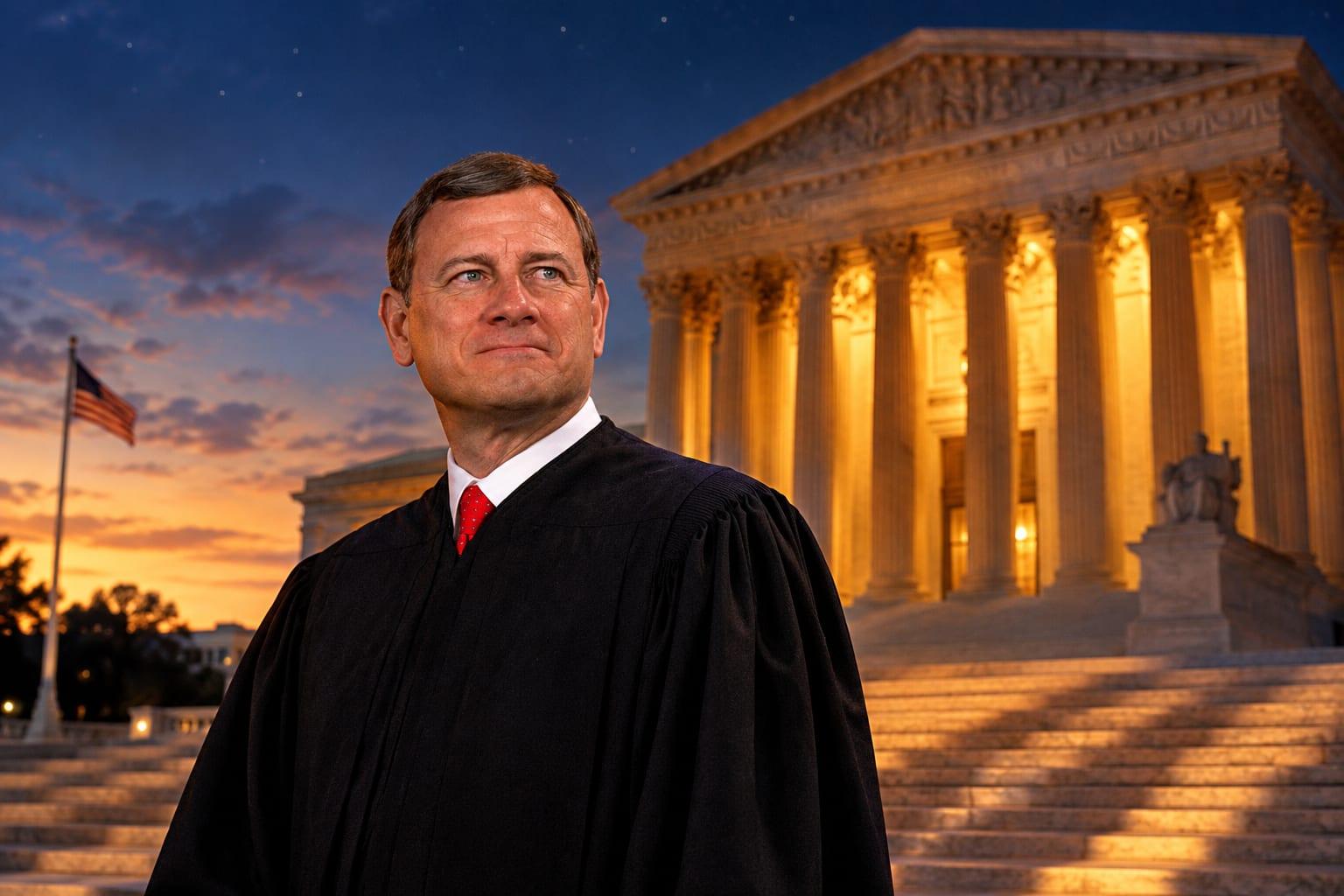
Chief Justice John Roberts handed the Federal Communications Commission a temporary victory Thursday, granting an administrative stay of a Fourth Circuit Court of Appeals order that would have forced the agency to issue a final ruling on revised political advertising rate rules by noon Friday — a 48-hour deadline the appeals court imposed Wednesday.
The underlying fight is about who gets to pay the lowest unit charge for television airtime in the closing weeks of the midterm elections. In March, the FCC's Media Bureau issued guidance stating that political parties and certain joint fundraising committees buying ads in coordination with candidates could qualify for the same discounted rates that candidates themselves receive. Four Democratic congressional candidates — Sherrod Brown of Ohio, Jon Ossoff of Georgia, Roy Cooper of North Carolina, and Kristen McDonald Rivet of Michigan's 8th District — challenged that guidance, according to the Washington Examiner and reporting at the SCOTUS-focused blog SmoosieQ.
The money at stake explains the urgency. Republicans hold a significant cash advantage at the party committee level, while Democratic candidates hold an edge in individual campaign accounts. The FCC's revised rule would let party committees and joint fundraising committees stretch those dollars further by unlocking candidate-level ad rates.
The candidates first asked the full FCC to review the guidance, but before the agency ruled, they also took their challenge to the Fourth Circuit. In August, a divided three-judge panel sided with the candidates and set aside the FCC guidance. The National Republican Congressional Committee and National Republican Senatorial Committee then sought emergency relief from the Supreme Court.On September 4, the Supreme Court stayed the Fourth Circuit's ruling, concluding the appeals court likely lacked jurisdiction because the FCC had not yet decided the candidates' pending administrative challenge. Under the Communications Act, the Court explained, an aggrieved party must wait for the agency to act before going to court.
Four days after that ruling, the candidates returned to the Fourth Circuit seeking a writ of mandamus — an extraordinary order compelling a government official or agency to perform a legally required duty. On Wednesday, the same 2-1 majority ordered the FCC to decide the candidates' application by noon Eastern on Friday, just 48 hours after issuing its ruling.
By Thursday, U.S. Solicitor General John Sauer was asking the high court to step in for the second time in just over a month, and Roberts granted the administrative stay. An administrative stay is temporary — it preserves the status quo while the full Court considers whether to grant more lasting relief — but it immediately halts the Fourth Circuit's Friday deadline.
The case is the second time this election season that a federal appeals court has pushed the Supreme Court to intervene on election-adjacent questions. Reporting from SmoosieQ described the Eighth Circuit as having taken the high court "on a wild ride" earlier in the cycle before the Fourth Circuit did the same.
It is not yet known whether the full Supreme Court will grant a longer stay or take up the underlying jurisdictional question. The FCC has not issued a final ruling on the candidates' administrative challenge. Democratic congressional candidates who brought the suit argue the revised rule exceeds the agency's authority and tilts the playing field toward party committees — a claim the FCC and Republican committee intervenors dispute.
With early voting already underway in several states and the airwaves saturated with midterm advertising, the practical effect of Thursday's order is that the FCC's March guidance remains in force for now, and party committees can continue purchasing coordinated ads at the favorable rate while the litigation plays out.
Our Take
Read the Fourth Circuit's conduct closely, and the tell is in the calendar. A 2-1 majority gave the FCC 48 hours to resolve a question that had been pending for months — a timeline that had nothing to do with careful review and everything to do with the Nov. 3 election. When a court manufactures an emergency in the middle of an ad-buy window, the emergency isn't legal. It's political.
This is the second time in five weeks the Supreme Court has had to tell an appeals court to slow down. In September, the justices said the Fourth Circuit likely had no business ruling before the FCC acted. The panel's answer, four days later, was to order the FCC to act on a 48-hour clock — the same jurisdictional problem, dressed up as a mandamus petition. Roberts didn't have to accept that premise, and he didn't.
Democrats tell this story as a fight about fair rules. It isn't. They are defending a money advantage that the FCC's guidance would erode — a rule that treats a coordinated party ad buy the same way the law has long treated a candidate's own buy. Nothing in the Communications Act gives one party's campaign structure a permanent discount while squeezing the other's. If Democrats wanted to win this argument on the merits, they'd let the agency finish its work and then challenge the result in court, in order, on the record. Instead they keep racing to a friendly panel and daring the Supreme Court to stop them.
Roberts stopped them. That is the whole ballgame for now — and it means the party committees, and the ads Americans are already seeing, stand on firmer ground heading into the homestretch. The full Court still has to decide whether to make that stay stick. Patriots should watch what the Fourth Circuit does next, because the panel has already shown it isn't finished.
