
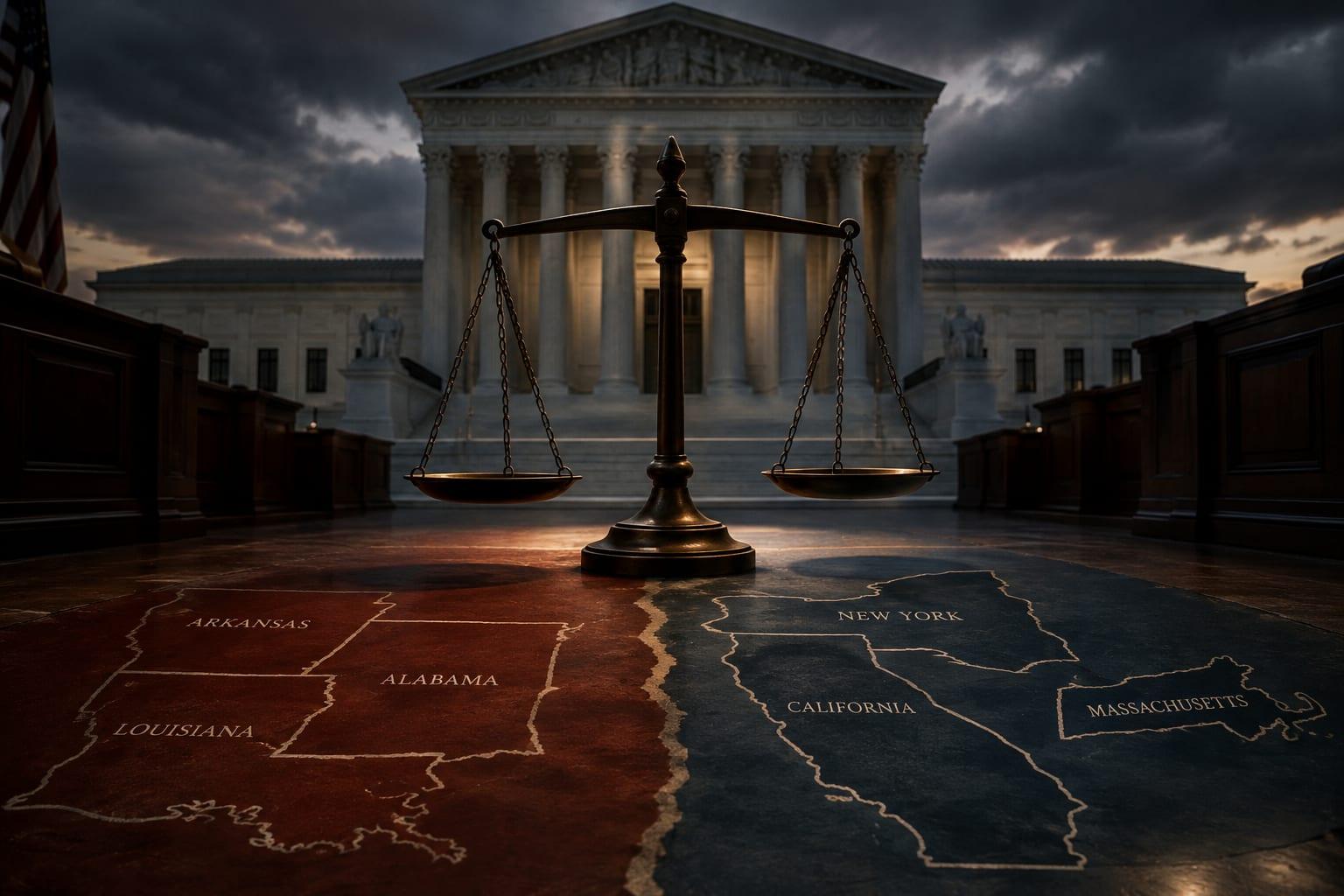
Louisiana Attorney General Liz Murrill, joined by Alabama Attorney General Steve Marshall and Arkansas Attorney General Tim Griffin, sued New York, California and Massachusetts at the Supreme Court on Wednesday, alleging their shield laws block cooperation with investigations into abortion-pill providers, according to reporting by Fox News Politics. In a separate Louisiana lawsuit filed the same day, the attorneys general targeted more than 30 people and organizations accused of advertising, prescribing, dispensing or shipping abortion pills into their states.
Murrill did not mince words about what she says is at stake. "These shield laws are very comprehensive," she said, arguing that California and New York prohibit officials from assisting other states seeking to enforce judgments stemming from abortion-related conduct. "We are going to take down those laws using every tool that we have at our disposal."
The fight is not theoretical. Louisiana has already indicted New York physician Margaret Carpenter and California physician Remy Coeytaux over allegations that they prescribed abortion drugs that were sent into Louisiana. New York Democratic Gov. Kathy Hochul and California Democratic Gov. Gavin Newsom have refused to extradite the doctors.
The Supreme Court complaint cites Louisiana's unsuccessful effort to extradite Carpenter, noting that Hochul declared there was "no way in hell" she would comply with Louisiana's request. The filing says New York later strengthened its shield law, including by allowing prescribers of abortion drugs to keep their names off prescription labels. Newsom similarly rejected Louisiana's request to extradite Coeytaux in January, saying California would not help other states punish doctors for providing abortion access that is legal in California.
What the Complaint Alleges
The 100-page complaint alleges providers used online questionnaires to obtain information from customers before abortion drugs were mailed into states where their distribution is prohibited. Fox News Politics reports that the states allege some organizations were involved in advertising, prescribing, dispensing or shipping the pills. Louisiana's separate suit names more than 30 people and organizations, according to the same reporting.
The two lawsuits, both filed Wednesday, are the latest move in a widening state-by-state fight over abortion. That conflict has grown since the Supreme Court's 2022 ruling in Dobbs v. Jackson Women's Health Organization, which struck down Roe v. Wade and gave elected officials the power to set abortion policy in their states.
The Supreme Court filing effectively asks the justices to decide whether one state's voters can define their own laws while another state's officials refuse to lift a finger to help enforce them. It is not yet known whether the Court will take up the case or how soon it might act. The attorneys general argue the shield laws amount to interstate obstruction; the defendant states have previously argued they will not aid prosecutions they consider unjust.
Why This Matters Beyond Abortion
Strip away the abortion politics and what remains is a question about the structure of American government: can a state nullify another state's criminal law simply by passing its own statute refusing to cooperate? For decades, the left cheered when blue states and cities declared themselves "sanctuaries" on immigration, refusing to help federal agents. Republicans warned then that the precedent cut both ways. Now the bill is coming due, and California, New York and Massachusetts are the ones insisting their laws should be respected across state lines.
Consider what this would mean for issues conservatives care about. If a state can shield anyone who violates another state's laws from across a border, why would that logic stop at abortion pills? Second Amendment cases, business regulations, election integrity investigations, tax enforcement — all of it depends on states cooperating with one another. Treat a state's criminal statute as optional and the whole system starts to rot from the inside.
The drugs themselves are not benign. Abortion pills obtained through an online questionnaire and shipped through the mail mean no examination, no ultrasound, no physician in the room when something goes wrong. Emergency rooms in Louisiana, Alabama and Arkansas are left to handle the bleeding — and the complications — of a transaction that began with a few clicks and a mailed package. That is what the attorneys general say happened in these cases, and that is what they are asking the Court to stop.
Democrats will frame this as an attack on women. It is not. It is an attempt to make one state's law mean something again, and to stop a constellation of websites, prescribers and shipping services operating as an unregulated interstate pharmacy with no accountability to anyone.
Our Take
This is exactly the fight the Supreme Court needs to settle, and it is exactly the fight the GOP has been too hesitant to force for years. Kathy Hochul says "no way in hell" she will honor another state's extradition request. Gavin Newsom says California will not help enforce laws it does not like. That is not federalism. That is nullification with a nicer logo — and it is precisely the doctrine the left spent four years cheering when it was used against ICE, against grand juries, and against Republican prosecutors.
Louisiana's attorney general is not asking California to ban anything. She is asking California not to stand in the way when Louisiana enforces its own law inside its own borders. If New York and California can write their own rules for the whole country by refusing to cooperate, then the Union is not fifty sovereign states — it is a handful of coastal governors with veto power over everyone else.
Watch what happens next. If the Court takes this case, it will not just be about a pill that arrives in the mail. It will be about whether the Constitution still means what it says about the states. Patriots should be paying attention — because the same shield-law playbook is already being written for the next issue the left decides to protect. If the states can nullify Louisiana's law today, what stops them from nullifying yours tomorrow?
