
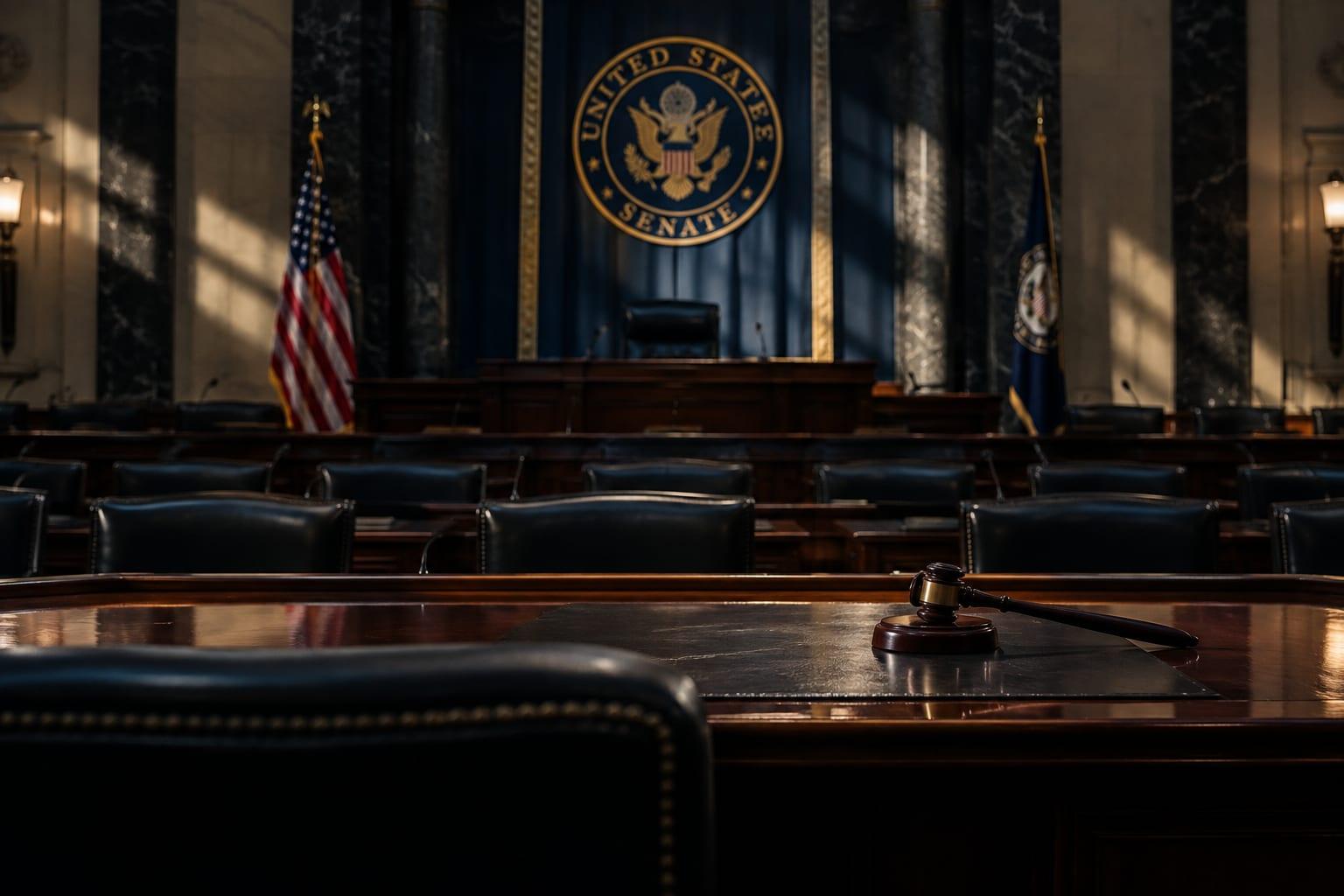
The Senate voted fifty-three to forty-seven along party lines to deny the sixty votes needed to advance a Republican-backed bill that would have barred members of Congress, their spouses and dependent children from purchasing individual stocks and would have established a photo voter ID requirement, according to the account @gatewaypundit, which called the outcome a defeat for the measure.
The procedural vote drew immediate pushback from conservative commentators, who described the result as Democrats protecting both their own trading activity and what they call lax election rules. The account @libsoftiktok wrote shortly after the vote that "every Democrat in the Senate just voted to BLOCK a bill banning stock trading in Congress, which also had a requirement for Voter ID attached," adding that "Democrats want to cheat in the elections."
The account @GuntherEagleman, posting before much of the reaction had circulated, responded to the same tally by calling for the elimination of the Senate's sixty-vote threshold altogether. "NUKE THE FILIBUSTER," the account wrote, claiming that "every Senate Democrat just voted against photo voter ID and against banning stock trading for members of Congress." The post noted that the bill received fifty-three votes and still failed because of the sixty-vote rule, and asserted that "Democrats will never protect our elections or stop their own insider" trading.
The account @RealAmVoice carried the story with a breaking-news post saying that "Senate Democrats block insider trading, voter ID bill" and reporting that the chamber voted fifty-three to forty-seven along party lines, short of the sixty votes needed to advance a bill restricting new stock purchases by lawmakers and their families while requiring voter ID.
The network's post also included a transcript of the Senate proceedings. In it, the presiding officer announces that "the motion is not agreed to," after which the clerk reports the cloture motion: "We, the undersigned Senators, in accordance with the provisions of Rule 22 of the Standing Rules of the Senate, do hereby move to bring to a closed debate on the motion to proceed to counter number 684HR9340, an act to amend the Public Utility Regulatory Policies Act of 1978 to establish a federal standard relating to the recovery of the full incremental costs of upgrades that serve large load customers and for other purposes, signed by 17 Senators."
The underlying substance of the bill was described in similar terms across several outlets. The Washington Times reported that Senate Democrats on Wednesday blocked a House-passed bill to ban the purchase of individual stocks by members of Congress. The Daily Caller reported that legislation aiming to ban members of Congress from insider trading failed to meet the necessary sixty-vote threshold after Democrats voted against it.
The accounts pushing the reaction were not the only ones weighing in. The New York Times described the vote as a Republican measure that would limit, but not bar, congressional stock trading, and framed the outcome as Democrats denying Republicans a pre-midterm win on an issue the paper said has rankled voters. CBS News reported that Democrats said the restrictions do not go far enough and pushed back against the voter ID provision attached to the bill. POLITICO similarly reported that opponents argued the bill did not go far enough in cracking down on lawmaker trades.
Reporting ahead of the vote indicated the Senate was expected to take up both the stock trading ban and a separate measure addressing data center-related utility costs before the election recess, amid Democratic opposition.
Conservative accounts framed the outcome differently, treating the vote as a single act of obstruction covering two separate issues. @libsoftiktok tied the stock trading provisions directly to the voter ID language in its post, characterizing the vote as an effort to undermine election security. @GuntherEagleman treated the sixty-vote threshold itself as the central grievance, arguing that the bill's fifty-three-vote majority should have been sufficient to pass it and calling for the filibuster's removal.
The competing explanations for the vote were not addressed in the same breath by either side. According to the coverage cited above, Democratic senators opposed the measure on the grounds that it did not go far enough to prevent corruption, and separately objected to the voter ID provision. The conservative accounts quoted here did not engage with that argument, instead presenting the vote as a straightforward refusal to act on either issue.
It is not yet known whether Senate leadership intends to bring a revised version of the measure back to the floor before the recess, or whether the sixty-vote threshold will remain the mechanism that decides its fate. Next News Network could not independently verify the claims made in the social media posts cited in this report.
The vote comes as members of both parties have faced sustained public scrutiny over their personal financial holdings, an issue that has polled strongly across the political spectrum. The House-passed version of the bill would have restricted new stock purchases by lawmakers while leaving existing holdings in place, a structure that critics in both chambers described as insufficient.
Our Take
Fifty-three senators voted to stop members of Congress from trading individual stocks and to require photo identification at the ballot box. Forty-seven voted no. That is the entire story, and it is the reason the reaction spread so fast across conservative accounts within minutes of the gavel. When a bill that polls well with nearly every voter in the country dies on a procedural motion, the people who killed it do not get to lecture anyone about process.
The Democratic objection that the bill did not go far enough is the oldest trick in the Senate playbook: vote no on a half-measure, then blame the other side for the fact that nothing passed. If senators genuinely wanted a stronger ban, they had every opportunity to offer amendments. Instead, they supplied the votes that sent the bill to the floor of the chamber where good ideas go to die, and then explained afterward that the bill they just killed was not pure enough.
The voter ID provision is where the argument collapses entirely. Attaching it to the stock trading ban was a political move, and everyone knew it. But that does not change the fact that opposition to photo identification at the polls is not a serious governing position in a country where you need an ID to board a plane, buy a beer or enter a federal building. Republicans wanted Democrats on the record on both issues before the midterms, and they got what they wanted.
Which brings us to the filibuster. Fifty-three votes is a majority in any normal legislative body. In the modern Senate, it is a participation trophy. The sixty-vote rule has become a shield that lets both parties avoid accountability on the issues their voters care about most, and the people now calling loudest for its removal will be the first to rediscover their love for it the moment the other party holds the gavel. That is not a moral failing unique to Democrats. It is a structural one that both parties have spent decades exploiting.
The one thing every senator in that chamber agrees on is that the rules should make it hard to force them to change. That is why the stock trading ban failed, and it is why it will fail again the next time it is brought up, no matter which party is nominally in charge.
