
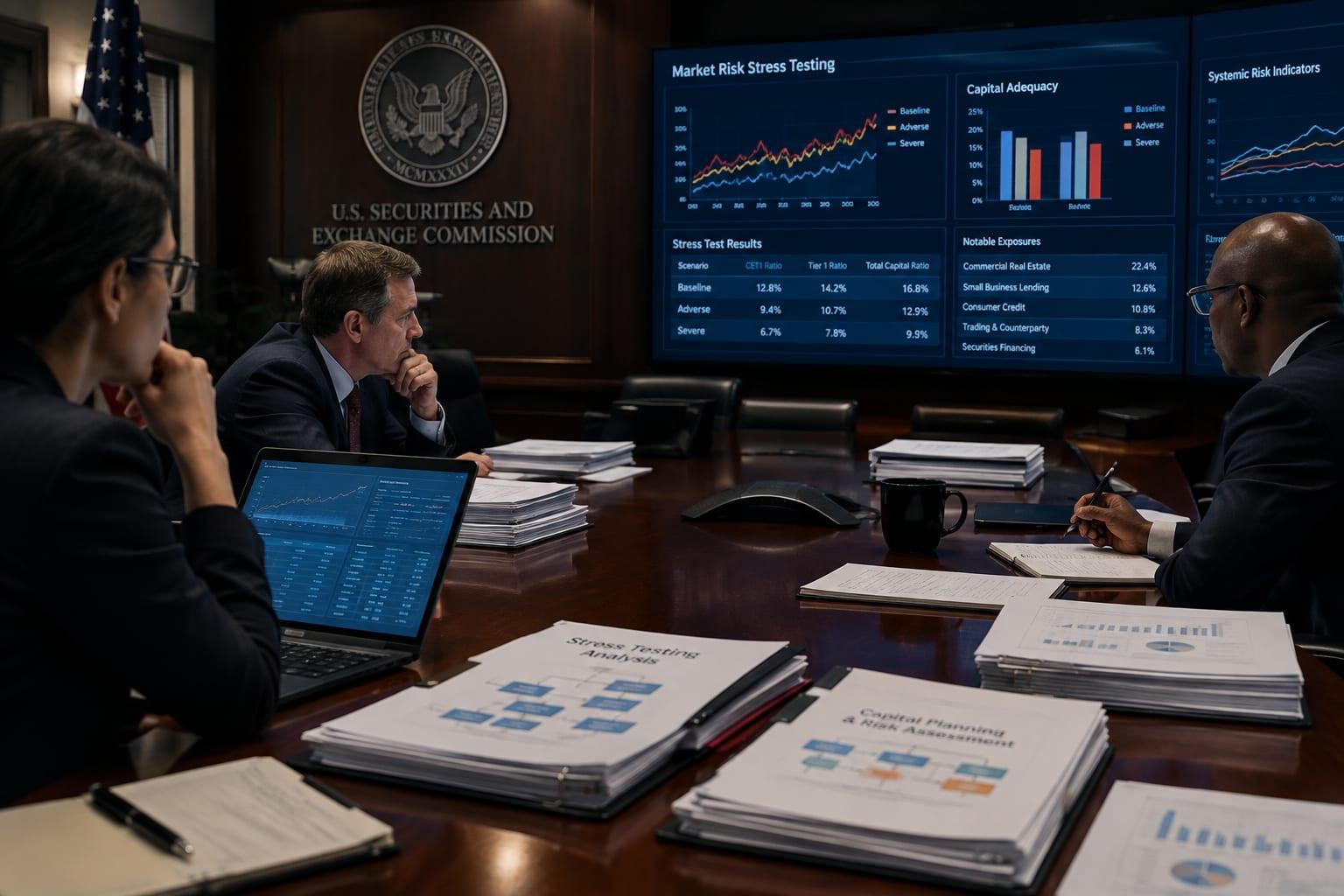
The Federal Reserve Board announced Tuesday it has finalized changes to its annual bank stress test framework, saying the revisions will improve transparency and public accountability while reducing the volatility of stress-test-related capital requirements imposed on large banks.
The announcement, published on the Fed's own website, caps a review process that had drawn intense attention from Wall Street, community banks, and critics of the central bank's regulatory reach. According to the Fed, the changes are aimed at making the stress testing process more predictable for financial institutions while giving the public a clearer view into how the central bank judges bank health.
The Fed's stress tests — first launched in the aftermath of the 2008 financial crisis — determine how much capital the largest banks must hold against potential losses in a severe economic downturn. Those capital requirements directly affect how much money banks can lend, invest, and return to shareholders.
What Actually Changes
Under the finalized framework, the Fed says it will provide greater clarity on the models and scenarios used to evaluate bank balance sheets, reducing the year-to-year swings in capital requirements that banks have long complained make long-term planning nearly impossible.
According to the Fed's announcement, the goal is twofold: enhance the transparency and public accountability of the stress testing regime, and cut down on the volatility that has turned capital planning into a guessing game for major financial institutions.
The Fed has not yet published the full text of the final rule as of Tuesday morning, and it is not yet known whether the changes will apply beginning with the next stress testing cycle or take effect on a delayed schedule.
The K-Shaped Economy Problem
The Fed's announcement lands as Americans' financial health continues to diverge sharply. Reporting from EUROPE SAYS, citing economic data, describes a "K-shaped" economy in which wealthier households have recovered strongly while working-class families remain squeezed by elevated prices, high borrowing costs, and stagnant real wages.
That divergence matters because stress tests are supposed to be the firewall against another 2008-style collapse. If the Fed's models fail to capture the strain on ordinary borrowers — credit card delinquencies, auto loan defaults, commercial real estate exposure — then a cleaner, more transparent stress test process is only as good as the assumptions baked into it.
Why Conservatives Have Been Watching
The Federal Reserve has been a target of sustained criticism from the right for years. The central bank holds trillions in assets accumulated during successive rounds of quantitative easing, sets interest rates that affect every mortgage and small business loan in the country, and operates with a degree of independence that critics argue has become insulation from accountability rather than protection from political pressure.
On Capitol Hill, Republicans have repeatedly pushed legislation to audit the Fed, expose its internal deliberations, and force greater disclosure around how its regulatory decisions are made. The stress test framework has been a particular flashpoint, because banks that fail or barely pass can face restrictions on dividends and buybacks — decisions that can move markets and affect millions of retirement accounts.
Whether Tuesday's finalized changes will satisfy those demands is an open question. A more transparent process is not the same as a smaller or less powerful one. The Fed still decides the scenarios. The Fed still runs the models. The Fed still determines which banks pass.
What It Means for Everyday Americans
For most Americans, stress tests feel abstract. They are not. The capital requirements that come out of these exercises influence whether a bank tightens lending in your town, whether a small business gets a line of credit, and whether mortgage rates move up or down based on how banks are managing their balance sheets.
If reduced volatility makes it easier for banks to lend and plan, that could be a modest positive for Main Street. If it simply makes it easier for the biggest institutions to game the process and return more capital to shareholders while quietly carrying more risk, then it is a different story entirely.
Conservative economists and Fed critics have long argued that the central bank's regulatory apparatus is opaque by design — that complexity protects the institution from oversight and keeps the public in the dark about decisions that carry enormous consequences.
Our Take
Let's be clear about what Tuesday's announcement is and what it isn't.
It is the Federal Reserve acknowledging — quietly, in bureaucrat-speak — that its stress test process has been too opaque and too volatile for too long. That is a concession that critics have been demanding for years, and it should be welcomed as such.
But this is not reform. This is the Fed polishing its own windows while keeping the vault locked. The same institution that ran trillions in asset purchases, that missed the inflation surge of the early 2020s, and that operates with virtually no external audit power, is now promising to be more transparent about how it grades bank health.
Patriots, ask yourselves: if the Fed were serious about accountability, why has Congress still not been allowed a full, unrestricted audit of its operations? Why do the biggest banks always seem to get the benefit of the doubt while community banks get buried in compliance costs?
The K-shaped economy is the real stress test. Working-class Americans are failing it every month, and the Fed's models still can't see them.
Bottom line: a step toward transparency is a step in the right direction. But we've seen this movie before. The administrative state doesn't give up power voluntarily — it recycles it, rebrands it, and sells the packaging as reform. Watch what the Fed actually does when the next crisis hits. That's the only stress test that matters.
