
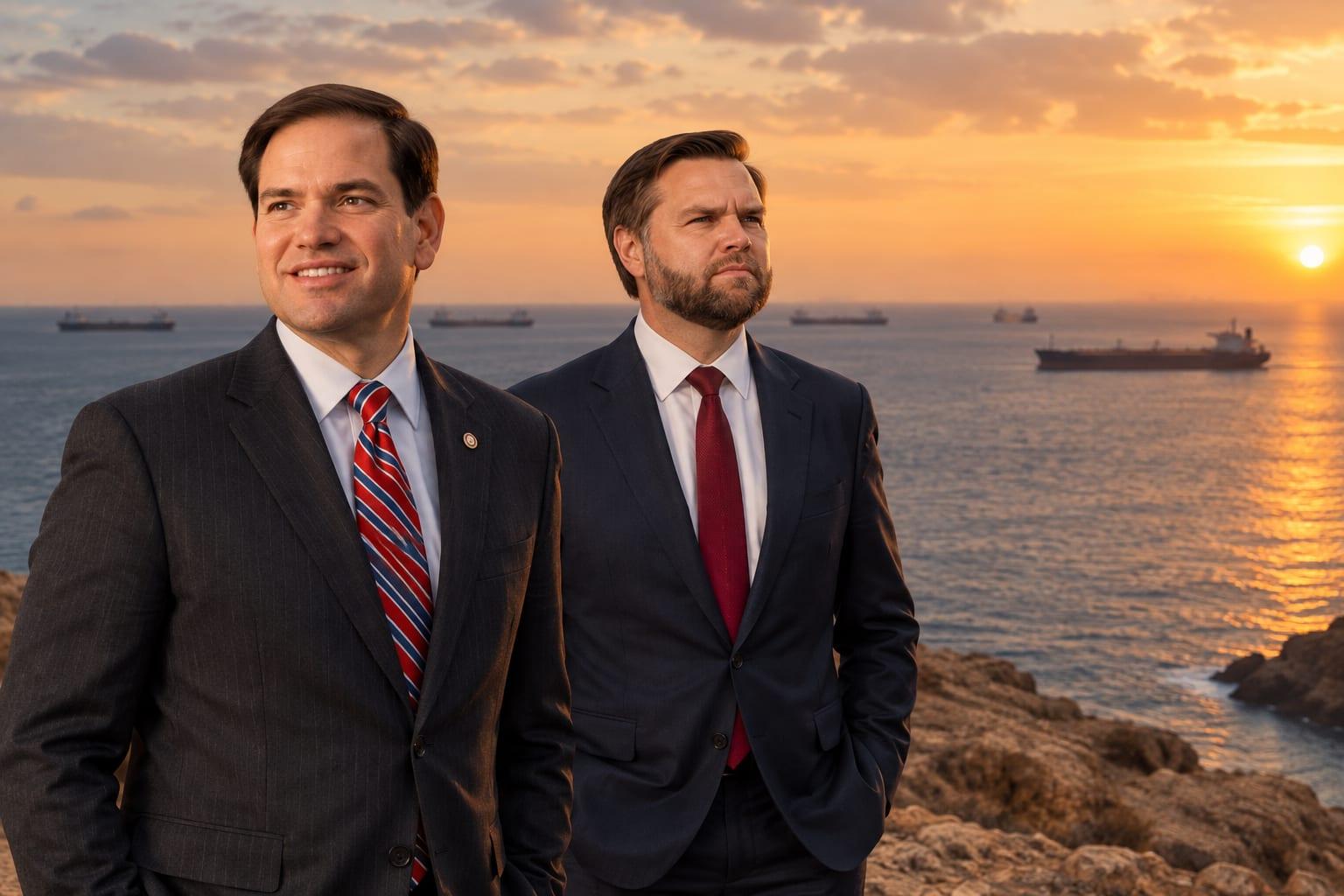
Secretary of State Marco Rubio said Wednesday that Iran has "lost complete control" of the Strait of Hormuz, the narrow waterway between the Persian Gulf and the Gulf of Oman that carries roughly a fifth of the world's oil supply, and he described the Iranian economy as being in "freefall" under American sanctions.
Speaking during a visit to Greece, Rubio said the Islamic Republic's position at the chokepoint has deteriorated to the point that it can no longer dictate the terms of commercial passage. "Iran has lost complete control of the Strait of Hormuz," Rubio said, according to accounts of his remarks. He added that "crippling" sanctions have pushed the Iranian economy toward "a place few countries in the world have been."
The comments were carried by the Gulf-based news account @FirstSquawk, which told its followers Wednesday morning that Rubio had stated Iran has lost control of the strait and that oil flow through the waterway is almost unchanged since the war began. Regional outlets including JFeed and This Is Beirut, along with the National Security Journal, quickly amplified the secretary's characterization.
The assessment echoed remarks from Vice President JD Vance, who told Reuters in an interview that while Iran periodically strikes commercial ships in the strait, it is "largely unable to prevent oil exports through the waterway." The @JavierBlas account relayed Vance's comments Wednesday, framing them as the administration's read on Tehran's remaining leverage over global energy traffic.
Maritime traffic data cited in the coverage suggests why the administration is making the argument. Gulf oil exports climbed back to roughly four-fifths of prewar levels in September, according to the National Security Journal, as operators leaned on Saudi pipelines, Emirati terminals and ship-to-ship transfers to route crude around Iranian attacks. Iran's own exports, meanwhile, stand at zero under the American blockade, and Saudi Aramco is reportedly weighing a discount to hold onto market share.
The picture is not entirely calm. Nearly twenty commercial vessels, mostly tankers, have come under attack over the past month while transiting the Hormuz choke point, and analysts quoted in the same coverage warned that rebounding exports remain vulnerable to stepped-up Iranian tanker attacks. The administration's public position is that those attacks have not translated into the ability to shut the waterway down.
That gap between what Iran can still do and what it can no longer achieve is at the center of the message coming out of Washington this week. Rubio's framing in Greece went further than a narrow military assessment: by tying the strait to the broader condition of the Iranian economy, he presented the loss of control as a symptom of sanctions rather than a battlefield development alone. The secretary's suggestion that Iran's economy is approaching conditions rarely seen internationally left the specific benchmark unstated.
The sequence of statements followed a recognizable pattern for the administration. Vance's interview with Reuters set out the operational claim first, noting that periodic strikes have not stopped the flow of crude. Rubio then escalated the language on foreign soil, adding the phrase "lost complete control" and pairing it with the economic argument. By Wednesday morning, the formulation was moving through regional and energy-focused accounts, with @FirstSquawk leading its bulletin on the oil angle and Middle East outlets leading on the diplomatic one.
Iran has not issued a direct response to Rubio's characterization in the material available. It is not yet known whether Tehran will adjust its naval posture in the strait in response to the secretary's remarks, or whether the administration's public confidence will be tested by further attacks on shipping.
Next News Network could not independently verify the claims that Iran has lost control of the Strait of Hormuz or that its economy is in freefall.
The stakes around the waterway are difficult to overstate. Hormuz is the single most important oil transit point on the planet, and any credible threat to passage ripples immediately into insurance rates, freight costs and the price of crude. The administration's argument is that, for now at least, those ripples have been contained by redundancy in the Gulf's export infrastructure and by the willingness of shippers to keep sailing. Whether that holds depends on how aggressively Iran chooses to press a capability the White House says is no longer decisive.
Our Take
The timing of this announcement is not accidental. With gas prices still a kitchen-table issue for American families and a midterm cycle in the rearview, the White House wants voters to hear that the pressure campaign on Tehran is working — and that the world's most dangerous oil chokepoint is no longer hostage to the mullahs. Rubio's language in Greece, delivered on foreign soil with an eye toward both allies and adversaries, was calibrated to project strength: not merely that Iran is being contained, but that it has already been beaten at the one piece of geography that gave it global leverage.
Republicans should treat that claim as an argument to be proven, not a headline to be repeated. The same reporting that shows Gulf exports rebounding also shows nearly twenty ships attacked in a single month. An adversary that cannot close the strait can still make it dangerous, and dangerous is enough to move prices. The administration's case is strongest when it sticks to what is measurable — exports flowing, Iran's own barrels off the market, sanctions biting — and resists the temptation to declare a final victory that the next tanker fire could complicate. Rubio's message was aimed at Tehran, but its durability will be judged in the marketplace, where no amount of confident rhetoric substitutes for ships getting through.