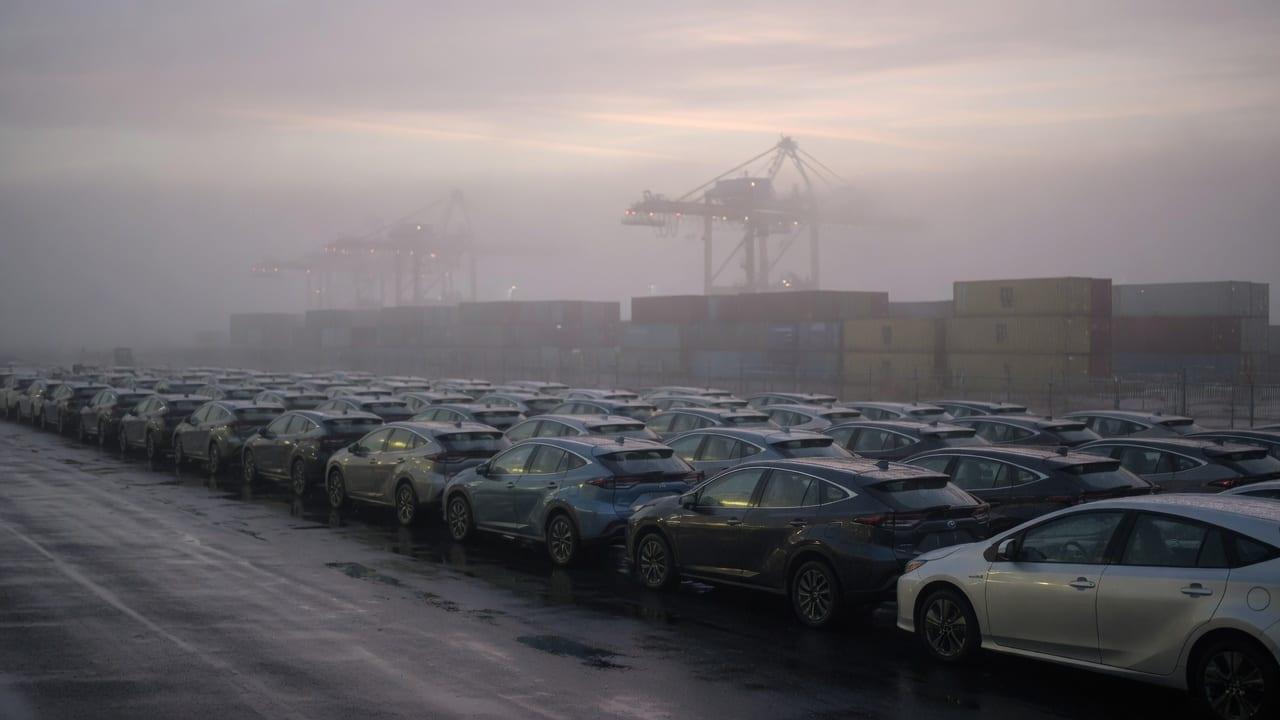
Just days before European leaders gather in Brussels, the European Union and China announced an interim trade deal Friday that EU Trade Commissioner Maroš Šefčovič said could cut Chinese hybrid and plug-in hybrid vehicle exports to the bloc by more than half — a concession he described as the first of its kind.
Šefčovič, who traveled to Beijing for two days of talks with Chinese Commerce Minister Wang Wentao, told reporters the agreement rests on a "shared understanding to moderate China's export of hybrids and plug-in hybrids to the European Union." According to POLITICO, he said the arrangement "opens the prospect of cutting China's exports by more than a half" and could prevent "several millions of car exports from China to the European Union" over the next four years.
The deal came together after France and Germany publicly pushed Brussels to take a harder line on trade with Beijing — an ultimatum that appears to have moved the Chinese side. Chinese auto exports to Europe have been surging; according to POLITICO, Chinese-made cars accounted for one in eight vehicles sold in the bloc in August, driven heavily by hybrid sales.
What's Actually in the Deal
Details remain thin. Šefčovič declined to specify the mechanics of the arrangement before EU leaders formally authorize the European Commission to proceed, and he would not say whether the deal permits the EU to impose safeguards — the combination of import quotas and tariffs Brussels has been weighing, per POLITICO.
What is known: Beijing agreed to lower duties on European goods worth roughly €4 billion, spanning products from olive oil to footwear, a move Bloomberg and other outlets report would save European exporters around €225 million. The agreement is structured as a 16-point document, and the Guardian reports both sides will keep negotiating on autos, China's export restrictions on rare earths, and expanded EU access to Chinese markets for food and drink. Šefčovič said the deal complies with World Trade Organization rules and would be followed by a video conference in January and an in-person meeting in March, per the Associated Press.
"It is the first time that China has accepted to moderate its exports without going through the phase of prior trade tension," Šefčovič said — a reference to the WTO investigations the EU would normally have to complete before imposing safeguards. He called the agreement "a crucial first step, but only a first step."
The backdrop is pressure, not goodwill. The EU's trade deficit with China runs at €1.18 billion per day, according to the Guardian, and hit €360 billion ($410 billion) last year, the AP reports. China's global trade surplus reached $1.2 trillion in 2025. Brussels has already moved to limit imports of Chinese-made EVs and EV batteries, enacted protections for European steel, and restricted duty-free imports of small e-commerce parcels — a measure aimed squarely at Chinese fast-fashion firms. Last week, China answered with an anti-dumping investigation into a chemical compound imported from the EU, and its Commerce Ministry warned Brussels against protectionist measures that "could backfire."
The Trump Factor
Looming over the entire negotiation is Washington. The AP notes that worries about a "China shock 2.0" — a flood of cheap Chinese goods into Europe and elsewhere — have deepened as the United States, especially since President Donald Trump returned to the White House, has raised tariffs and taken other steps to shrink its own trade deficit with Beijing.
Read that again. Brussels spent years lecturing about the rules-based order while Chinese EVs and hybrids hollowed out European manufacturing. What finally produced a Chinese concession wasn't a UN panel or a WTO ruling. It was the threat of Europe facing a choice between negotiating and being left alone to absorb the flood after Trump cut American consumers out of the equation. The EU saw what American leverage looked like and decided it wanted some.
Šefčovič will report back to European Commission President Ursula von der Leyen and EU leaders at their Brussels summit next Thursday, where further action against Beijing is on the agenda. Whether the interim deal survives that meeting — or whether leaders decide it's too little — is the open question heading into next week.
For American readers, the relevant number is $1.2 trillion: China's global surplus, still growing. A deal that shaves a few million hybrids off Europe's tally doesn't shrink that pile. It redirects it. The cars Beijing can't sell in Munich have to go somewhere.
Our Take
Notice what actually moved China here: leverage. Not scolding, not framework agreements, not climate accords signed in ballrooms. France and Germany threatened tough action, Trump's tariffs had already shut down the easy American dumping ground, and suddenly Beijing discovered the virtue of "moderation." That is how the CCP has always operated. It concedes just enough to keep a market open and splits the difference until the pressure fades.
The EU just proved the America First playbook works even when Europe pretends to despise it. Brussels spent years mocking Trump's tariffs while China ate its auto industry alive. Now the EU is collecting Chinese concessions under the implicit threat that something worse is coming — and Šefčovič admitted as much when he bragged that China folded "without going through the phase of prior trade tension." Translation: without the usual years-long WTO shuffle, because everyone knew time was up.
But patriots should watch two things. First, "interim" means China can stall. The follow-up meetings are slated for January and March, and the real enforcement tools — quotas, tariffs, safeguards — have not been written down. Second, and more important, every hybrid Beijing can't dump in Rotterdam or Hamburg has to land somewhere. The global surplus is still $1.2 trillion and climbing. If Europe walls itself off and American tariffs stand, the pressure points find U.S. shores anyway, through Mexico, through Vietnam, through shell companies and transshipping schemes.
The lesson from Friday isn't that deals are bad. It's that only deals backed by real, credible tariffs ever produce anything. The moment Brussels signals it will go soft — under pressure from its own automakers, its climate lobby, or von der Leyen's globalist instincts — Beijing will take every one of those concessions back.
So here's the question for our readers: if the EU can squeeze the CCP with a tariff threat, why does anyone still believe the free-trade establishment's line that confrontation with Beijing is the dangerous path? And more to the point — if China is willing to blink when Europe pushes, what does that tell you about the trade war the establishment media says Trump is losing?