
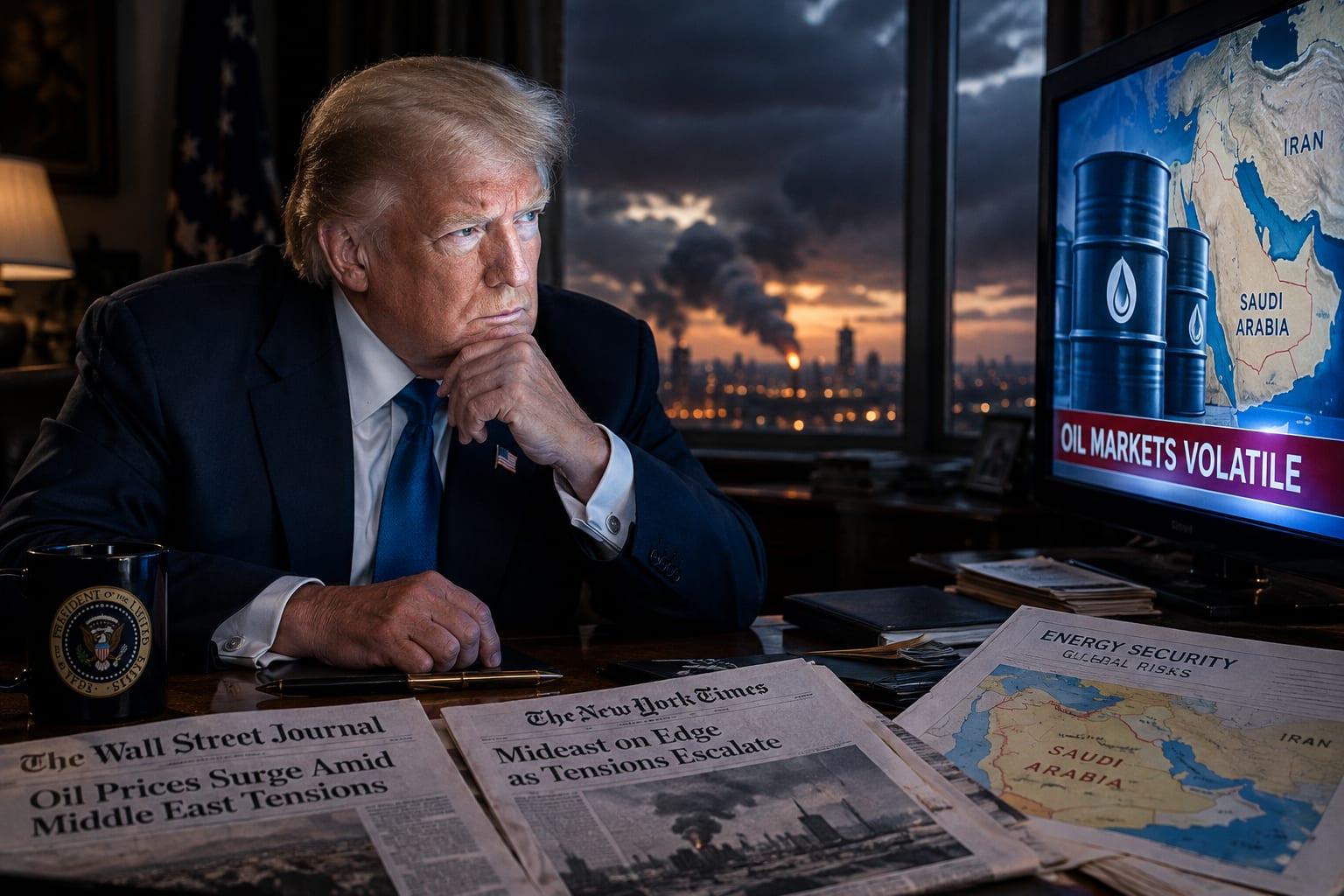
Oil prices rose Wednesday after President Donald Trump denied he is willing to ease sanctions on Iran, pushing back on a published report that he had offered Tehran sanctions relief and access to frozen funds as part of mediated talks.
Brent crude futures climbed $1.14, or 1.11 percent, to $103.73 a barrel by 0131 GMT, while US West Texas Intermediate gained to roughly $89 a barrel. The move followed a decline in the prior session tied to a recovery in crude supply from the Middle East, with oil flows through the Strait of Hormuz reportedly nearing pre-war levels even as the diplomatic track remains unresolved.
The denial centered on an Axios report that Trump had offered Iran sanctions relief and frozen funds. Trump called that story a hoax. The claim at the center of the dispute has not been confirmed by Next News Network or by the other outlets carrying it, and it is being described here as what is alleged, not as what happened.
Speaking to reporters, Trump said he had offered Tehran "nothing" on sanctions. That single word became the headline across financial and general-news desks from London to New York within hours, as traders read the comment as a signal that near-term relief for Iranian crude exports is off the table.
Qatar has been pressing for a diplomatic breakthrough between Washington and Tehran, and mediators met with Iranian Foreign Minister Abbas Araghchi on the sidelines of the United Nations General Assembly to discuss Iran's nuclear program, according to the reporting around the exchange. The substance of those meetings has not been released in full, and it is not yet known what specific terms, if any, were placed on the table.
The reaction spread quickly across social media, with the account @Reuters carrying the headline "Oil gains after Trump denies he is willing to ease sanctions on Iran" and the account @OilPricecom reporting that Brent climbed to $103 and WTI to $89 as Trump ruled out easing sanctions even with Hormuz oil flows nearing pre-war levels. The account @Independent carried live coverage under the headline that oil prices rose after Trump said he had offered Tehran "nothing" in peace talks, while the account @Mandatory reported that prices jumped after the denial, framing the move against Qatar's push for a diplomatic breakthrough amid tensions.
Those accounts did not simply repeat one another. @Reuters led with the market move. @OilPricecom tied the move to the physical supply picture, noting that Hormuz flows are approaching pre-war levels. @Independent widened the frame to include a political development out of Iran, reporting that Iran's Revolutionary Guards urged American voters to punish Trump at the ballot box in November's midterm elections. @Mandatory folded the whole sequence into a single line about prices jumping as Qatar pushes for a diplomatic opening.
Taken together, the coverage describes a market reacting less to the underlying diplomacy than to the public signals coming out of it. The Axios report had suggested a channel was opening. Trump's denial closed it in the eyes of traders, at least for now. The result was a one-session reversal from the prior day's decline.
The numbers matter for American households. Brent above $103 a barrel feeds through to gasoline, diesel, jet fuel and home heating costs, and it lands in an economy where voters are already weighing prices at the pump ahead of the midterms. A sustained move higher would tighten budgets heading into the winter. The relief rally in supply from the Middle East had briefly offered the opposite signal; Trump's remarks reversed it.
Iran's response added a political dimension. The Revolutionary Guards' call for American voters to punish Trump at the ballot box in November is a direct appeal into US domestic politics, issued as the diplomatic track stalls. It is not clear how widely that message is being amplified or what effect, if any, it will have on the election.
What remains unclear is the actual state of the talks. Qatar's push for a breakthrough continues, and mediators have engaged Araghchi at the United Nations General Assembly. But the specific terms discussed, the level of US participation, and whether any sanctions relief was ever formally offered are not established in the public record. The Axios report and the denial cannot both be fully accurate as written, and no independent confirmation of either account has surfaced in the coverage reviewed here.
Next News Network could not independently verify the claim that Trump offered Iran sanctions relief or frozen funds, nor the details of what mediators discussed with Araghchi.
For the oil market, the immediate takeaway is narrower: traders are pricing in the continuation of sanctions, not their easing. Whether that holds depends on what happens next in the talks, and on whether the supply recovery from the Middle East continues at the pace reported.
Trump's public position, as he stated it, is that he offered nothing. The market heard him. Whether the private channel described in the Axios report exists at all, and what it contains, is a question the public record does not yet answer.
Our Take
The establishment press spent a day telling Americans that Trump had quietly offered Tehran sanctions relief and frozen funds, citing an Axios report, and then acted surprised when the President said it was a hoax and that he had offered nothing. That is not a reporting error so much as a habit. The same outlets that spent years promising a diplomatic breakthrough with Iran are now the ones whose leaks move oil markets before anyone has confirmed a word of them. Notice what happened to prices: they fell on the supply recovery, then jumped when Trump spoke plainly. The market is treating his words as the actual policy and the leaks as noise, and it is right to. Middle America pays for every barrel at these levels, and it pays again if Washington trades sanctions relief for a deal that cannot be verified and that Iran's own Revolutionary Guards are already using as a midterm talking point against the President. Qatar can mediate, the UN can host, and Axios can publish. But until the White House puts terms on paper and Iran signs them, there is no deal, and there should be no relief. The President said nothing was offered. That is the position, and it is the one that keeps the pressure where it belongs.
